
配偶的感知反应性会改变痴呆症患者配偶照顾者的婚姻困扰与幸福感之间的关联。
Perceived partner responsiveness alters the association between marital distress and well-being in dementia spousal caregivers.
作者信息
Lai Vincent D, Paoletti-Hatcher Jensine, Wu-Chung E Lydia, Mahant Itee, Argueta Daniel L, Brice Kelly N, Denny Bryan T, Green Charles, Medina Luis D, Schulz Paul E, Stinson Jennifer M, Heijnen Cobi J, Fagundes Christopher P
机构信息
Department of Psychological Sciences, Rice University, United States.
Department of Pediatrics, McGovern Medical School, United States.
出版信息
Compr Psychoneuroendocrinol. 2024 Oct 18;20:100271. doi: 10.1016/j.cpnec.2024.100271. eCollection 2024 Nov.
UNLABELLED
Caregivers for spouses with Alzheimer's disease and related dementias (ADRD) experience drastic changes in the marital relationship that may put them at risk for worsening well-being. Perceived partner responsiveness, or feeling cared for, understood, and appreciated by one's spouse, may help mitigate these effects. In this study, we investigated the associations between marital distress, perceived partner responsiveness, and psychological and physiological well-being indicators among ADRD spousal caregivers.
METHOD
A sample of 161 caregivers provided blood samples and completed self-report measures of marital distress, perceived partner responsiveness, and depressive symptoms. We tested hypotheses in our sample cross-sectionally based on two theoretical frameworks.
RESULTS
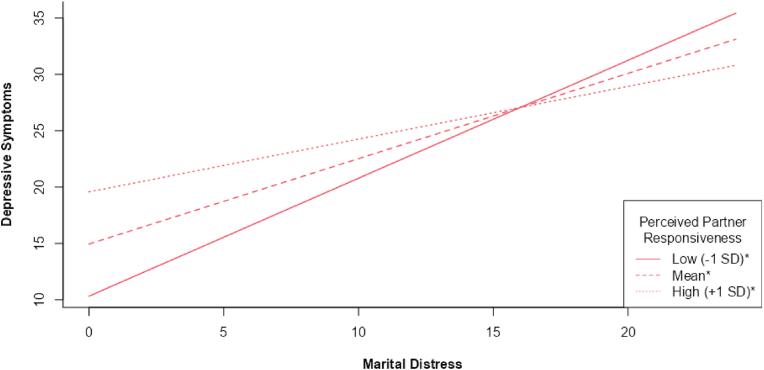
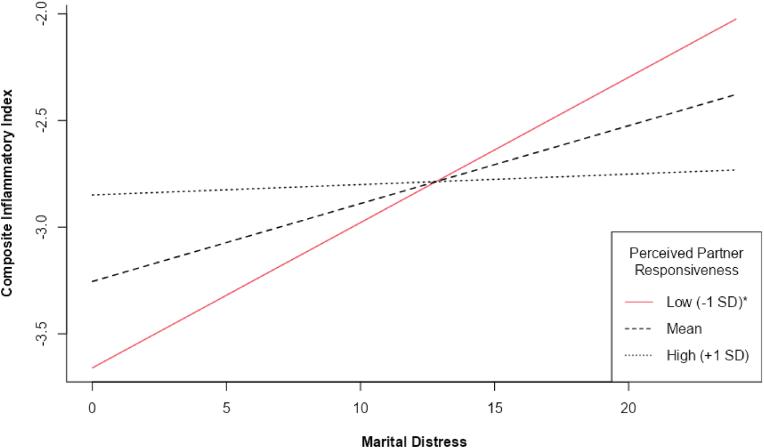
Testing the marital discord model of depression, caregivers who reported greater marital distress also reported more depressive symptoms, and this association was stronger as participants reported lower perceived partner responsiveness. Caregivers who reported greater marital distress exhibited elevated proinflammatory cytokine production by in vitro lipopolysaccharide (LPS)-stimulated peripheral blood leukocytes at low levels of perceived partner responsiveness, but not mean or high levels. Testing the vulnerability-stress-adaptation model, caregivers who reported more depressive symptoms also reported greater marital distress. Further, caregivers who exhibited elevated LPS-stimulated proinflammatory cytokine production reported greater marital distress at mean and high levels of perceived partner responsiveness, but not low levels. These patterns of results held even when accounting for the dementia stage and reported hours of caregiving per day.
DISCUSSION
This study's findings contribute to the body of research examining interpersonal factors that shape health and well-being among the caregiver population.
未标注
患有阿尔茨海默病及相关痴呆症(ADRD)的配偶的照料者,其婚姻关系会发生巨大变化,这可能使他们面临幸福感恶化的风险。伴侣的感知反应性,即感到被配偶关心、理解和欣赏,可能有助于减轻这些影响。在本研究中,我们调查了ADRD配偶照料者的婚姻困扰、伴侣感知反应性与心理和生理幸福感指标之间的关联。
方法
161名照料者的样本提供了血样,并完成了关于婚姻困扰、伴侣感知反应性和抑郁症状的自我报告测量。我们基于两个理论框架对样本进行了横断面假设检验。
结果
在检验抑郁症的婚姻不和模型时,报告婚姻困扰程度较高的照料者也报告了更多的抑郁症状,并且随着参与者报告的伴侣感知反应性降低,这种关联更强。在伴侣感知反应性较低水平时,报告婚姻困扰程度较高的照料者在体外脂多糖(LPS)刺激的外周血白细胞中表现出促炎细胞因子产生升高,但在中等或高水平时则没有。在检验脆弱性-应激-适应模型时,报告抑郁症状较多的照料者也报告了更大的婚姻困扰。此外,在伴侣感知反应性处于中等和高水平时,LPS刺激的促炎细胞因子产生升高的照料者报告了更大的婚姻困扰,但在低水平时则没有。即使考虑到痴呆阶段和每天报告的照料时长,这些结果模式仍然成立。
讨论
本研究的结果有助于丰富关于塑造照料者群体健康和幸福感的人际因素的研究。

 Zotero 插件