
全球癌症现状及 2050 年预估负担。
Global Disparities of Cancer and Its Projected Burden in 2050.
机构信息
Rural Health Research Institute, Charles Sturt University, Orange, Australia.
School of Public Health, Faculty of Health, University of Technology Sydney, Ultimo, Australia.
出版信息
JAMA Netw Open. 2024 Nov 4;7(11):e2443198. doi: 10.1001/jamanetworkopen.2024.43198.
IMPORTANCE
Cancer prevention and care efforts have been challenged by the COVID-19 pandemic and armed conflicts, resulting in a decline in the global Human Development Index (HDI), particularly in low- and middle-income countries. These challenges and subsequent shifts in health care priorities underscore the need to continuously monitor cancer outcome disparities and statistics globally to ensure delivery of equitable and optimal cancer prevention and care in uncertain times.
OBJECTIVE
To measure the global burden of 36 cancers in 2022 by sex, age, and geographic location and to project future trends by 2050.
DESIGN, SETTING, AND PARTICIPANTS: This cross-sectional study used population-based data from 2022 in 185 countries and territories were obtained from the Global Cancer Observatory database. Data extraction and analysis were carried out in April 2024.
MAIN OUTCOMES AND MEASURES
Counts, rates, prevalence, mortality to incidence ratios (MIRs), and demography-based projections were used to characterize current and future cancer burden.
RESULTS
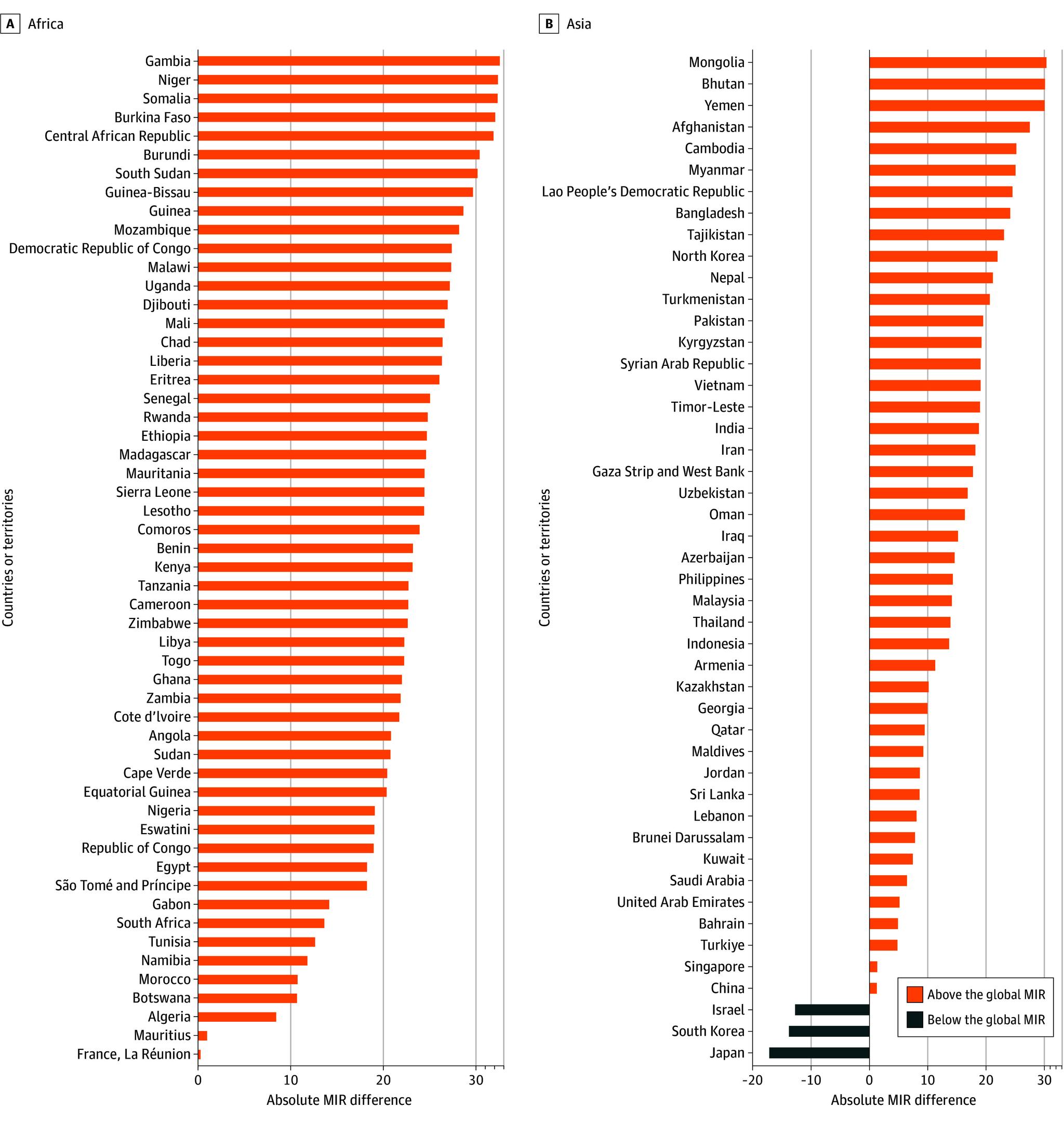
This population-based study included 36 cancer types from 185 countries and territories. By 2050, 35.3 million cancer cases worldwide are expected, a 76.6% increase from the 2022 estimate of 20 million. Similarly, 18.5 million cancer deaths are projected by 2050, an 89.7% increase from the 2022 estimate of 9.7 million. Cancer cases and deaths are projected to nearly triple in low-HDI countries by 2050, compared to a moderate increase in very high-HDI countries (142.1% vs 41.7% for cancer cases and 146.1% vs 56.8% for cancer deaths). Males had a higher incidence and greater number of deaths in 2022 than females, with this disparity projected to widen by up to 16.0% in 2050. In 2022, the MIR for all cancers was 46.6%, with higher MIRs observed for pancreatic cancer (89.4%), among males (51.7%), among those aged 75 years or older (64.3%), in low-HDI countries (69.9%), and in the African region (67.2%).
CONCLUSIONS AND RELEVANCE
In this cross-sectional study based on data from 2022, cancer disparities were evident across HDI, geographic regions, age, and sex, with further widening projected by 2050. These findings suggest that strengthening access to and quality of health care, including universal health insurance coverage, is key to providing evidence-based cancer prevention, diagnostics, and care.
重要性
新冠疫情和武装冲突给癌症预防和护理工作带来了挑战,导致全球人类发展指数(HDI)下降,尤其是在低收入和中等收入国家。这些挑战以及随后医疗保健重点的转变突显了持续监测全球癌症结局差异和统计数据的必要性,以确保在不确定时期提供公平和最佳的癌症预防和护理。
目的
按性别、年龄和地理位置衡量 2022 年 36 种癌症的全球负担,并预测到 2050 年的未来趋势。
设计、设置和参与者: 本横断面研究使用了 2022 年来自全球癌症观察站数据库的 185 个国家和地区的基于人群的数据。数据提取和分析于 2024 年 4 月进行。
主要结果和措施
使用计数、比率、患病率、死亡率与发病率比(MIR)和基于人口的预测来描述当前和未来的癌症负担。
结果
本基于人群的研究包括来自 185 个国家和地区的 36 种癌症类型。到 2050 年,预计全球将有 3530 万例癌症病例,比 2022 年估计的 2000 万例增长 76.6%。同样,预计到 2050 年将有 1850 万例癌症死亡,比 2022 年估计的 970 万例增长 89.7%。到 2050 年,低人类发展指数国家的癌症病例和死亡人数预计将增加两倍,而高人类发展指数国家的增幅适中(病例增加 142.1%,死亡增加 56.8%)。2022 年,男性的发病率和死亡率均高于女性,预计到 2050 年,这一差距将扩大 16.0%。2022 年,所有癌症的 MIR 为 46.6%,其中胰腺癌(89.4%)、男性(51.7%)、75 岁及以上人群(64.3%)、低人类发展指数国家(69.9%)和非洲地区(67.2%)的 MIR 较高。
结论和相关性
在这项基于 2022 年数据的横断面研究中,按人类发展指数、地理区域、年龄和性别存在癌症差异,预计到 2050 年这些差异将进一步扩大。这些发现表明,加强获得和医疗保健质量,包括全民健康保险覆盖范围,是提供循证癌症预防、诊断和护理的关键。

 Zotero 插件