
肺部菌群衍生的脂多糖通过激活参与聚苯乙烯微塑料诱导的认知功能障碍的小胶质细胞来介导肺-脑轴。
Pulmonary Flora-Derived Lipopolysaccharide Mediates Lung-Brain Axis through Activating Microglia Involved in Polystyrene Microplastic-Induced Cognitive Dysfunction.
作者信息
Kang Huiwen, Huang Danyang, Zhang Wei, Wang JingYu, Liu Ziyan, Wang Ziyan, Jiang Guangyu, Gao Ai
机构信息
Department of Occupational Health and Environmental Health, School of Public Health, Capital Medical University, Beijing, 100069, China.
Beijing Key Laboratory of Environmental Toxicology, Capital Medical University, Beijing, 100069, China.
出版信息
Adv Sci (Weinh). 2024 Dec;11(47):e2404966. doi: 10.1002/advs.202404966. Epub 2024 Nov 5.
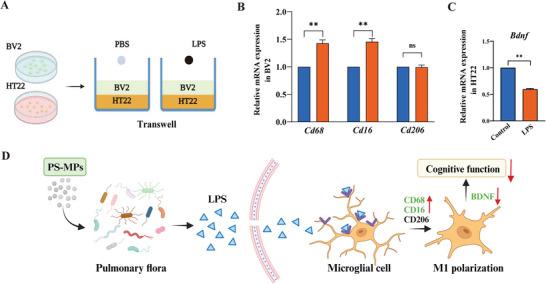
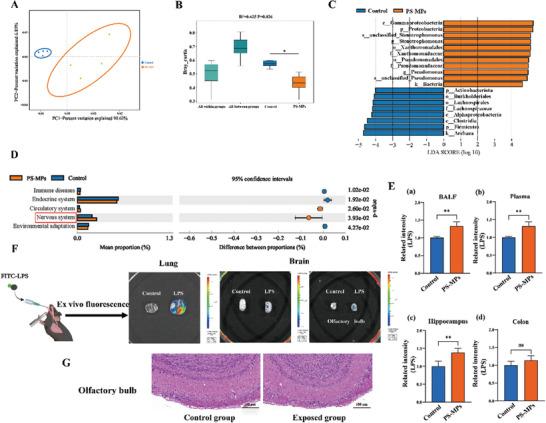
Microplastics (MPs) have been detected in the atmospheric and the human respiratory system, indicating that the respiratory tract is a significant exposure route for MPs. However, the effect of inhaled MPs on cognitive function has not been adequately studied. Here, a C57BL/6 J mouse model of inhalation exposure to polystyrene MPs (PS-MPs, 5 µm, 60 d) is established by intratracheal instillation. Interestingly, in vivo fluorescence imaging and transmission electron microscopy reveal that PS-MPs do not accumulate in the brain. However, behavioral experiments shows that cognitive function of mice is impaired, accompanied by histopathological damage of lung and brain tissue. Transcriptomic studies in hippocampal and lung tissue have demonstrated key neuroplasticity factors as well as cognitive deficits linked to lung injury, respectively. Mechanistically, the lung-brain axis plays a central role in PS-MPs-induced neurological damage, as demonstrated by pulmonary flora transplantation, lipopolysaccharide (LPS) intervention, and cell co-culture experiments. Together, inhalation of PS-MPs reduces cognitive function by altering the composition of pulmonary flora to produce more LPS and promoting M1 polarization of microglia, which provides new insights into the mechanism of nerve damage caused by inhaled MPs and also sheds new light on the prevention of neurotoxicity of environmental pollutants.
大气和人体呼吸系统中已检测到微塑料(MPs),这表明呼吸道是MPs的一个重要暴露途径。然而,吸入MPs对认知功能的影响尚未得到充分研究。在此,通过气管内滴注建立了C57BL/6 J小鼠吸入聚苯乙烯微塑料(PS-MPs,5 µm,60天)暴露模型。有趣的是,体内荧光成像和透射电子显微镜显示PS-MPs不会在大脑中积累。然而,行为实验表明小鼠的认知功能受损,同时伴有肺和脑组织的组织病理学损伤。海马和肺组织的转录组学研究分别证实了关键的神经可塑性因子以及与肺损伤相关的认知缺陷。从机制上讲,肺-脑轴在PS-MPs诱导的神经损伤中起核心作用,这在肺菌群移植、脂多糖(LPS)干预和细胞共培养实验中得到了证实。总之,吸入PS-MPs通过改变肺菌群组成以产生更多LPS并促进小胶质细胞的M1极化来降低认知功能,这为吸入MPs导致神经损伤的机制提供了新见解,也为预防环境污染物的神经毒性带来了新启示。




 Zotero 插件