
基于社区的参与式研究(CBPR)在疫苗推广中的应用:范围综述。
Community-based participatory research (CBPR) approaches in vaccination promotion: a scoping review.
机构信息
School of Nursing, Faculty of Health and Social Sciences, The Hong Kong Polytechnic University, Kowloon, Hong Kong SAR, China.
Cardiology Department, The Affiliated Hospital of Qingdao University, Qingdao, China.
出版信息
Int J Equity Health. 2024 Nov 5;23(1):227. doi: 10.1186/s12939-024-02278-1.
BACKGROUND
Community-based participatory research (CBPR) is a collaborative research approach that engages academic researchers and community stakeholders as equal partners in all research steps to address community concerns and achieve health equity. The CBPR approach has been widely used in vaccination promotion programmes. However, the elements and steps of CBPR-based programmes varied among studies. The purpose of this scoping review was to synthesize the elements and steps, and establish an implementation framework to guide the utilisation of CBPR approaches in vaccination promotion.
METHODS
This scoping review was performed in accordance with Arksey and O'Malley's five-stage framework. A systematic search was conducted on a set of electronic databases and grey literature sources. The retrieved articles were screened according to the criteria of CBPR and vaccination promotion, and data were extracted and recorded on a calibrated and predefined form in terms of study characteristics and CBPR components. Two authors worked independently to complete literature search, study selection, and data extraction. A narrative summary was used in categorising characteristics, and the contents of the included studies were summarised through qualitative analysis.
RESULTS
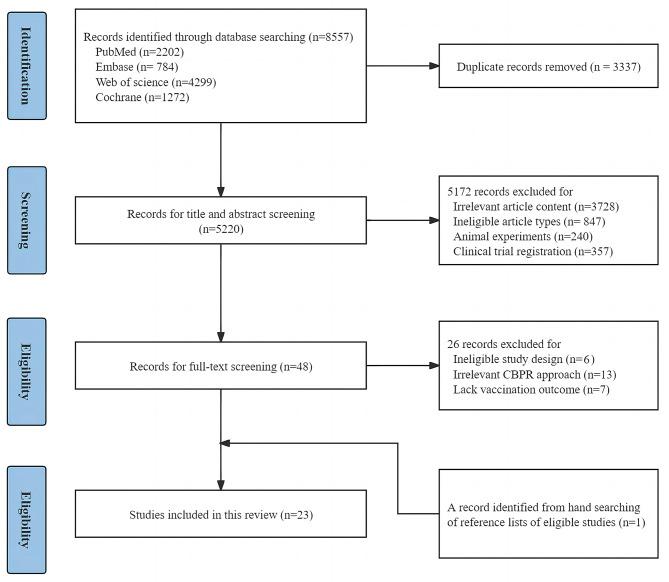
A total of 8557 publications were initially screened, and 23 articles were finally included. According to the CBPR conceptual model, the elements in each CBPR component specifically for vaccination promotion included (1) the establishment of community-academic partnership (CAP)s, (2) community capacity building by partner training vaccination knowledge, research literacy, and service abilities and skills, (3) development and implementation of community-based intervention and (4) Outcome evaluation. A CAP was established between academic researchers or institutes and eight types of partners, including community service organisation-related non-government organisations (NGOs), health service institution-related NGOs, religious organisations, government agencies, educational institutions, media agencies, business agencies, and community representatives. The maintenance of CAP was achieved with four key strategies, namely, strengthening communication, forming management groups, sharing resources and information, and providing incentives. Twelve studies provided comprehensive insights into the strategies employed for intervention development, utilising either quantitative surveys, qualitative methods or a combination of both approaches. The contents of interventions included health service supports, health education activities, social marketing campaigns, community mobilisation, interactive discussions, vaccination reminders and incentives. As for outcome evaluation, vaccination rate and the effectiveness of interventions were assessed. A considerable increase was observed in 95.7% of the included studies (22/23), and the highest increase (92.9%) was attained after the intervention. An implementation framework was generated to summarise the elements and steps of CBPR approaches for vaccination promotion.
CONCLUSIONS
This review summarised current evidence and generated an implementation framework to elucidate the elements and steps in the development and application of CBPR approaches in vaccination promotion. CBPR approaches are recommended for future vaccination promotion programmes, involving community stakeholders and research professionals, to ensure equitable access to vaccinations across diverse populations.
背景
社区参与式研究(CBPR)是一种协作研究方法,它使学术研究人员和社区利益相关者作为平等的合作伙伴参与所有研究步骤,以解决社区关注的问题并实现健康公平。CBPR 方法已广泛应用于疫苗推广计划。然而,基于 CBPR 的计划的要素和步骤在研究之间有所不同。本范围综述的目的是综合要素和步骤,并建立一个实施框架,以指导在疫苗推广中利用 CBPR 方法。
方法
本范围综述是按照 Arksey 和 O'Malley 的五个阶段框架进行的。对一组电子数据库和灰色文献来源进行了系统搜索。根据 CBPR 和疫苗推广的标准,对检索到的文章进行了筛选,并在经过校准和预先确定的表格中记录了有关研究特征和 CBPR 组成部分的数据。两名作者独立完成文献检索、研究选择和数据提取。使用叙述性摘要对特征进行分类,并通过定性分析总结纳入研究的内容。
结果
最初筛选出 8557 篇出版物,最终纳入 23 篇文章。根据 CBPR 概念模型,每个专门用于疫苗推广的 CBPR 组成部分的要素包括:(1)建立社区-学术伙伴关系(CAP),(2)通过伙伴培训疫苗知识、研究素养和服务能力和技能来增强社区能力,(3)制定和实施基于社区的干预措施,以及(4)结果评估。在学术研究人员或机构与包括社区服务组织相关的非政府组织(NGO)、与卫生服务机构相关的 NGO、宗教组织、政府机构、教育机构、媒体机构、商业机构和社区代表在内的八类合作伙伴之间建立了 CAP。通过加强沟通、组建管理小组、共享资源和信息以及提供激励措施,实现了 CAP 的维护。有 12 项研究全面介绍了干预措施发展所采用的策略,使用了定量调查、定性方法或两者结合的方法。干预措施的内容包括卫生服务支持、健康教育活动、社会营销活动、社区动员、互动讨论、疫苗提醒和激励措施。至于结果评估,评估了疫苗接种率和干预措施的效果。在纳入的 23 项研究中,有 95.7%(22/23)观察到显著增加,干预后最高增加 92.9%。生成了一个实施框架,以总结疫苗推广中 CBPR 方法的要素和步骤。
结论
本综述总结了当前的证据,并生成了一个实施框架,阐明了在疫苗推广中开发和应用 CBPR 方法的要素和步骤。建议在未来的疫苗推广计划中采用 CBPR 方法,让社区利益相关者和研究专业人员参与其中,以确保不同人群公平获得疫苗接种。



 Zotero 插件