
韩国新冠疫情前后流感发病率分析。
Analysis of the incidence of influenza before and after the COVID-19 pandemic in South Korea.
作者信息
Kim Hayeon, Son Hyeon S
机构信息
Laboratory of Public Health AI, Graduate School of Public Health, Seoul National University, Seoul, Korea.
Institute of Health and Environment, Seoul National University, Seoul, Korea.
出版信息
Trop Med Int Health. 2024 Dec;29(12):1018-1025. doi: 10.1111/tmi.14055. Epub 2024 Nov 6.
OBJECTIVES
Influenza outbreaks of varying size occur every year, but during the COVID-19 pandemic, many countries experienced influenza at lower levels. However, following the relaxation of COVID-19 prevention measures in 2022, the incidence of influenza began to increase gradually. Thus, this study compared the occurrence of influenza from week 36 of 2017, before the COVID-19 outbreak, until 2023.
METHODS
The analysis was conducted using influenza-like illness occurrence data available from the Korea Disease Control and Prevention Agency infectious disease website. Additionally, to examine the changes in COVID-19 and influenza occurrence during the pandemic, COVID-19 incidence data from 20 January 2020 to 31 August 2023 were obtained from the KDCA Coronavirus Disease 19 homepage.
RESULTS
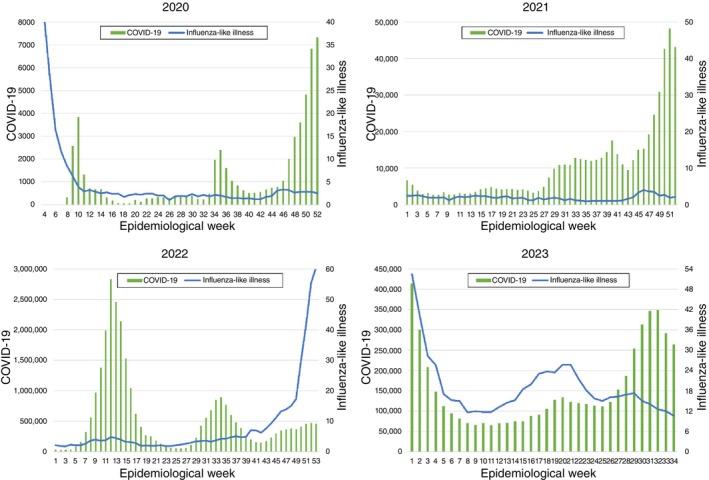
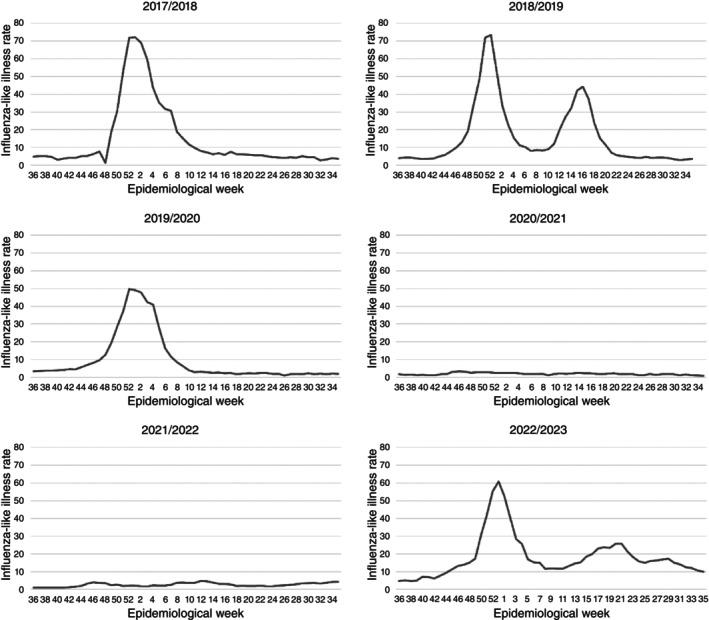
During the COVID-19 pandemic, which corresponds to the 2020/2021 and 2021/2022 influenza seasons, there was no seasonal influenza epidemic, and the incidence rates were below the usual outbreak levels. However, in the 2022/2023 season, when the spread of COVID-19 had eased, a seasonal pattern similar to that observed before the COVID-19 pandemic was noted. Furthermore, correlation analysis between the rates of influenza-like illness and COVID-19 incidence showed no significant correlation during the entire period. However, a significant correlation emerged in 2023 (r = 0.393, p <0.05). These results suggest that influenza was suppressed during the COVID-19 pandemic but returned to typical seasonal patterns after the COVID-19 prevention policies were eased.
CONCLUSION
The positive correlation observed between the incidences of COVID-19 and influenza in 2023 indicates that COVID-19, no longer a novel pandemic-causing infectious disease, may have transitioned to an endemic pattern similar to seasonal influenza.
目的
每年都会发生规模不等的流感疫情,但在新冠疫情期间,许多国家的流感疫情处于较低水平。然而,在2022年新冠疫情防控措施放宽后,流感发病率开始逐渐上升。因此,本研究比较了2017年第36周(新冠疫情爆发前)至2023年期间流感的发生情况。
方法
利用韩国疾病控制与预防机构传染病网站上提供的流感样疾病发生数据进行分析。此外,为了研究疫情期间新冠病毒和流感发生情况的变化,从韩国疾病控制与预防机构新冠病毒疾病19主页获取了2020年1月20日至2023年8月31日的新冠发病率数据。
结果
在对应2020/2021和2021/2022流感季节的新冠疫情期间,没有季节性流感流行,发病率低于通常的爆发水平。然而,在2022/2023季节,当新冠病毒传播有所缓解时,出现了与新冠疫情爆发前观察到的类似的季节性模式。此外,流感样疾病发病率与新冠发病率之间的相关性分析显示,在整个期间没有显著相关性。然而,在2023年出现了显著相关性(r = 0.393,p <0.05)。这些结果表明,流感在新冠疫情期间受到抑制,但在新冠疫情防控政策放宽后恢复到典型的季节性模式。
结论
2023年观察到的新冠病毒和流感发病率之间的正相关表明,新冠病毒不再是一种新型的引起大流行的传染病,可能已经转变为一种类似于季节性流感的地方病模式。

 Zotero 插件