
PARP1 通过 PAR 化 GCN5 将其募集到 DSBs 处,促进 HR 和 NHEJ 修复。
PARylation of GCN5 by PARP1 mediates its recruitment to DSBs and facilitates both HR and NHEJ Repair.
机构信息
Shilpee Dutt Laboratory, Advanced Centre for Treatment, Research and Education in Cancer, Tata Memorial Centre, Navi Mumbai, 410210, India.
Homi Bhabha National Institute, Training School Complex, Anushakti Nagar, Mumbai, 400085, India.
出版信息
Cell Mol Life Sci. 2024 Nov 7;81(1):446. doi: 10.1007/s00018-024-05469-9.
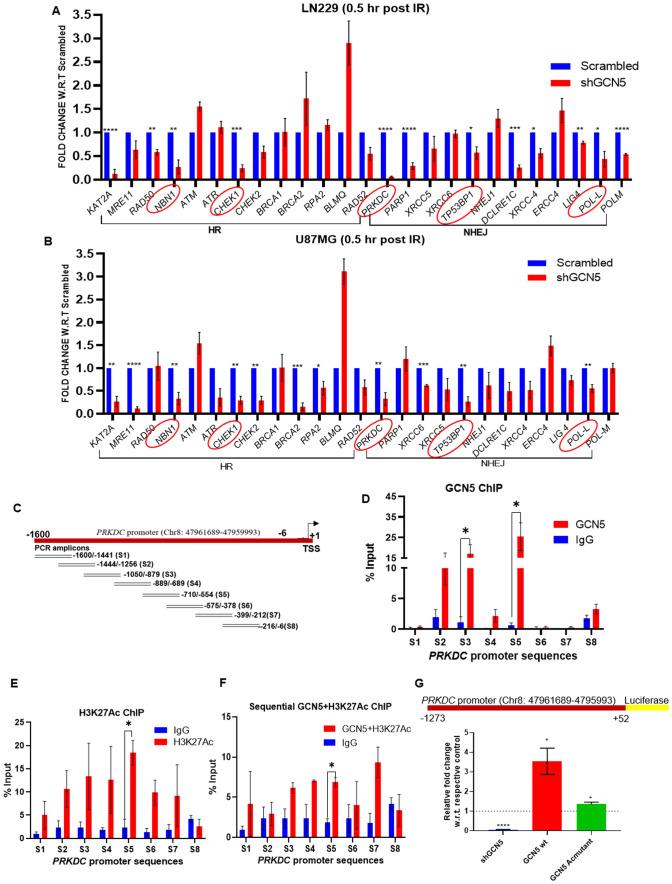
Efficient DNA double strand break (DSB) repair is necessary for genomic stability and determines efficacy of DNA damaging cancer therapeutics. Spatiotemporal dynamics and post-translational modifications of repair proteins at DSBs dictate repair efficacy. Here, we identified a non-canonical function of GCN5 in regulating both HR and NHEJ repair post genotoxic stress. Mechanistically, genotoxic stress induced GCN5 recruitment to DSBs. GCN5 PARylation by PARP1 was essential for its recruitment, acetyltransferase activity and DSB repair function. Liquid chromatography-mass spectrometry (LC-MS) identified DNA-PKcs as part of GCN5 interactome. In-vitro acetyltransferase assays revealed that GCN5 acetylates DNA-PKcs at K3241 residue, a prerequisite for DNA-PKcs S2056 phosphorylation and DSB recruitment. Alongside, ChIP-qPCR revealed GCN5 mediates transcription of PRKDC via H3K27Ac acetylation in its promoter region (- 710 to - 554). Genetic perturbation of GCN5 also decreased CHEK1, NBN1, TP53BP1, POL-L transcription and abrogated ATM, BRCA1 activation. Accordingly, GCN5 loss led to persistent ɣ-H2AX foci formation, compromised in-vivo HR-NHEJ and caused GBM radio-sensitization. Importantly, PARP1 inhibition phenocopied GCN5 loss. Together, this study identifies an untraversed DSB repair function of GCN5 and provides mechanistic insights into transcriptional as well as post-translational regulation of pivotal HR-NHEJ factors. Alongside, it highlights the translational importance of PARP1-GCN5 axis in mediating GBM radio-resistance.
高效的 DNA 双链断裂 (DSB) 修复对于基因组稳定性至关重要,决定了 DNA 损伤癌症治疗的疗效。修复蛋白在 DSB 处的时空动力学和翻译后修饰决定了修复效率。在这里,我们发现了 GCN5 在基因毒性应激后调节同源重组 (HR) 和非同源末端连接 (NHEJ) 修复的非典型功能。在机制上,基因毒性应激诱导 GCN5 募集到 DSB 。PARP1 对 GCN5 的 PAR 化对于其募集、乙酰转移酶活性和 DSB 修复功能是必不可少的。液相色谱-质谱 (LC-MS) 鉴定了 DNA-PKcs 是 GCN5 相互作用组的一部分。体外乙酰转移酶实验表明,GCN5 在 K3241 残基上将 DNA-PKcs 乙酰化,这是 DNA-PKcs S2056 磷酸化和 DSB 募集的前提。与此同时,ChIP-qPCR 显示 GCN5 通过其启动子区域(-710 至-554)中的 H3K27Ac 乙酰化来介导 PRKDC 的转录。GCN5 的遗传扰动也降低了 CHEK1、NBN1、TP53BP1、POL-L 的转录,并阻断了 ATM、BRCA1 的激活。因此,GCN5 的缺失导致持续形成 γ-H2AX 焦点,体内 HR-NHEJ 受损,并导致 GBM 放射增敏。重要的是,PARP1 抑制可模拟 GCN5 的缺失。总之,这项研究确定了 GCN5 未被探索的 DSB 修复功能,并为 HR-NHEJ 关键因子的转录和翻译后调控提供了机制见解。此外,它强调了 PARP1-GCN5 轴在介导 GBM 放射抗性中的翻译重要性。



 Zotero 插件