
基于传统机器学习和深度学习的静息态脑电图抑郁诊断:对比分析。
Resting-State Electroencephalogram Depression Diagnosis Based on Traditional Machine Learning and Deep Learning: A Comparative Analysis.
机构信息
Heilongjiang Province Key Laboratory of Laser Spectroscopy Technology and Application, Harbin University of Science and Technology, Harbin 150080, China.
出版信息
Sensors (Basel). 2024 Oct 23;24(21):6815. doi: 10.3390/s24216815.
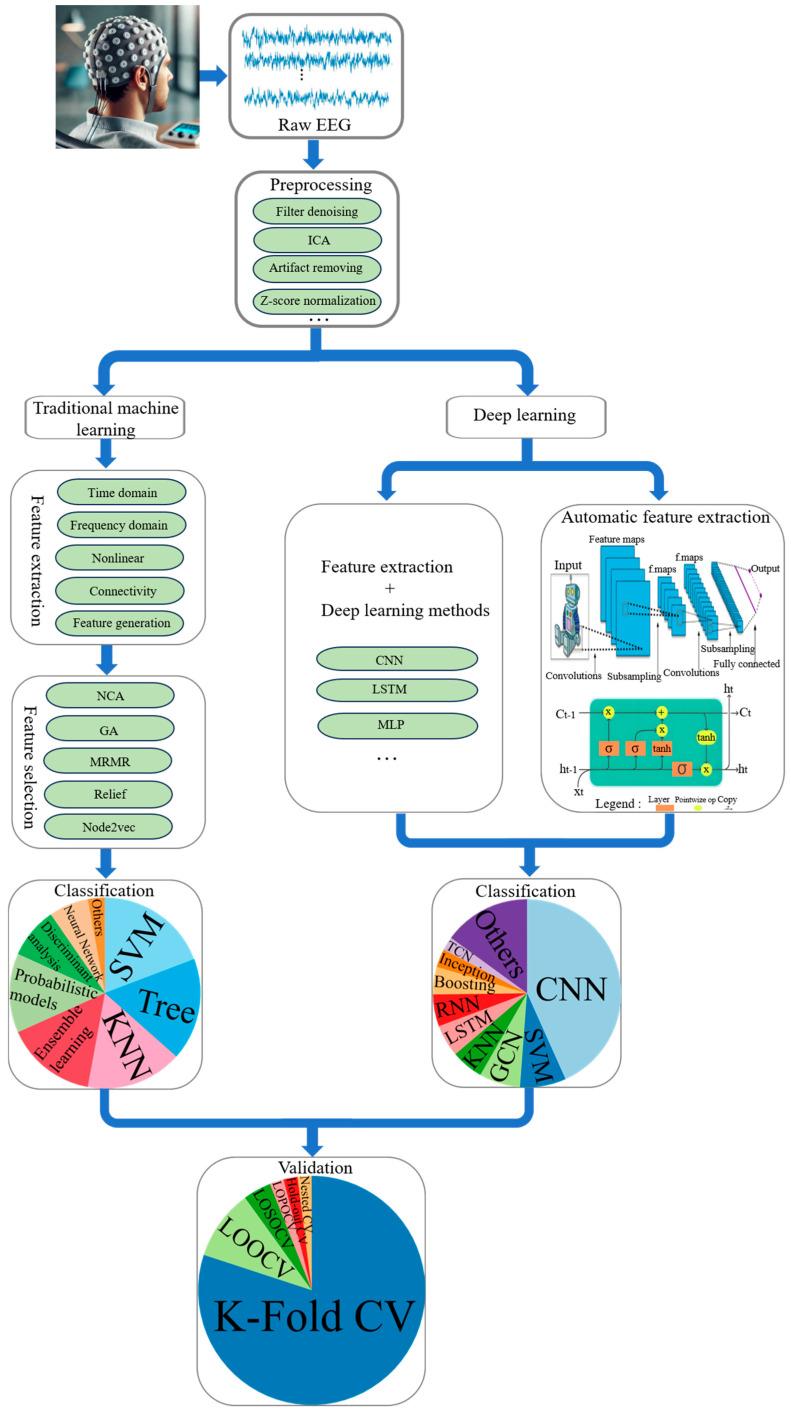
The global prevalence of Major Depressive Disorder (MDD) is increasing at an alarming rate, underscoring the urgent need for timely and accurate diagnoses to facilitate effective interventions and treatments. Electroencephalography remains a widely used neuroimaging technique in psychiatry, due to its non-invasive nature and cost-effectiveness. With the rise of computational psychiatry, the integration of EEG with artificial intelligence has yielded remarkable results in diagnosing depression. This review offers a comparative analysis of two predominant methodologies in research: traditional machine learning and deep learning methods. Furthermore, this review addresses key challenges in current research and suggests potential solutions. These insights aim to enhance diagnostic accuracy for depression and also foster further development in the area of computational psychiatry.
全球重度抑郁症(MDD)的患病率呈惊人速度上升,突显了及时、准确诊断以促进有效干预和治疗的迫切需求。脑电图仍然是精神病学中广泛使用的神经影像学技术,因为它具有非侵入性和成本效益。随着计算精神病学的兴起,脑电图与人工智能的结合在抑郁症诊断方面取得了显著成果。本综述对研究中两种主要方法进行了比较分析:传统机器学习和深度学习方法。此外,本综述还讨论了当前研究中的关键挑战,并提出了潜在的解决方案。这些见解旨在提高抑郁症的诊断准确性,并促进计算精神病学领域的进一步发展。


 Zotero 插件