
阿替利珠单抗用于非小细胞肺癌患者后续治疗线的疗效:来自真实世界数据的见解
Efficacy of Atezolizumab in Subsequent Lines of Therapy for NSCLC Patients: Insights from Real-World Data.
作者信息
Kontić Milica, Marković Filip, Nikolić Nikola, Samardžić Natalija, Stojanović Goran, Simurdić Petar, Petkov Svetlana, Bursać Daliborka, Zarić Bojan, Stjepanović Mihailo
机构信息
Clinic for Pulmonology, University Clinical Centre of Serbia, 11000 Belgrade, Serbia.
Faculty of Medicine, University of Belgrade, 11000 Belgrade, Serbia.
出版信息
Cancers (Basel). 2024 Nov 1;16(21):3696. doi: 10.3390/cancers16213696.
UNLABELLED
Immune checkpoint inhibitors (ICIs) like atezolizumab have improved outcomes in advanced non-small cell lung cancer (NSCLC) patients, especially in the second-line setting after progression on platinum-based chemotherapy. However, access to ICIs remains limited in many developing nations. This study evaluated the efficacy of atezolizumab as a second-line versus later-line treatment for advanced NSCLC patients in Serbia.
METHODS
This retrospective study involved 147 advanced NSCLC patients treated with atezolizumab following progression on prior platinum-based chemotherapy at two academic centers in Serbia. Data on demographics and clinical, pathological, and molecular characteristics were collected. Median progression-free survival (PFS) and overall survival (OS) were estimated using the Kaplan-Meier method, and multivariable Cox proportional hazards regression identified outcome predictors.
RESULTS
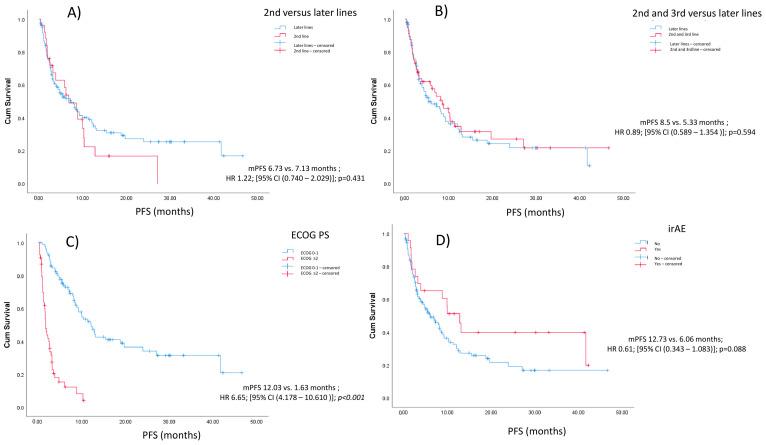
The median PFS was 7.13 months, and median OS was 38.6 months. The overall response rate (ORR) was 15%, with a disease control rate (DCR) of 57.9%. No significant PFS differences were observed between patients treated with atezolizumab in the second line versus later lines. Patients with good performance status (ECOG 0-1) had significantly better PFS compared to those with poorer status (12.03 vs. 1.63 months, < 0.0001).
CONCLUSIONS
Atezolizumab is effective in both second-line and later-line settings for advanced NSCLC, particularly in patients with good performance status. This highlights the importance of patient selection based on performance status, as well as the need for wider access to ICIs in resource-limited regions.
未标注
阿替利珠单抗等免疫检查点抑制剂已改善了晚期非小细胞肺癌(NSCLC)患者的预后,尤其是在铂类化疗进展后的二线治疗中。然而,在许多发展中国家,获得免疫检查点抑制剂的机会仍然有限。本研究评估了阿替利珠单抗作为塞尔维亚晚期NSCLC患者二线与后线治疗的疗效。
方法
这项回顾性研究纳入了147例晚期NSCLC患者,这些患者在塞尔维亚的两个学术中心接受了先前铂类化疗进展后的阿替利珠单抗治疗。收集了人口统计学以及临床、病理和分子特征数据。使用Kaplan-Meier方法估计中位无进展生存期(PFS)和总生存期(OS),并通过多变量Cox比例风险回归确定预后预测因素。
结果
中位PFS为7.13个月,中位OS为38.6个月。总缓解率(ORR)为15%,疾病控制率(DCR)为57.9%。二线与后线接受阿替利珠单抗治疗的患者之间未观察到显著的PFS差异。体能状态良好(东部肿瘤协作组0-1)的患者与体能状态较差的患者相比,PFS显著更好(12.03对1.63个月,<0.0001)。
结论
阿替利珠单抗在晚期NSCLC的二线和后线治疗中均有效,尤其是在体能状态良好的患者中。这突出了基于体能状态进行患者选择的重要性,以及在资源有限地区更广泛获得免疫检查点抑制剂的必要性。
 Zotero 插件