
与拉脱维亚绵羊育肥羔羊生长指标相关的肌肉生长抑制素基因多位点基因型
The Multi-Loci Genotypes of the Myostatin Gene Associated with Growth Indicators of Intensively Fattened Lambs of Latvian Sheep.
作者信息
Trapina Ilva, Kairisa Daina, Plavina Samanta, Krasnevska Nikole, Paramonovs Jegors, Senfelde Liga, Paramonova Natalia
机构信息
Genomics and Bioinformatics, Institute of Biology, Faculty of Medicine and Life Sciences, The University of Latvia, Jelgava Str. 3, LV-1004 Riga, Latvia.
Institute of Agrobiotechnology, Faculty of Agriculture, Latvian University of Life Sciences and Technologies, Liela Street 2, LV-3001 Jelgava, Latvia.
出版信息
Animals (Basel). 2024 Nov 1;14(21):3143. doi: 10.3390/ani14213143.
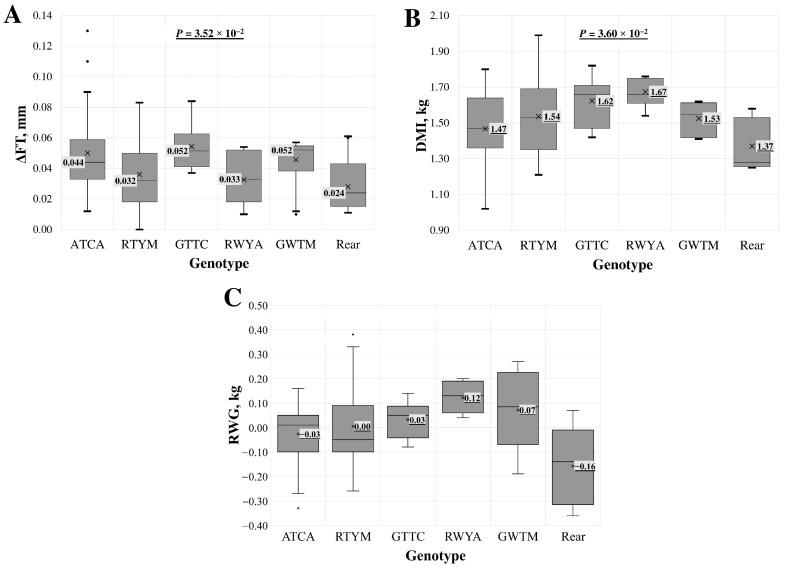
Myostatin (MSTN), a member of the TGFβ superfamily, negatively affects skeletal muscle growth and controls muscle development at stages of pre-natal muscle growth. Marker-assisted selection with molecular markers of the MSTN gene can be used in animal husbandry for higher-quality and more economically profitable lambs. The study aims to identify multi-locus genotypes within the MSTN gene regions as molecular markers for fattening, feed efficiency, and carcass traits in Latvian sheep. This analysis was conducted on 76 intensively fattened male lambs representing six breeds in Latvia. Nine genotypes were identified based on four SNPs in the promoter and exon 1 regions, while six and four SNPs in introns 1 and 2 led to the formation of 14 and 10 genotypes, respectively. Six genotypes identified in the 3'UTR were significantly linked to traits such as birth weight, slaughter yield, muscle development, fat depth, average daily gain, dry matter intake, and feed efficiency. Genotypes of intron 1 were associated with slaughter yield, while genotypes of intron 2 were linked to fat depth, dry matter intake, and residual weight gain. The study concludes that MSTN gene SNPs can be used in selection to enhance sheep breeds in Latvia and improve economic outcomes for breeders.
肌肉生长抑制素(MSTN)是转化生长因子β(TGFβ)超家族的成员之一,对骨骼肌生长具有负面影响,并在产前肌肉生长阶段控制肌肉发育。利用MSTN基因的分子标记进行标记辅助选择可应用于畜牧业,以培育出质量更高、经济效益更好的羔羊。本研究旨在确定MSTN基因区域内的多位点基因型,作为拉脱维亚绵羊育肥、饲料效率和胴体性状的分子标记。对代表拉脱维亚六个品种的76只集约化育肥雄性羔羊进行了该分析。基于启动子和外显子1区域的四个单核苷酸多态性(SNP)鉴定出九种基因型,而内含子1和2中的六个和四个SNP分别导致形成14种和10种基因型。在3'非翻译区(3'UTR)鉴定出的六种基因型与出生体重、屠宰率、肌肉发育、脂肪厚度、平均日增重、干物质摄入量和饲料效率等性状显著相关。内含子1的基因型与屠宰率相关,而内含子2的基因型与脂肪厚度、干物质摄入量和剩余体重增加相关。该研究得出结论,MSTN基因的SNP可用于拉脱维亚绵羊品种的选育,以提高育种者的经济效益。


 Zotero 插件