
脂肪来源的基质细胞和癌相关成纤维细胞:在肿瘤进展中的相互作用和影响。
Adipose-Derived Stromal Cells and Cancer-Associated Fibroblasts: Interactions and Implications in Tumor Progression.
机构信息
Biomedical Research Centre, Qatar University, Doha P.O. Box 2713, Qatar.
出版信息
Int J Mol Sci. 2024 Oct 28;25(21):11558. doi: 10.3390/ijms252111558.
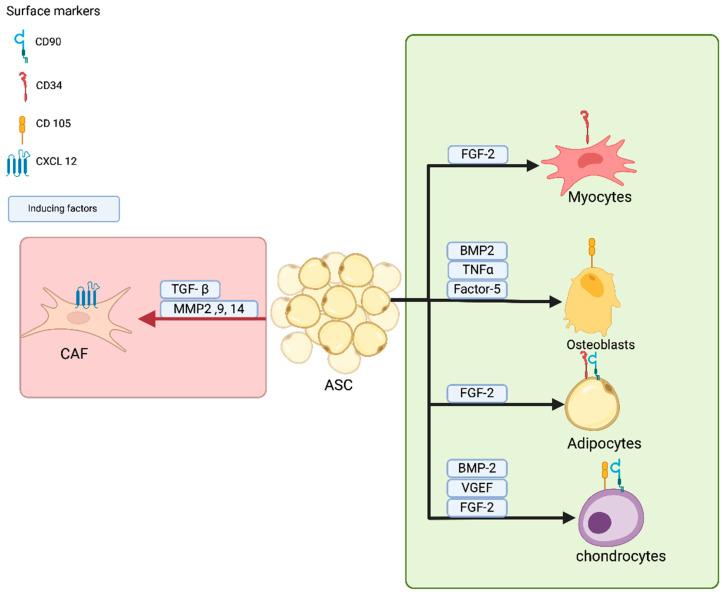
Adipose-derived stromal cells (ASCs) and cancer-associated fibroblasts (CAFs) play pivotal roles in the tumor microenvironment (TME), significantly influencing cancer progression and metastasis. This review explores the plasticity of ASCs, which can transdifferentiate into CAFs under the influence of tumor-derived signals, thus enhancing their secretion of extracellular matrix components and pro-inflammatory cytokines that promote tumorigenesis. We discuss the critical process of the epithelial-to-mesenchymal transition (EMT) facilitated by ASCs and CAFs, highlighting its implications for increased invasiveness and therapeutic resistance in cancer cells. Key signaling pathways, including the transforming growth factor-β (TGF-β), Wnt/β-catenin, and Notch, are examined for their roles in regulating EMT and CAF activation. Furthermore, we address the impact of epigenetic modifications on ASC and CAF functionality, emphasizing recent advances in targeting these modifications to inhibit their pro-tumorigenic effects. This review also considers the metabolic reprogramming of ASCs and CAFs, which supports their tumor-promoting activities through enhanced glycolytic activity and lactate production. Finally, we outline potential therapeutic strategies aimed at disrupting the interactions between ASCs, CAFs, and tumor cells, including targeted inhibitors of key signaling pathways and innovative immunotherapy approaches. By understanding the complex roles of ASCs and CAFs within the TME, this review aims to identify new therapeutic opportunities that could improve patient outcomes in cancer treatment.
脂肪来源的基质细胞 (ASCs) 和癌症相关成纤维细胞 (CAFs) 在肿瘤微环境 (TME) 中发挥着关键作用,显著影响癌症的进展和转移。本综述探讨了 ASCs 的可塑性,它们可以在肿瘤衍生信号的影响下转分化为 CAFs,从而增强其细胞外基质成分和促炎细胞因子的分泌,促进肿瘤发生。我们讨论了 ASCs 和 CAFs 促进的上皮间质转化 (EMT) 的关键过程,强调了其对癌细胞侵袭性和治疗耐药性增加的影响。关键的信号通路,包括转化生长因子-β (TGF-β)、Wnt/β-catenin 和 Notch,被研究其在调节 EMT 和 CAF 激活中的作用。此外,我们还探讨了表观遗传修饰对 ASC 和 CAF 功能的影响,强调了针对这些修饰以抑制其促肿瘤作用的最新进展。本综述还考虑了 ASCs 和 CAFs 的代谢重编程,其通过增强糖酵解活性和乳酸产生来支持其促进肿瘤的活性。最后,我们概述了旨在破坏 ASCs、CAFs 和肿瘤细胞之间相互作用的潜在治疗策略,包括针对关键信号通路的靶向抑制剂和创新的免疫治疗方法。通过了解 ASCs 和 CAFs 在 TME 中的复杂作用,本综述旨在确定新的治疗机会,以改善癌症治疗中的患者预后。


 Zotero 插件