
利用蜂胶及其多酚/类黄酮化合物联合化疗和放疗克服耐药途径的潜在策略。
Potential Strategies for Overcoming Drug Resistance Pathways Using Propolis and Its Polyphenolic/Flavonoid Compounds in Combination with Chemotherapy and Radiotherapy.
机构信息
Division of Animal Physiology, Faculty of Science, University of Zagreb, Rooseveltov trg 6, HR-10000 Zagreb, Croatia.
Division of Molecular Medicine, Laboratory for Protein Dynamics, Ruđer Bošković Institute, Bijenička cesta 54, HR-10000 Zagreb, Croatia.
出版信息
Nutrients. 2024 Oct 31;16(21):3741. doi: 10.3390/nu16213741.
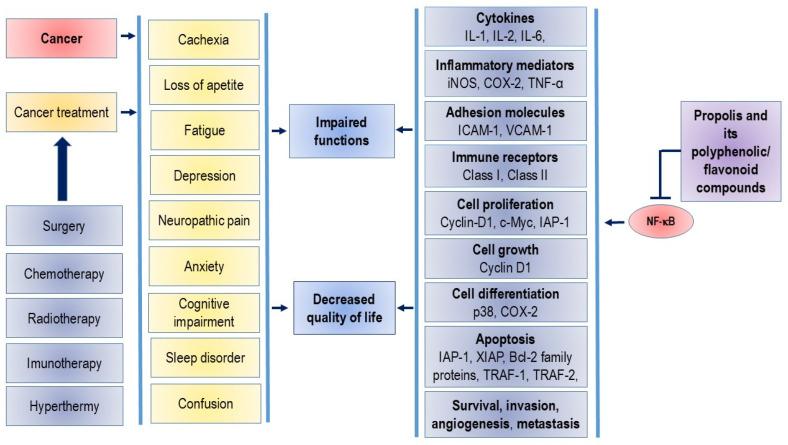
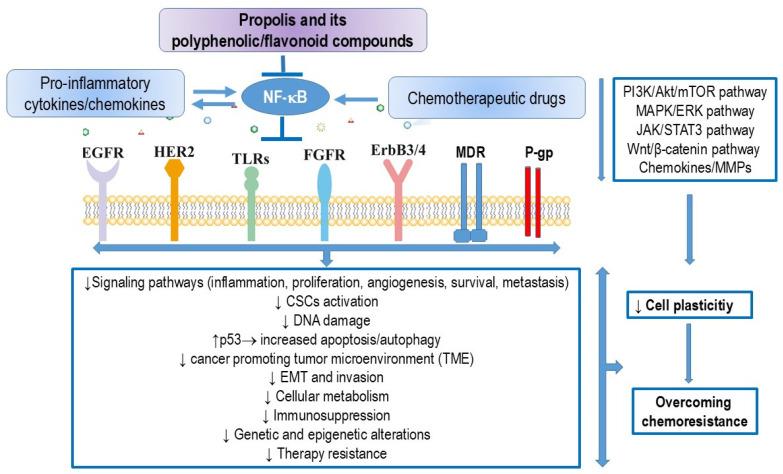
Conventional cancer treatments include surgical resection, chemotherapy, hyperthermia, immunotherapy, hormone therapy, and locally targeted therapies such as radiation therapy. Standard cancer therapies often require the use of multiple agents, which can activate nuclear factor kappa B (NF-κB) in tumor cells, leading to reduced cell death and increased drug resistance. Moreover, the use of multiple agents also contributes to added toxicity, resulting in poor treatment outcomes. Cancer cells gradually develop resistance to almost all chemotherapeutics through various mechanisms, such as drug efflux, alterations in drug metabolism and transport, changes in signal transduction pathways, enhanced DNA repair capacity, evasion of apoptosis, increased mutations, reactivation of drug targets, interaction with the cancer microenvironment, cancer cell-stroma interactions, epithelial-mesenchymal transition (EMT)-mediated chemoresistance, epigenetic modifications, metabolic alterations, and the effect of cancer stem cells (CSCs). Developing new strategies to improve chemotherapy sensitivity while minimizing side effects is essential for achieving better therapeutic outcomes and enhancing patients' quality of life. One promising approach involves combining conventional cancer treatments with propolis and its flavonoids. These natural compounds may enhance tumor response to treatment while reducing toxicity. Propolis and its components can sensitize cancer cells to chemotherapeutic agents, likely by inhibiting NF-κB activation, reprogramming tumor-associated macrophages (TAMs; an M2-like phenotype), and thereby reducing the release of matrix metalloproteinase (MMP)-9, cytokines, chemokines, and the vascular endothelial growth factor (VEGF). By reducing TAMs, propolis and its components may also overcome EMT-mediated chemoresistance, disrupt the crosstalk between macrophages and CSCs, inhibit the maintenance of stemness, and reverse acquired immunosuppression, thus promoting an antitumor response mediated by cytotoxic T-cells. This review highlights the potential of flavonoids to modulate the responsiveness of cancer to conventional treatment modalities. The evidence suggests that novel therapeutic strategies incorporating flavonoids could be developed to improve treatment outcomes. The positive effects of combining propolis with chemotherapeutics include reduced cytotoxicity to peripheral blood leukocytes, liver, and kidney cells. Therefore, polyphenolic/flavonoid components may hold potential for use in combination with chemotherapeutic agents in the clinical treatment of various types of cancers.
传统的癌症治疗方法包括手术切除、化疗、热疗、免疫疗法、激素疗法和局部靶向治疗,如放射治疗。标准的癌症治疗方法通常需要使用多种药物,这些药物可以激活肿瘤细胞中的核因子 kappa B(NF-κB),导致细胞死亡减少和药物耐药性增加。此外,使用多种药物也会导致毒性增加,从而导致治疗效果不佳。癌细胞通过各种机制逐渐对几乎所有化疗药物产生耐药性,例如药物外排、药物代谢和转运的改变、信号转导途径的改变、增强的 DNA 修复能力、逃避细胞凋亡、增加突变、药物靶点的再激活、与癌症微环境的相互作用、癌细胞-基质相互作用、上皮-间充质转化(EMT)介导的化疗耐药性、表观遗传修饰、代谢改变以及癌症干细胞(CSC)的作用。开发提高化疗敏感性同时最小化副作用的新策略对于实现更好的治疗效果和提高患者生活质量至关重要。一种有前途的方法是将传统癌症治疗与蜂胶及其类黄酮结合使用。这些天然化合物可以增强肿瘤对治疗的反应,同时降低毒性。蜂胶及其成分可以使癌细胞对化疗药物敏感,可能通过抑制 NF-κB 激活、重编程肿瘤相关巨噬细胞(TAMs;M2 样表型),从而减少基质金属蛋白酶(MMP)-9、细胞因子、趋化因子和血管内皮生长因子(VEGF)的释放。通过减少 TAMs,蜂胶及其成分还可以克服 EMT 介导的化疗耐药性,破坏巨噬细胞和 CSC 之间的串扰,抑制干性维持,并逆转获得性免疫抑制,从而促进细胞毒性 T 细胞介导的抗肿瘤反应。本综述强调了类黄酮调节癌症对传统治疗方法的反应能力的潜力。有证据表明,将类黄酮纳入新的治疗策略可能会开发出改善治疗效果的方法。蜂胶与化疗药物联合使用的积极影响包括减少外周血白细胞、肝脏和肾脏细胞的细胞毒性。因此,多酚/类黄酮成分可能具有与各种类型癌症的化疗药物联合使用的潜力。




 Zotero 插件