
匈牙利基于医院的严重急性呼吸道感染患儿临床特征的横断面研究。
Hospital-based cross-sectional study on the clinical characteristics of children with severe acute respiratory infections in Hungary.
机构信息
Department of Hospital Hygiene, University of Debrecen Clinical Centre, Debrecen, Hungary.
Coordinating Centre for Epidemiology, University of Debrecen Clinical Centre, Debrecen, Hungary.
出版信息
BMC Infect Dis. 2024 Nov 9;24(1):1268. doi: 10.1186/s12879-024-10186-6.
BACKGROUND
Severe acute respiratory infection (SARI) is a major cause for hospital admission and associated with high mortality among children worldwide. Severe acute respiratory syndrome coronavirus 2 (SARS-CoV-2), influenza viruses and respiratory syncytial virus (RSV) are the most frequently identified pathogens in children with SARI. The duration of care can be affected by the type of infection and patient characteristics. Therefore, the objective of this study was to identify factors affecting the length of hospitalization in children infected with SARS-CoV-2, influenza A and RSV.
METHODS
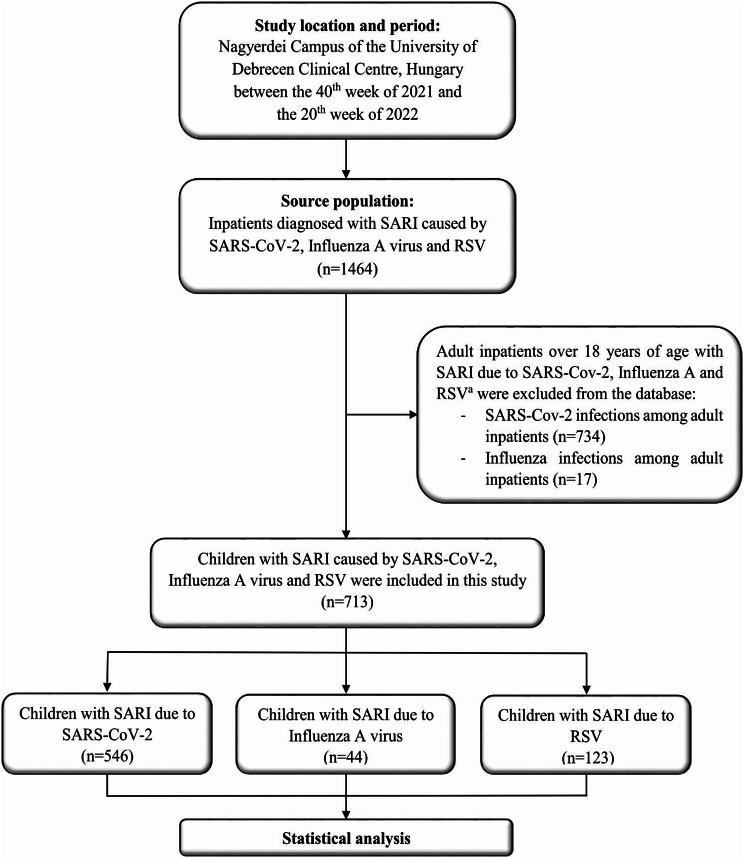
We collected data on 713 children with SARI from the medical databases of a university hospital in Hungary. To examine whether there is a difference in the length of hospitalization in children with the SARI Kruskal-Wallis test was performed. To determine the factors that may have an impact on the duration of care a multiple logistic regression analysis was executed.
RESULTS
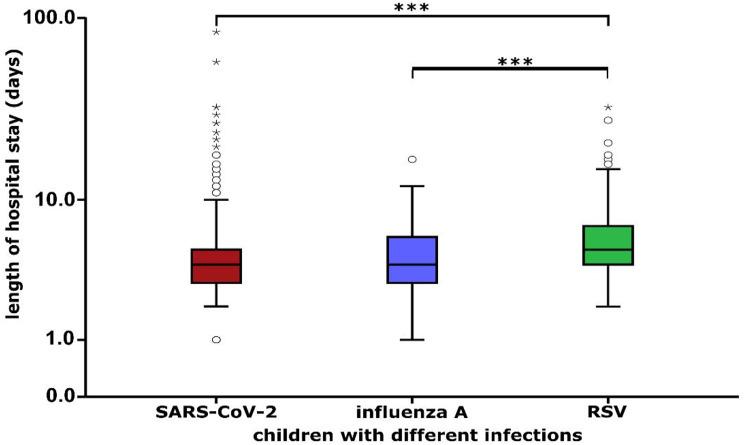
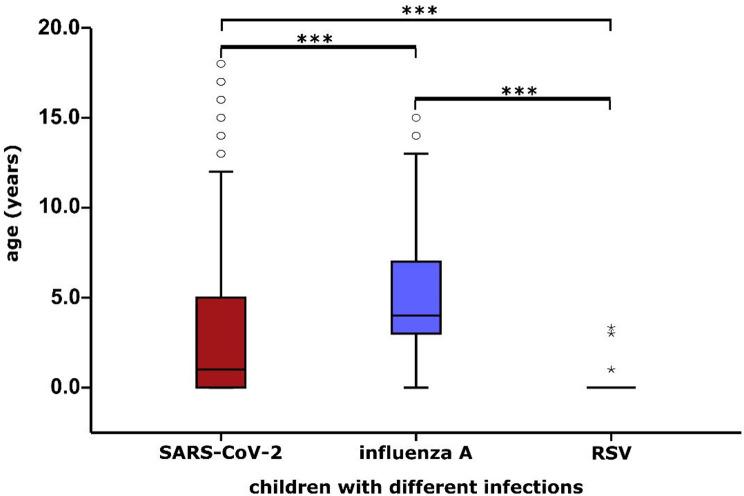
Our results showed that among RSV infected patients the proportions of children requiring intensive care (8.94%), mechanical ventilation (8.94%) and oxygen therapy (13.01%) and suffering from pneumonia (29.27%) were larger than among cases with SARS-CoV-2 and influenza A infection. Considering the age distribution and the duration of care in children with SARI, cases with RSV were significantly younger (p < 0.001) and stayed longer in the hospital (median: 5 days, IQR: 4-7 days, p < 0.001) than those with SARS-CoV-2 and influenza A virus. Multiple logistic regression analysis showed that RSV infection (adjusted odds ratio (aOR): 3.25, 95% confidence interval (CI): 1.43-7.38; p = 0.005), pneumonia (aOR: 3.65, 95% CI: 2.14-6.24; p < 0.001), mechanical ventilation or oxygen therapy (aOR: 3.23, 95% CI: 1.29-8.11; p = 0.012) and underlying illnesses (aOR: 2.39, 95% CI: 1.35-4.23; p = 0.003) significantly increased the odds of hospitalization for more than 4 days.
CONCLUSIONS
Our research showed that of the viruses causing SARI, RSV had the greatest clinical relevance, contributing to hospital stays of more than 4 days in a large share of paediatric patients below 1 year of age. Our results supply new information on children with SARI, and provide evidence for health policy makers to allocate additional resources to hospitals during SARI epidemics.
背景
严重急性呼吸道感染(SARI)是导致住院的主要原因,也是全球儿童死亡的主要原因。严重急性呼吸综合征冠状病毒 2(SARS-CoV-2)、流感病毒和呼吸道合胞病毒(RSV)是儿童 SARI 中最常鉴定出的病原体。护理时间的长短可能受感染类型和患者特征的影响。因此,本研究的目的是确定影响 SARS-CoV-2、流感 A 和 RSV 感染儿童住院时间的因素。
方法
我们从匈牙利一所大学医院的医学数据库中收集了 713 名患有 SARI 的儿童的数据。为了检查 SARS-CoV-2、流感 A 和 RSV 感染儿童的住院时间是否存在差异,采用 Kruskal-Wallis 检验。为了确定可能影响护理时间的因素,我们进行了多因素逻辑回归分析。
结果
我们的结果表明,在 RSV 感染患者中,需要重症监护(8.94%)、机械通气(8.94%)和氧疗(13.01%)以及患有肺炎(29.27%)的儿童比例高于 SARS-CoV-2 和流感 A 感染患者。考虑到 SARI 患儿的年龄分布和护理时间,RSV 组患儿明显更年轻(p<0.001),住院时间也更长(中位数:5 天,IQR:4-7 天,p<0.001)。多因素逻辑回归分析显示,RSV 感染(调整后的优势比(aOR):3.25,95%置信区间(CI):1.43-7.38;p=0.005)、肺炎(aOR:3.65,95%CI:2.14-6.24;p<0.001)、机械通气或氧疗(aOR:3.23,95%CI:1.29-8.11;p=0.012)和基础疾病(aOR:2.39,95%CI:1.35-4.23;p=0.003)显著增加了住院时间超过 4 天的几率。
结论
我们的研究表明,在引起 SARI 的病毒中,RSV 具有最大的临床相关性,导致大量年龄在 1 岁以下的儿科患者住院时间超过 4 天。我们的研究结果为患有 SARI 的儿童提供了新的信息,并为卫生政策制定者在 SARI 流行期间向医院分配额外资源提供了证据。
 Zotero 插件