
一种具有助眠作用的大麻成分:大麻酚及其活性代谢物对大鼠睡眠结构的影响。
A sleepy cannabis constituent: cannabinol and its active metabolite influence sleep architecture in rats.
作者信息
Arnold Jonathon C, Occelli Hanbury-Brown Cassandra V, Anderson Lyndsey L, Bedoya-Pérez Miguel A, Udoh Michael, Sharman Laura A, Raymond Joel S, Doohan Peter T, Ametovski Adam, McGregor Iain S
机构信息
Lambert Initiative for Cannabinoid Therapeutics, The University of Sydney, Sydney, NSW, Australia.
Discipline of Pharmacology, School of Pharmacy, Faculty of Medicine and Health, The University of Sydney, Sydney, NSW, Australia.
出版信息
Neuropsychopharmacology. 2025 Feb;50(3):586-595. doi: 10.1038/s41386-024-02018-7. Epub 2024 Nov 12.
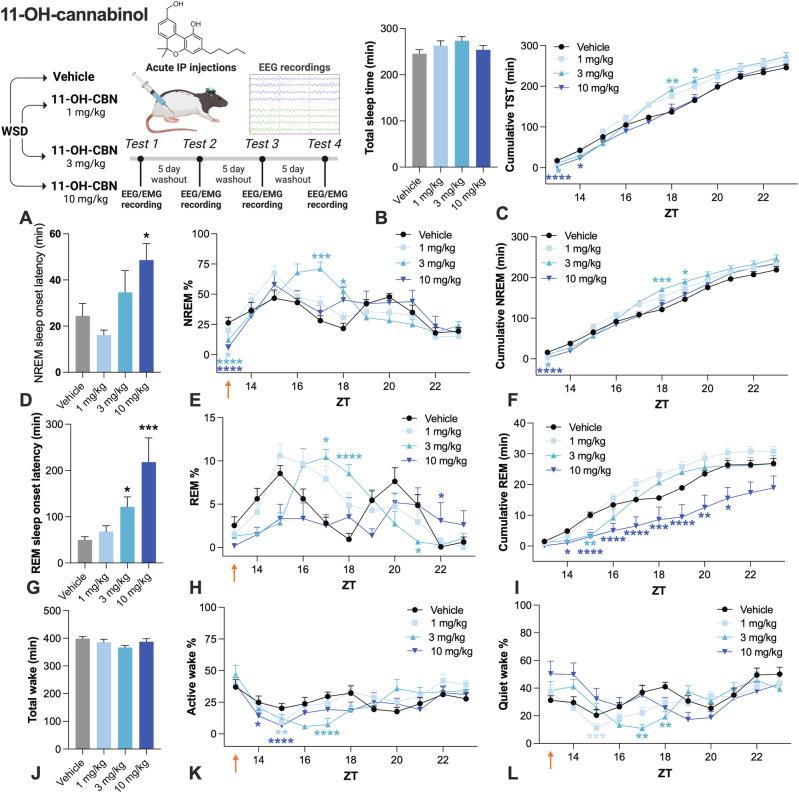
Medicinal cannabis is being used worldwide and there is increasing use of novel cannabis products in the community. Cannabis contains the major cannabinoids, Δ-tetrahydrocannabinol (Δ-THC) and cannabidiol (CBD), but also an array of minor cannabinoids that have undergone much less pharmacological characterization. Cannabinol (CBN) is a minor cannabinoid used in the community in "isolate' products and is claimed to have pro-sleep effects comparable to conventional sleep medications. However, no study has yet examined whether it impacts sleep architecture using objective sleep measures. The effects of CBN on sleep in rats using polysomnography were therefore examined. CBN increased total sleep time, although there was evidence of biphasic effects with initial sleep suppression before a dramatic increase in sleep. CBN increased both non-rapid eye movement (NREM) and rapid eye movement (REM) sleep. The magnitude of the effect of CBN on NREM was comparable to the sleep aid zolpidem, although, unlike CBN, zolpidem did not influence REM sleep. Following CBN dosing, 11-hydroxy-CBN, a primary metabolite of CBN surprisingly attained equivalently high brain concentrations to CBN. 11-hydroxy-CBN was active at cannabinoid CB receptors with comparable potency and efficacy to Δ-THC, however, CBN had much lower activity. We then discovered that the metabolite 11-hydroxy-CBN also influenced sleep architecture, albeit with some subtle differences from CBN itself. This study shows CBN affects sleep using objective sleep measures and suggests an active metabolite may contribute to its hypnotic action.
药用大麻正在全球范围内使用,社区中新型大麻产品的使用也在增加。大麻含有主要的大麻素,Δ-四氢大麻酚(Δ-THC)和大麻二酚(CBD),但也有一系列次要大麻素,其药理学特性研究较少。大麻酚(CBN)是一种在社区“分离”产品中使用的次要大麻素,据称具有与传统睡眠药物相当的促睡眠作用。然而,尚无研究使用客观睡眠测量方法来检验其是否会影响睡眠结构。因此,研究了CBN对大鼠睡眠的多导睡眠图影响。CBN增加了总睡眠时间,尽管有证据表明存在双相效应,即最初睡眠受到抑制,随后睡眠急剧增加。CBN增加了非快速眼动(NREM)睡眠和快速眼动(REM)睡眠。CBN对NREM睡眠的影响程度与助眠药物唑吡坦相当,不过,与CBN不同的是,唑吡坦不影响REM睡眠。给予CBN后,CBN的主要代谢产物11-羟基-CBN出人意料地在大脑中达到了与CBN相当高的浓度。11-羟基-CBN在大麻素CB受体上具有活性,其效力和功效与Δ-THC相当,然而,CBN的活性要低得多。然后我们发现代谢产物11-羟基-CBN也会影响睡眠结构,尽管与CBN本身存在一些细微差异。这项研究表明,CBN使用客观睡眠测量方法影响睡眠,并表明一种活性代谢产物可能有助于其催眠作用。


 Zotero 插件