
西普罗与异丙酚用于无痛宫腔镜检查患者的疗效和安全性:一项随机、双盲、对照试验。
The efficacy and safety of ciprofol versus propofol in patients undergoing painless hysteroscopy: a randomized, double-blind, controlled trial.
机构信息
Department of Anesthesiology, the First Central Hospital of Baoding, No.443 Wusi East Road, Lianchi District, Baoding, 071000, P.R. China.
Key Laboratory of Molecular Pathology and Early Diagnosis of Tumor in Hebei Province, Baoding, P.R. China.
出版信息
BMC Anesthesiol. 2024 Nov 12;24(1):411. doi: 10.1186/s12871-024-02787-0.
BACKGROUND
Studies have reported that ciprofol has the advantage of reducing injection pain compared to propofol during gastroscopy, colonoscopy, and fiberoptic bronchoscopy. The effect of ciprofol on the injection pain in painless hysteroscopy needs to further explore.
METHODS
A double-blind randomized controlled trial (RCT) was designed, and patients were recruited from the First Central Hospital of Baoding from March 2024 to June 2024. The eligible participants were allocated into ciprofol group (ciprofol combined with alfentanil) and propofol group (propofol combined with alfentanil) at 1:1 ratio. The primary outcome was injection pain. The secondary outcomes included sedation success rate, anesthesia success rate, adverse events, patient satisfaction, and comparison of vital signs before and after administration.
RESULTS
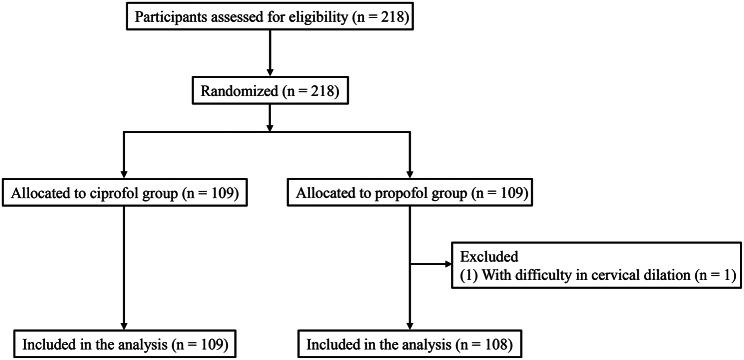
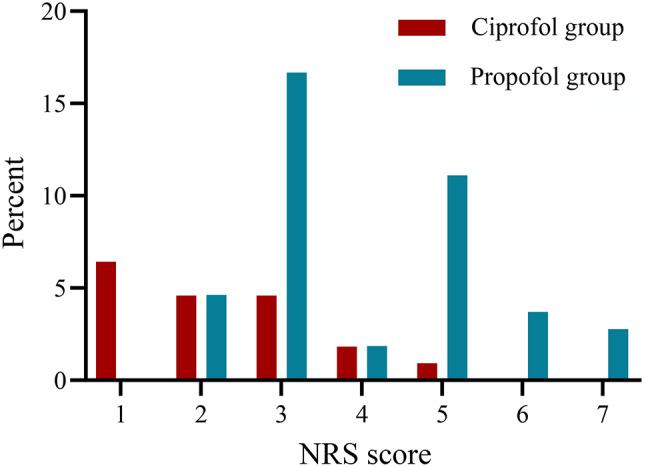
A total of 217 participants were included for analysis, with 109 participants in the ciprofol group and 108 participants in the propofol group. The injection pain rate of ciprofol group (18.35%) was significantly lower than the propofol group (40.74%). Both the ciprofol group and propofol group had 100% of the sedation success rate. The anesthesia success rate between the two groups was comparable (P > 0.05). The rate of adverse events was lower (27.52% vs. 45.37%) and patient satisfaction was higher (9.84 ± 0.45 vs. 9.65 ± 0.85) in the ciprofol group than the propofol group. In addition, values of systolic blood pressure (SBP), diastolic blood pressure (DBP), and mean arterial pressure (MAP) in propofol group were significantly lower than those in ciprofol group at the time of cervical dilation and consciousness recovery.
CONCLUSIONS
Ciprofol exhibits comparable efficacy to that of propofol, and is associated with less injection pain rate, fewer adverse events, higher patient satisfaction, and more stable hemodynamics when used for general anesthesia during the painless hysteroscopy.
CLINICAL TRIAL NUMBER
NCT06413862.
背景
研究表明,与丙泊酚相比,西普罗酚在胃镜、结肠镜和纤维支气管镜检查中具有减轻注射疼痛的优势。西普罗酚在无痛宫腔镜检查中引起的注射疼痛的效果需要进一步探讨。
方法
设计了一项双盲随机对照试验(RCT),参与者于 2024 年 3 月至 2024 年 6 月从保定市第一中心医院招募。将符合条件的参与者以 1:1 的比例分配到西普罗酚组(西普罗酚联合阿芬太尼)和丙泊酚组(丙泊酚联合阿芬太尼)。主要结局为注射疼痛。次要结局包括镇静成功率、麻醉成功率、不良事件、患者满意度以及给药前后生命体征的比较。
结果
共有 217 名参与者纳入分析,西普罗酚组 109 名,丙泊酚组 108 名。西普罗酚组(18.35%)的注射疼痛发生率明显低于丙泊酚组(40.74%)。西普罗酚组和丙泊酚组的镇静成功率均为 100%。两组的麻醉成功率相当(P>0.05)。西普罗酚组不良事件发生率较低(27.52%比 45.37%),患者满意度较高(9.84±0.45 比 9.65±0.85)。此外,丙泊酚组在宫颈扩张和意识恢复时的收缩压(SBP)、舒张压(DBP)和平均动脉压(MAP)值明显低于西普罗酚组。
结论
西普罗酚与丙泊酚疗效相当,在无痛宫腔镜检查全身麻醉中使用时,注射疼痛发生率较低,不良事件较少,患者满意度较高,血流动力学更稳定。
临床试验注册号
NCT06413862。

 Zotero 插件