
SNTB1 通过调节 SRC 激活结肠腺癌转移过程中的 Hippo-YAP 通路。
Modulation of SRC by SNTB1 activates the Hippo-YAP pathway during colon adenocarcinoma metastasis.
机构信息
Department of Pathology, Shanghai Tenth People's Hospital, Tongji University School of Medicine, 301 Yanchang Road, Shanghai, 200072, China.
Department of Burn Surgery, The First Affiliated Hospital of Naval Medical University, Shanghai, People's Republic of China.
出版信息
J Transl Med. 2024 Nov 15;22(1):1029. doi: 10.1186/s12967-024-05548-2.
BACKGROUND
Colon adenocarcinoma (COAD) ranks as the third most prevalent and lethal cancer in 2020, with metastasis being the primary cause of cancer-related mortality. A comprehensive understanding of the mechanism underlying distant metastasis is imperative for enhancing the prognosis and quality of life of patients with COAD.
METHODS
This study employed gene set enrichment analysis (GSEA) on RNA-sequencing data from 408 patients with COAD in The Cancer Genome Atlas (TCGA) database. GSEA analysis was applied to find the significant hallmark gene set, and genes in the significant hallmark gene set was performed by univariate Cox regression to select the key gene. Then, multivariate Cox regression model was constructed. And various databases were utilized to validate and find the significant oncoprotein and hallmark gene set of the key gene. In addition, the expression of key regulators in para-carcinoma tissue, colon cancer and distant metastases samples were detected by real-time PCR, Immunohistochemistry and Western blot. Additionally, the biological functions were examined by in vitro and in vivo experiments. The scRNA-seq and CellphoneDB were performed to explore cell characters in COAD and the potential mechanism of metastasis.
RESULTS
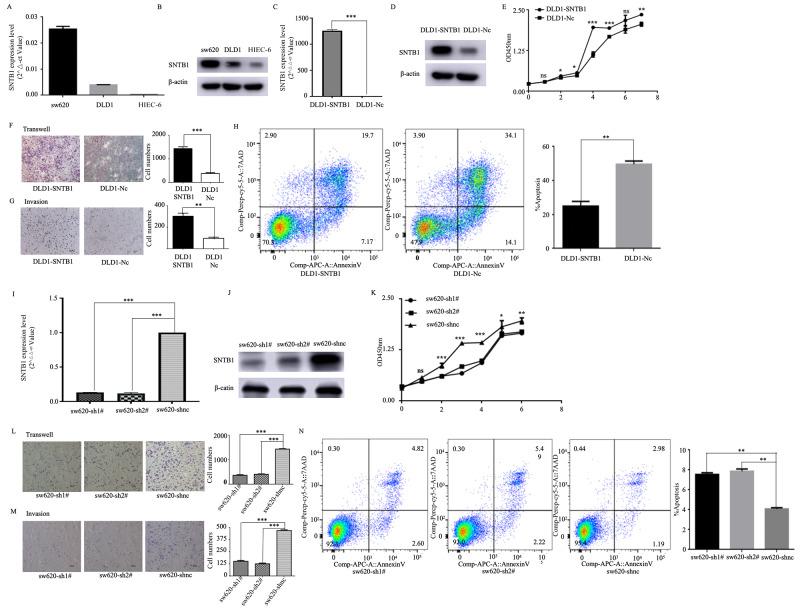
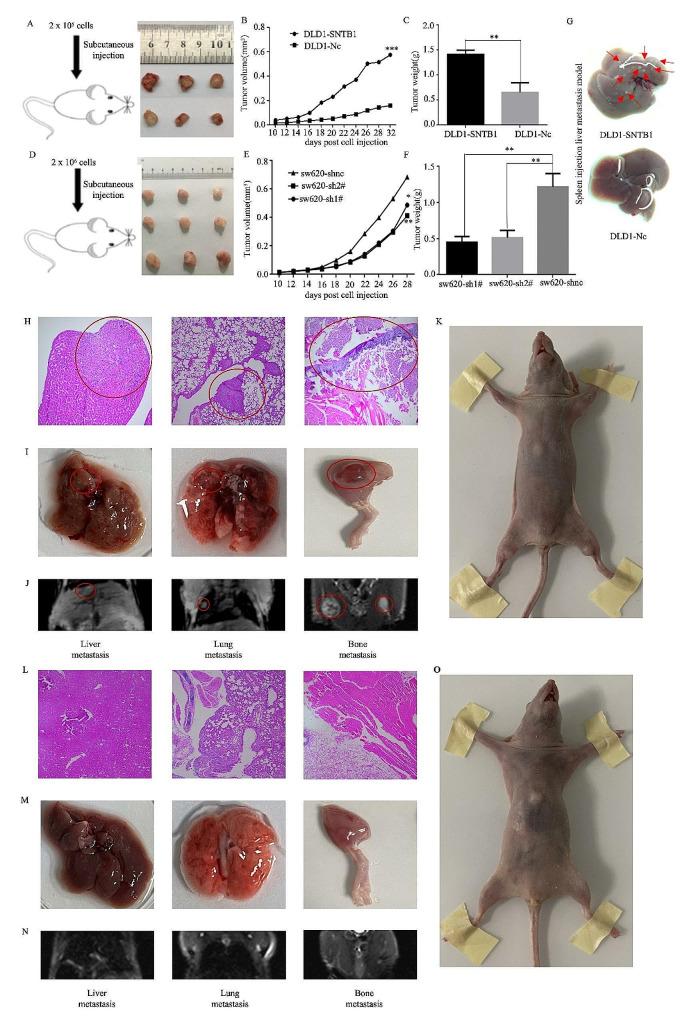
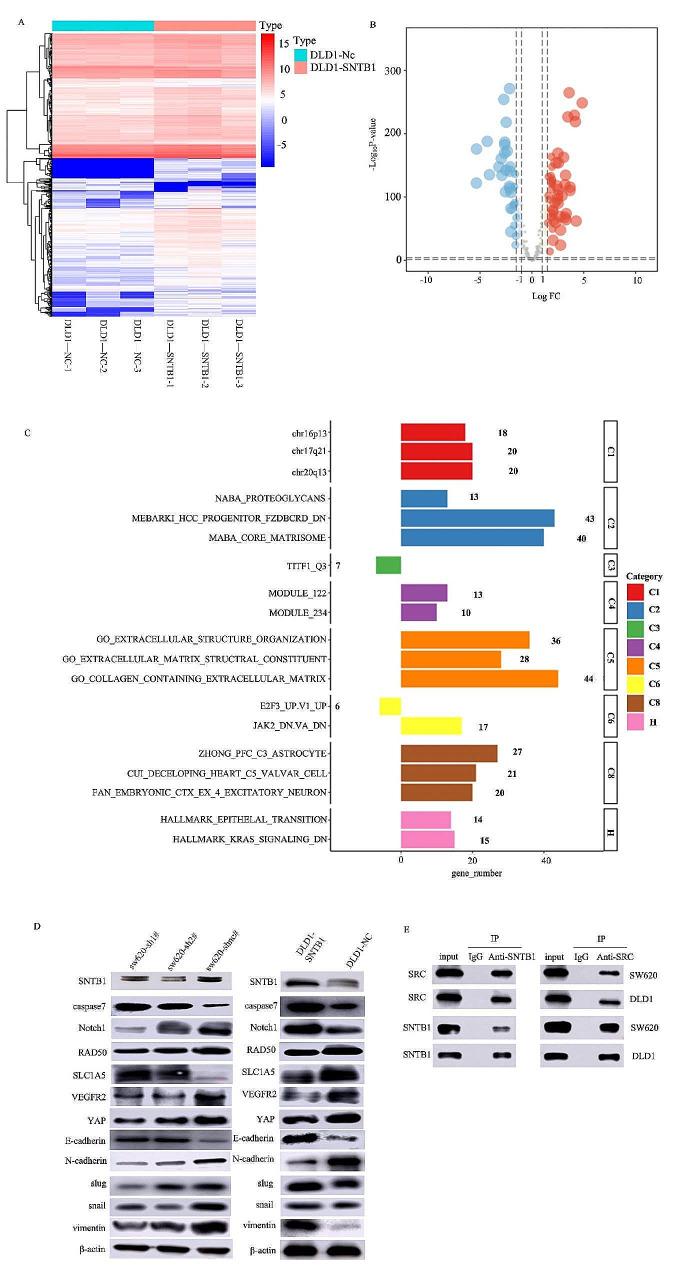
The regulatory network analysis revealed SRC/YAP1 as the most significant oncoprotein and signature gene set associated with SNTB1. Moreover, significant SNTB1 overexpression in COAD metastatic tissues was observed compared to para-carcinoma and primary COAD tissues. Co-immunoprecipitation assays demonstrated the formation of a complex between SNTB1 and SRC proteins. Furthermore, the overexpression of SNTB1 enhanced the proliferation, migration and invasion capacities of COAD cell lines. Caudal vein injection of COAD cells overexpressing SNTB1 in nude mice resulted in increased tumour growth and metastasis to the lung, liver and bone. Finally, single cell RNA-seq revealed alterations in the cellular subtypes of COAD, and CellphoneDB indicated that the interaction between cancer cells exhibiting high SNTB1 expression and enterocytes promoted EMT through cellular communications involving TGF-β, accelerating metastasis in COAD.
CONCLUSION
This study postulates that SNTB1 interacts with SRC to activate the Hippo-YAP pathway, thereby promoting COAD metastasis. Furthermore, cellular communication with enterocytes promotes EMT, facilitating metastasis. These findings propose novel therapeutic targets for preventing or treating metastatic COAD.
背景
结肠癌(COAD)在 2020 年的发病率和死亡率均排名第三,转移是癌症相关死亡的主要原因。全面了解远处转移的机制对于提高 COAD 患者的预后和生活质量至关重要。
方法
本研究采用基因集富集分析(GSEA)对癌症基因组图谱(TCGA)数据库中 408 例 COAD 患者的 RNA 测序数据进行分析。进行 GSEA 分析以找到显著的标志性基因集,并通过单因素 Cox 回归对显著标志性基因集中的基因进行分析,以选择关键基因。然后,构建多因素 Cox 回归模型。并利用多种数据库验证和寻找关键基因的显著癌蛋白和标志性基因集。此外,通过实时 PCR、免疫组织化学和 Western blot 检测癌旁组织、结肠癌和远处转移样本中关键调节剂的表达。此外,通过体外和体内实验检测生物功能。进行 scRNA-seq 和 CellphoneDB 分析以探索 COAD 中的细胞特征和转移的潜在机制。
结果
调控网络分析显示 SRC/YAP1 是与 SNTB1 相关的最重要的癌蛋白和标志性基因集。此外,与癌旁组织和原发性 COAD 组织相比,COAD 转移组织中 SNTB1 的表达显著升高。共免疫沉淀实验证实了 SNTB1 与 SRC 蛋白形成复合物。此外,SNTB1 的过表达增强了 COAD 细胞系的增殖、迁移和侵袭能力。裸鼠尾静脉注射过表达 SNTB1 的 COAD 细胞导致肿瘤生长和向肺、肝和骨转移增加。最后,单细胞 RNA-seq 揭示了 COAD 细胞亚型的变化,CellphoneDB 表明高 SNTB1 表达的癌细胞与肠细胞之间的相互作用通过涉及 TGF-β 的细胞通讯促进 EMT,加速 COAD 的转移。
结论
本研究提出 SNTB1 与 SRC 相互作用激活 Hippo-YAP 通路,从而促进 COAD 转移。此外,与肠细胞的细胞通讯促进 EMT,促进转移。这些发现为预防或治疗转移性 COAD 提供了新的治疗靶点。


 Zotero 插件