
聚乙二醇化依斯氯莫@基于铜(Ⅱ)的金属有机框架,具有有效的纳米酶性能和铜死亡诱导功效,用于增强基于PD-L1的免疫治疗。
PEGylated Elesclomol@Cu(Ⅱ)-based Metal‒organic framework with effective nanozyme performance and cuproptosis induction efficacy for enhanced PD-L1-based immunotherapy.
作者信息
Lu Xufeng, Deng Wenhai, Wang Shuaibin, Zhao Shengsheng, Zhu Bingzi, Bai Binglong, Mao Yiwen, Lin Ji, Yi Yongdong, Xie Zuoliang, Wang Xiang, Lu Yongyong, Huang Xiufeng, You Tao, Chen Xiaolei, Sun Weijian, Shen Xian
机构信息
Zhejiang International Scientific and Technological Cooperation Base of Translational Cancer Research, Department of Gastrointestinal Surgery, The Second Affiliated Hospital and Yuying Children's Hospital of Wenzhou Medical University, Wenzhou, Zhejiang, 325000, China.
Zhejiang Key Laboratory of Intelligent Cancer Biomarker Discovery and Translation, Department of Gastrointestinal Surgery, The First Affiliated Hospital, Wenzhou Medical University, Wenzhou, Zhejiang, 325000, China.
出版信息
Mater Today Bio. 2024 Oct 28;29:101317. doi: 10.1016/j.mtbio.2024.101317. eCollection 2024 Dec.
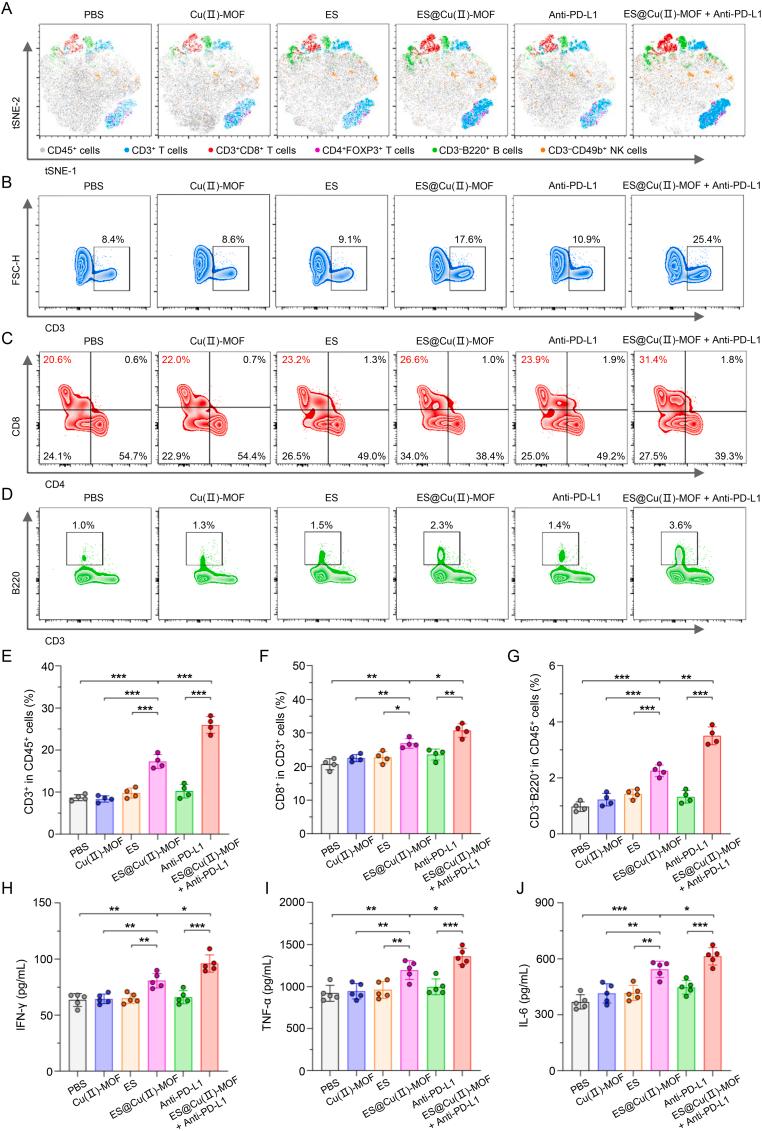
Nanozymes constitute a promising treatment strategy for antitumor therapy. However, the catalytic function of metal‒organic framework (MOF)-based nanozymes during cuproptosis remains unclear. In this study, a Cu(Ⅱ)-based MOF nanocomposite loaded with the copper ionophore elesclomol and surface modified with polyethylene glycol polymer (PEG) was developed (ES@Cu(Ⅱ)-MOF) for effective cuproptosis induction. The peroxidase (POD)-like activity of ES@Cu(Ⅱ)-MOF generated an abundance of hydroxyl radicals (•OH) via a Fenton-like reaction, and its glutathione peroxidase (GSH-Px)-like activity converted Cu into more toxic Cu ions to efficiently consume endogenous GSH. Notably, the rapid accumulation of Cu and ES in tumor cells induced the aggregation of lipoylated dihydrolipoamide S-acetyltransferase (DLAT) and the downregulation of Fe‒S cluster proteins, ultimately leading to cuproptosis. ES@Cu(Ⅱ)-MOF exhibited extraordinary cytotoxicity against breast cancer cells and significantly suppressed 4T1 breast tumor growth . Moreover, ES@Cu(Ⅱ)-MOF induced immunogenic cell death (ICD) to increase the antitumor immune response. Furthermore, combining ES@Cu(Ⅱ)-MOF with an anti-programmed cell death-ligand 1 (PD-L1) antibody converted the immunosuppressive tumor microenvironment to an immunogenic microenvironment, thus effectively inhibiting breast tumor growth. Overall, this work provides an innovative approach utilizing nanozymes to facilitate cuproptosis for cancer treatment, which potentially enhances the effectiveness of immune checkpoint inhibitor-based immunotherapy.
纳米酶构成了一种很有前景的抗肿瘤治疗策略。然而,基于金属有机框架(MOF)的纳米酶在铜死亡过程中的催化功能仍不清楚。在本研究中,开发了一种负载铜离子载体依斯氯铵并经聚乙二醇聚合物(PEG)表面修饰的基于Cu(Ⅱ)的MOF纳米复合材料(ES@Cu(Ⅱ)-MOF),用于有效诱导铜死亡。ES@Cu(Ⅱ)-MOF的过氧化物酶(POD)样活性通过类芬顿反应产生大量羟基自由基(•OH),其谷胱甘肽过氧化物酶(GSH-Px)样活性将Cu转化为毒性更强的Cu离子,从而有效消耗内源性GSH。值得注意的是,Cu和ES在肿瘤细胞中的快速积累诱导了脂酰化二氢硫辛酰胺S-乙酰转移酶(DLAT)的聚集和铁硫簇蛋白的下调,最终导致铜死亡。ES@Cu(Ⅱ)-MOF对乳腺癌细胞表现出非凡的细胞毒性,并显著抑制4T1乳腺肿瘤的生长。此外,ES@Cu(Ⅱ)-MOF诱导免疫原性细胞死亡(ICD)以增强抗肿瘤免疫反应。此外,将ES@Cu(Ⅱ)-MOF与抗程序性细胞死亡配体1(PD-L1)抗体联合使用,可将免疫抑制性肿瘤微环境转化为免疫原性微环境,从而有效抑制乳腺肿瘤生长。总体而言,这项工作提供了一种利用纳米酶促进铜死亡进行癌症治疗的创新方法,这可能会提高基于免疫检查点抑制剂的免疫疗法的有效性。


 Zotero 插件