
通过工程化嵌合吡咯赖氨酸tRNA利用丙氨酸有效抑制提前终止密码子
Efficient suppression of premature termination codons with alanine by engineered chimeric pyrrolysine tRNAs.
作者信息
Awawdeh Aya, Tapia Alejandro, Alshawi Sarah A, Dawodu Olabode, Gaier Sarah A, Specht Caitlin, Beaudoin Jean-Denis, Tharp Jeffery M, Vargas-Rodriguez Oscar
机构信息
Department of Molecular Biology and Biophysics, University of Connecticut School of Medicine, 263 Farmington Avenue, Farmington, CT 06030, USA.
Department of Biochemistry and Molecular Biology, Indiana University School of Medicine, 635 Barnhill Drive, Indianapolis, IN 46202, USA.
出版信息
Nucleic Acids Res. 2024 Dec 11;52(22):14244-14259. doi: 10.1093/nar/gkae1048.
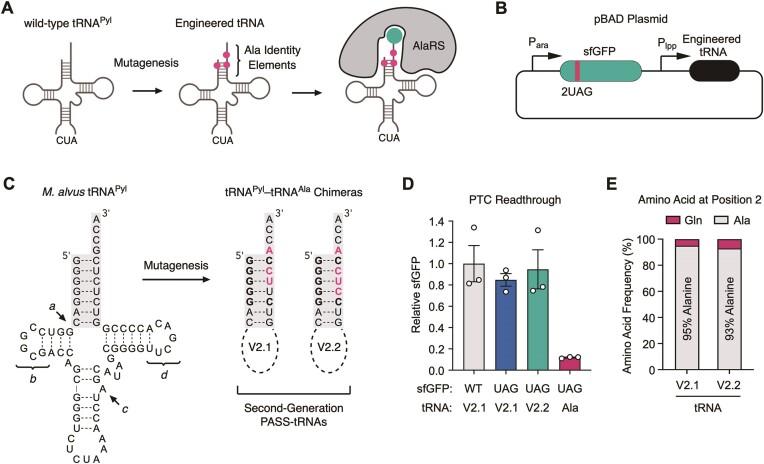
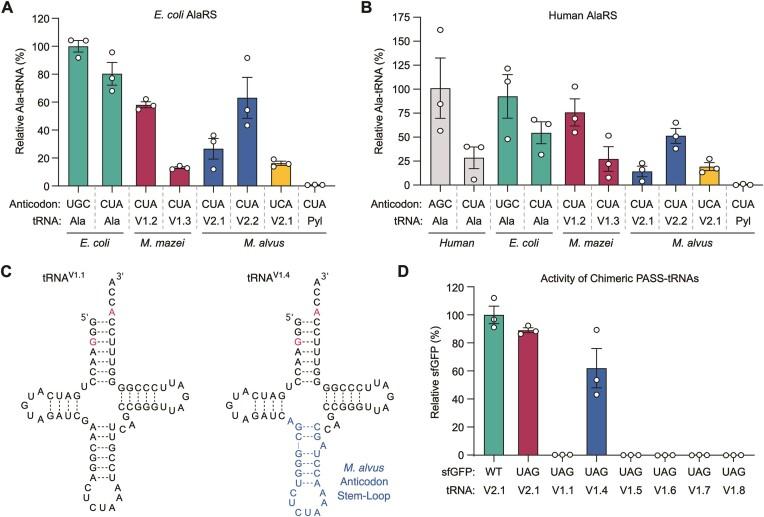
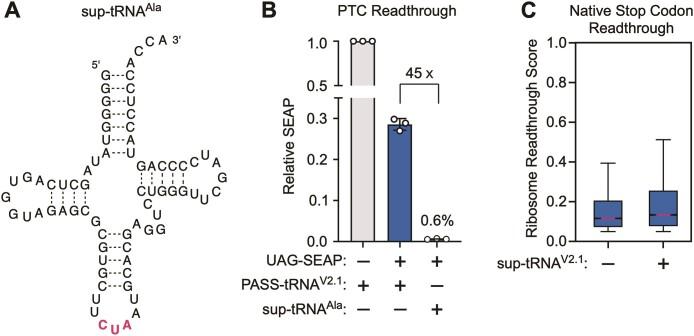
Mutations that introduce premature termination codons (PTCs) within protein-coding genes are associated with incurable and severe genetic diseases. Many PTC-associated disorders are life-threatening and have no approved medical treatment options. Suppressor transfer RNAs (sup-tRNAs) with the capacity to translate PTCs represent a promising therapeutic strategy to treat these conditions; however, developing novel sup-tRNAs with high efficiency and specificity often requires extensive engineering and screening. Moreover, these efforts are not always successful at producing more efficient sup-tRNAs. Here we show that a pyrrolysine (Pyl) tRNA (tRNAPyl), which naturally translates the UAG stop codon, offers a favorable scaffold for developing sup-tRNAs that restore protein synthesis from PTC-containing genes. We created a series of rationally designed Pyl tRNAScaffold Suppressor-tRNAs (PASS-tRNAs) that are substrates of bacterial and human alanyl-tRNA synthetase. Using a PTC-containing fluorescent reporter gene, PASS-tRNAs restore protein synthesis to wild-type levels in bacterial cells. In human cells, PASS-tRNAs display robust and consistent PTC suppression in multiple reporter genes, including pathogenic mutations in the tumor suppressor gene BRCA1 associated with breast and ovarian cancer. Moreover, PTC suppression occurred with high codon specificity and no observed cellular dysregulation. Collectively, these results unveil a new class of sup-tRNAs with encouraging potential for tRNA-based therapeutic applications.
在蛋白质编码基因中引入提前终止密码子(PTC)的突变与无法治愈的严重遗传疾病相关。许多与PTC相关的疾病危及生命,且没有获批的医学治疗方案。具有翻译PTC能力的抑制性转移RNA(sup-tRNA)是治疗这些疾病的一种有前景的治疗策略;然而,开发高效且特异的新型sup-tRNA通常需要大量的工程设计和筛选。此外,这些努力并不总是能成功产生更有效的sup-tRNA。在这里,我们表明,天然翻译UAG终止密码子的吡咯赖氨酸(Pyl)tRNA(tRNAPyl)为开发能从含PTC的基因中恢复蛋白质合成的sup-tRNA提供了一个有利的支架。我们创建了一系列经过合理设计的Pyl tRNA支架抑制性tRNA(PASS-tRNA),它们是细菌和人丙氨酰-tRNA合成酶的底物。使用一个含PTC的荧光报告基因,PASS-tRNA在细菌细胞中将蛋白质合成恢复到野生型水平。在人类细胞中,PASS-tRNA在多个报告基因中表现出强大且一致的PTC抑制作用,包括与乳腺癌和卵巢癌相关的肿瘤抑制基因BRCA1中的致病突变。此外,PTC抑制以高密码子特异性发生,且未观察到细胞失调。总的来说,这些结果揭示了一类新的sup-tRNA,在基于tRNA的治疗应用方面具有令人鼓舞的潜力。




 Zotero 插件