
铜绿假单胞菌的抗生素耐药趋势及意义:来自浙江省 19 年研究的新视角
Trends and implications of antimicrobial resistance in Pseudomonas aeruginosa: Insights from a 19-year study in Zhejiang Province.
机构信息
Key Laboratory of Non-coding RNA and Drug Discovery at Chengdu Medical College of Sichuan Province, School of Basic Medical Sciences, Chengdu Medical College, Chengdu, Sichuan China.
Department of Stomatology, The First Affiliated Hospital of Chengdu Medical College, Chengdu, Sichuan, China.
出版信息
Medicine (Baltimore). 2024 Nov 15;103(46):e40606. doi: 10.1097/MD.0000000000040606.
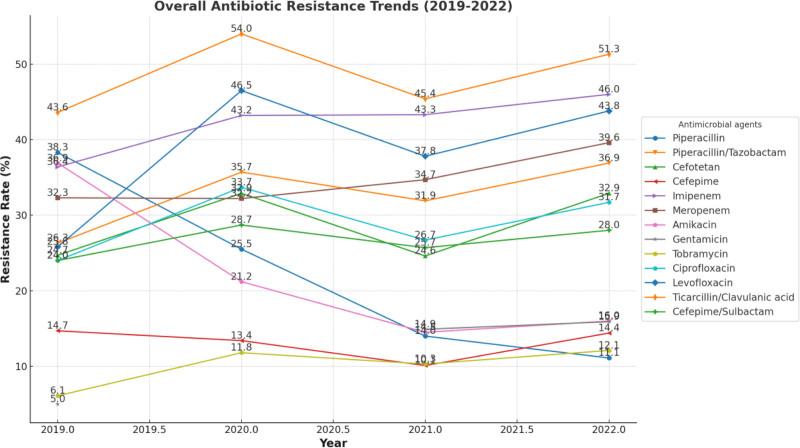
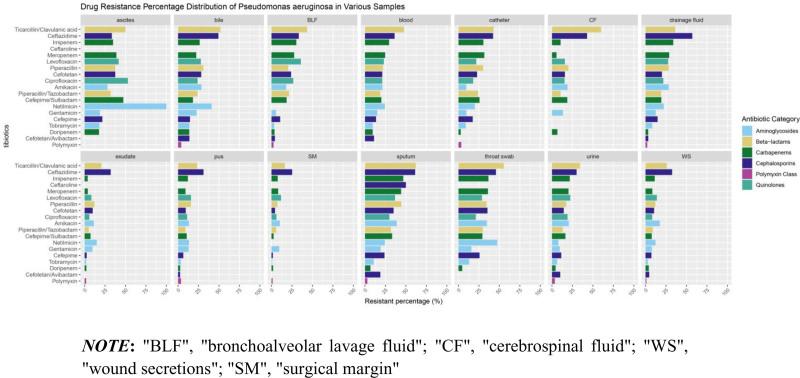
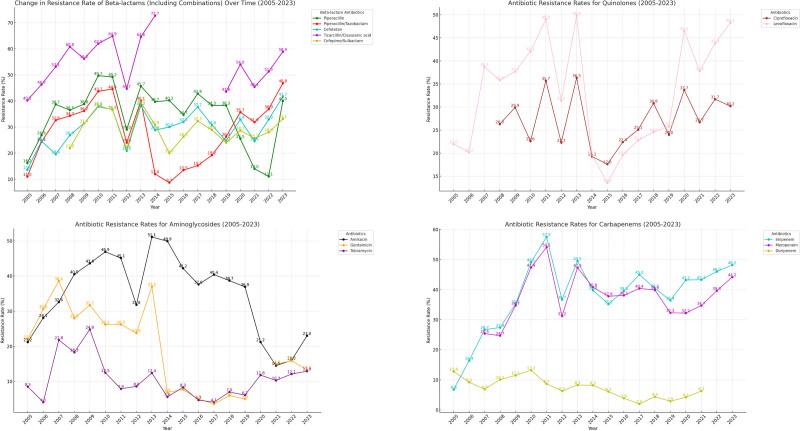
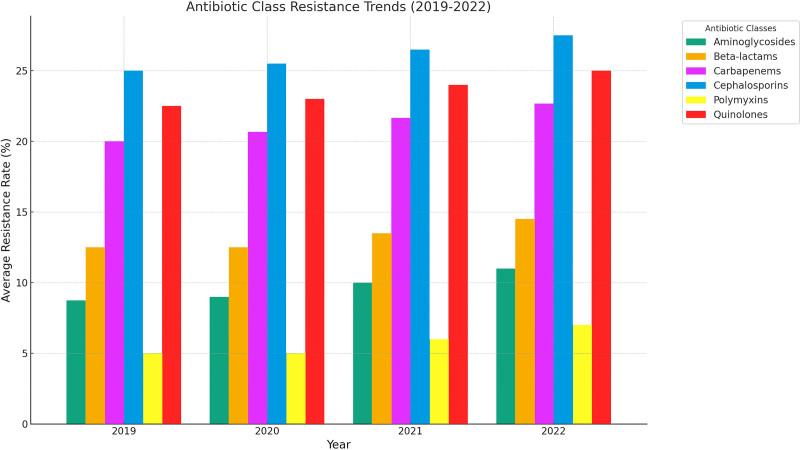
This study aimed to elucidate the resistance trends of P. aeruginosa isolates from 2005 to 2023 in Zhejiang Province, emphasizing the impact of Coronavirus disease 2019 (COVID-19) on antimicrobial resistance patterns and clinical management. We retrospectively analyzed 7326 P. aeruginosa isolates collected from diverse clinical sources in a tertiary hospital in Zhejiang Province from 2005 to 2023. Identification and antibiotic susceptibility testing of each isolate were performed using the VITEK-32 automated system and the disk diffusion method, following Clinical and Laboratory Standards Institute guidelines. We assessed resistance patterns for key antibiotic classes relevant to P. aeruginosa treatment, including carbapenems, β-lactams, aminoglycosides, and quinolones. Statistical analyses, including trend evaluations and resistance determinant assessments, were conducted in R software (version 4.2.2), with visualizations generated through ggplot2 to illustrate resistance trends over time. This study focused on key anti-pseudomonal agents including carbapenems (imipenem and meropenem), β-lactams (piperacillin), and quinolones (ciprofloxacin and levofloxacin). We observed a progressive increase in resistance to imipenem from 6.8% in 2005 to 48.2% in 2023 and meropenem from 25.4% to 44.2% over the same period. Conversely, resistance rates to aminoglycosides declined, with gentamicin resistance dropping from 22.0% in 2005 to 5.0% in 2019. Cephalosporins exhibited variable trends, with cefepime resistance peaking at 40.4% in 2013 before declining to 12.1% in 2023. The findings indicated a progressive increase in resistance rates for these antibiotics, with notable peaks coinciding with changes in clinical practices and the COVID-19 pandemic. The analysis demonstrated that shifts in prescription habits, particularly during the COVID-19 pandemic, influenced resistance patterns, underscoring the need for context-specific antimicrobial stewardship strategies. This study identifies significant, evolving resistance patterns in P. aeruginosa over a 19-year period, with marked increases in resistance to critical antibiotics, including carbapenems (imipenem, meropenem), quinolones (levofloxacin, ciprofloxacin), and certain β-lactams (piperacillin). These findings underscore an urgent need for dynamic, tailored infection control measures, emphasizing the importance of robust antibiotic stewardship programs, localized treatment guidelines, and proactive monitoring of resistance trends. Implementing these strategies is essential to effectively counter the challenges posed by multi-drug resistant P. aeruginosa, improve patient outcomes, and sustain the efficacy of vital antibiotic therapies.
本研究旨在阐明 2005 年至 2023 年期间浙江省铜绿假单胞菌分离株的耐药趋势,重点关注 2019 年冠状病毒病(COVID-19)对抗菌药物耐药模式和临床管理的影响。我们回顾性分析了 2005 年至 2023 年期间从浙江省一家三级医院不同临床来源采集的 7326 株铜绿假单胞菌。使用 VITEK-32 自动化系统和纸片扩散法按照临床和实验室标准协会指南对每个分离株进行鉴定和抗生素药敏试验。我们评估了与铜绿假单胞菌治疗相关的关键抗生素类别的耐药模式,包括碳青霉烯类、β-内酰胺类、氨基糖苷类和喹诺酮类。使用 R 软件(版本 4.2.2)进行统计学分析,包括趋势评估和耐药决定因素评估,并通过 ggplot2 生成可视化效果以说明随时间推移的耐药趋势。本研究重点关注关键抗假单胞菌药物,包括碳青霉烯类(亚胺培南和美罗培南)、β-内酰胺类(哌拉西林)和喹诺酮类(环丙沙星和左氧氟沙星)。我们观察到,亚胺培南的耐药率从 2005 年的 6.8%上升到 2023 年的 48.2%,美罗培南的耐药率从 25.4%上升到 44.2%。相反,氨基糖苷类的耐药率下降,庆大霉素的耐药率从 2005 年的 22.0%下降到 2019 年的 5.0%。头孢菌素类表现出不同的趋势,头孢吡肟的耐药率在 2013 年达到 40.4%的峰值,然后在 2023 年下降到 12.1%。研究结果表明,这些抗生素的耐药率呈渐进性上升,在临床实践和 COVID-19 大流行期间发生了显著变化。分析表明,处方习惯的变化,尤其是在 COVID-19 大流行期间,影响了耐药模式,突出了需要制定具体情况具体分析的抗菌药物管理策略。本研究确定了铜绿假单胞菌在 19 年期间显著、不断变化的耐药模式,对包括碳青霉烯类(亚胺培南、美罗培南)、喹诺酮类(左氧氟沙星、环丙沙星)和某些β-内酰胺类(哌拉西林)在内的关键抗生素的耐药性显著增加。这些发现突显了迫切需要采取动态、有针对性的感染控制措施,强调了实施强有力的抗菌药物管理计划、制定本地化的治疗指南以及积极监测耐药趋势的重要性。实施这些策略对于有效应对多药耐药铜绿假单胞菌带来的挑战、改善患者结局和维持重要抗生素治疗的疗效至关重要。
 Zotero 插件