
中心性肥胖可能是肥胖相关结直肠癌风险的主要原因:来自英国生物银行前瞻性队列的证据。
Central obesity may account for most of the colorectal cancer risk linked to obesity: evidence from the UK Biobank prospective cohort.
作者信息
Safizadeh Fatemeh, Mandic Marko, Schöttker Ben, Hoffmeister Michael, Brenner Hermann
机构信息
Division of Clinical Epidemiology and Aging Research, German Cancer Research Center (DKFZ), Heidelberg, Germany.
Medical Faculty Heidelberg, Heidelberg University, Heidelberg, Germany.
出版信息
Int J Obes (Lond). 2025 Apr;49(4):619-626. doi: 10.1038/s41366-024-01680-7. Epub 2024 Nov 19.
BACKGROUND
General obesity commonly represented by body mass index (BMI) is an established risk factor for colorectal cancer (CRC). However, it is unclear to what extent this association is accounted for by central obesity. We aimed to evaluate the associations between BMI, waist-to-hip ratio (WHR), and waist circumference (WC) with CRC risk and to investigate if and to what extent these associations are independent from each other.
METHODS
Data from more than 500,000 male and female participants aged 40-69, recruited in the UK Biobank study between 2006 and 2010, were analyzed. Multivariable Cox proportional hazards models were fitted and hazard ratios (HR) and their 95% confidence intervals (CI) were calculated.
RESULTS
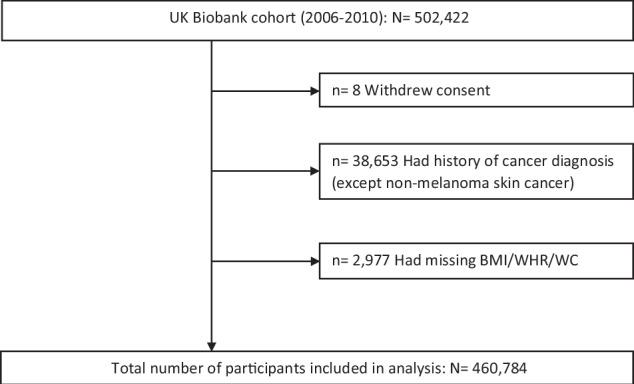
During a median follow-up of 12.5 years, of 460,784 participants, 5,977 developed CRC. Multivariable adjusted HRs (95% CIs) per standard deviation increase of BMI, WHR, and WC were 1.10 (1.07-1.13), 1.18 (1.14-1.22), and 1.14 (1.11-1.18), respectively. After mutual adjustment, the association with CRC was substantially attenuated for BMI (1.04 (1.01-1.07)), and remained substantially stronger for WHR (1.15 (1.11-1.20)). Furthermore, WHR showed strong, statistically significant associations with CRC risk within all BMI categories, whereas associations of BMI with CRC risk were weak and not statistically significant within WHR categories. BMI was also not associated with CRC risk in women and with rectal cancer after mutual adjustment. Conversely, WHR was strongly associated with CRC risk in both sexes and with both colon and rectal cancer risk before and after adjustment for BMI. BMI and WC could not be mutually adjusted for due to their high correlation.
CONCLUSION
Central obesity is a much stronger predictor of CRC and may account for most of the CRC risk linked to obesity. Our findings also emphasize the need for incorporating measures such as WHR alongside BMI in clinical practice to improve obesity prevention and management.
背景
通常用体重指数(BMI)表示的一般肥胖是结直肠癌(CRC)的既定风险因素。然而,尚不清楚这种关联在多大程度上由中心性肥胖导致。我们旨在评估BMI、腰臀比(WHR)和腰围(WC)与CRC风险之间的关联,并调查这些关联是否相互独立以及独立程度如何。
方法
分析了2006年至2010年在英国生物银行研究中招募的50多万名年龄在40 - 69岁的男性和女性参与者的数据。拟合多变量Cox比例风险模型,并计算风险比(HR)及其95%置信区间(CI)。
结果
在中位随访12.5年期间,460,784名参与者中有5,977人患CRC。BMI、WHR和WC每增加一个标准差,多变量调整后的HR(95%CI)分别为1.10(1.07 - 1.13)、1.18(1.14 - 1.22)和1.14(1.11 - 1.18)。相互调整后,BMI与CRC的关联大幅减弱(1.04(1.01 - 1.07)),而WHR与CRC的关联仍然显著更强(1.15(1.11 - 1.20))。此外,WHR在所有BMI类别中均与CRC风险呈现强烈的、具有统计学意义的关联,而BMI在WHR类别中与CRC风险的关联较弱且无统计学意义。相互调整后,BMI在女性中与CRC风险无关,与直肠癌也无关。相反,WHR在男女两性中均与CRC风险强烈相关,在调整BMI前后与结肠癌和直肠癌风险均相关。由于BMI和WC高度相关,无法对其进行相互调整。
结论
中心性肥胖是CRC更强的预测指标,可能是与肥胖相关的大部分CRC风险的原因。我们的研究结果还强调,在临床实践中需要将WHR等指标与BMI一起纳入考量,以改善肥胖的预防和管理。


 Zotero 插件