
一种针对新型冠状病毒肺炎的理论系统时间药理学方法:建立肺部感染的昼夜节律调节模型及潜在的精准治疗方法。
A theoretical systems chronopharmacology approach for COVID-19: Modeling circadian regulation of lung infection and potential precision therapies.
作者信息
Tseng Yu-Yao
机构信息
Department of Food Science, Nutrition, and Nutraceutical Biotechnology, Shih Chien University, Taipei, Taiwan.
出版信息
CPT Pharmacometrics Syst Pharmacol. 2025 Feb;14(2):340-350. doi: 10.1002/psp4.13277. Epub 2024 Nov 19.
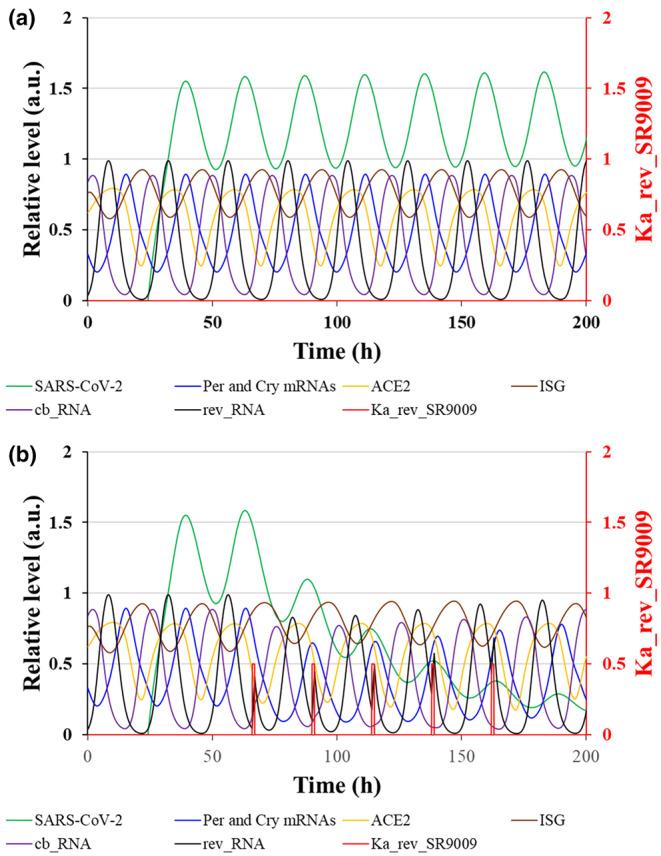
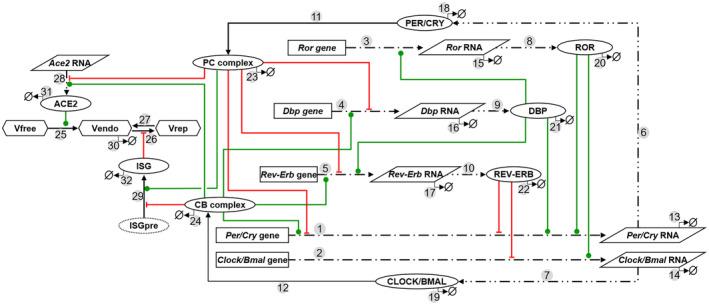
The COVID-19 pandemic, caused by SARS-CoV-2, has underscored the urgent need for innovative therapeutic approaches. Recent studies have revealed a complex interplay between the circadian clock and SARS-CoV-2 infection in lung cells, opening new avenues for targeted interventions. This systems pharmacology study investigates this intricate relationship, focusing on the circadian protein BMAL1. BMAL1 plays a dual role in viral dynamics, driving the expression of the viral entry receptor ACE2 while suppressing interferon-stimulated antiviral genes. Its critical position at the host-pathogen interface suggests potential as a therapeutic target, albeit requiring a nuanced approach to avoid disrupting essential circadian regulation. To enable precise tuning of potential interventions, we constructed a computational model integrating the lung cellular clock with viral infection components. We validated this model against literature data to establish a platform for drug administration simulation studies using the REV-ERB agonist SR9009. Our simulations of optimized SR9009 dosing reveal circadian-based strategies that potentially suppress viral infection while minimizing clock disruption. This quantitative framework offers insights into the viral-circadian interface, aiming to guide the development of chronotherapy-based antivirals. More broadly, it underscores the importance of understanding the connections between circadian timing, respiratory viral infections, and therapeutic responses for advancing precision medicine. Such approaches are vital for responding effectively to the rapid spread of coronaviruses like SARS-CoV-2.
由严重急性呼吸综合征冠状病毒2(SARS-CoV-2)引起的2019冠状病毒病疫情凸显了对创新治疗方法的迫切需求。最近的研究揭示了昼夜节律时钟与肺细胞中SARS-CoV-2感染之间的复杂相互作用,为靶向干预开辟了新途径。这项系统药理学研究调查了这种复杂关系,重点关注昼夜节律蛋白BMAL1。BMAL1在病毒动态中发挥双重作用,驱动病毒进入受体血管紧张素转换酶2(ACE2)的表达,同时抑制干扰素刺激的抗病毒基因。它在宿主-病原体界面的关键位置表明其具有作为治疗靶点的潜力,尽管需要采取细致入微的方法以避免破坏基本的昼夜节律调节。为了能够精确调整潜在干预措施,我们构建了一个将肺细胞时钟与病毒感染成分整合在一起的计算模型。我们根据文献数据验证了该模型,以建立一个使用REV-ERB激动剂SR9009进行药物给药模拟研究的平台。我们对优化后的SR9009给药方案的模拟揭示了基于昼夜节律的策略,这些策略有可能在最小化时钟破坏的同时抑制病毒感染。这个定量框架为病毒-昼夜节律界面提供了见解,旨在指导基于时间疗法的抗病毒药物的开发。更广泛地说,它强调了理解昼夜节律时间、呼吸道病毒感染和治疗反应之间的联系对于推进精准医学的重要性。此类方法对于有效应对像SARS-CoV-2这样的冠状病毒的快速传播至关重要。
 Zotero 插件