
铁皮石斛 UGT708S6 酶,催化黄酮类化合物 C-糖基化。
UGT708S6 from Dendrobium catenatum, catalyzes the formation of flavonoid C-glycosides.
机构信息
Department of Pharmaceutical Botany, School of Pharmacy, Naval Medical University, Shanghai, 200433, China.
Navy Special Medical Centre, Second Military Medical University, Shanghai, 200433, China.
出版信息
BMC Biotechnol. 2024 Nov 19;24(1):94. doi: 10.1186/s12896-024-00923-9.
BACKGROUND
Dendrobium catenatum is a perennial herb of the genus Dendrobium orchidaceae. It has been known as "Golden Grass, Soft Gold" since ancient times with effects of strengthening the body, benefiting the stomach, generating body fluid, nourishing Yin and clearing internal heat. The flowers of D. catenatum have anti-oxidation, immune regulation and other biological activities. The composition analysis of flowers showed that flavonoid glycosides were significantly accumulated in floral tissue. However, in the flowers of D. catenatum, there was only one case of the UDP-glycosyltransferase (UGT) responsible for the glycosylation of flavonoids has been reported.
RESULT
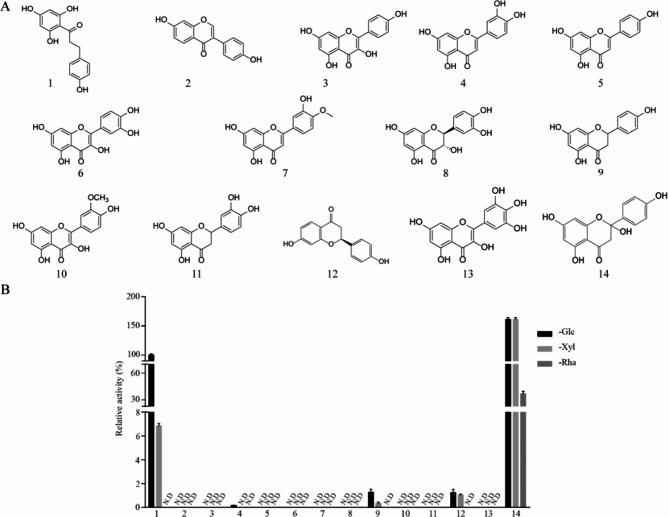
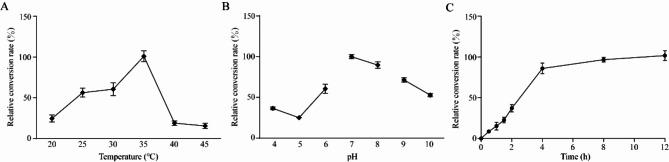
In this study, a new UGT (named UGT708S6) was cloned from D. catenatum flowers rich in O-glycosides and C-glycosides, and its function and biochemical properties were characterized. Through homology comparison and molecular docking, we identified the key amino acid residues affecting the catalytic function of UGT708S6. The glycosyltransferase UGT708S6 was characterized and demonstrated C-glycosyltransferase (CGT) activity in vitro assay using phloretin and 2-hydroxynaringenin as sugar acceptors. The catalytic promiscuity assay revealed that UGT708S6 has a clear sugar donor preference, and displayed O-glycosyltransferase (OGT) activity towards luteolin, naringenin and liquiritigenin. Furthermore, the catalytic characteristics of UGT708S6 were explored, shedding light on the structural basis of substrate promiscuity and the catalytic mechanism involved in the formation of flavonoid C-glycosides. R271 was a key amino acid residue site that sustained the catalytic reaction. The smaller binding pocket resulted in the production of new O-glycosides and the reduction of C-glycosides. This highlighted the importance of the binding pocket in determining whether C-glycosides or O-glycosides were produced.
CONCLUSIONS
The findings suggest that UGT708S6 holds promise as a new glycosyltransferase for synthesizing flavonoid glycosides and offer valuable insights for further understanding the catalytic mechanisms of flavonoid glycosyltransferases.
背景
铁皮石斛是兰科石斛属的多年生草本植物。自古以来,铁皮石斛就被称为“金草、软金”,具有强身健体、益胃生津、滋阴清热的功效。铁皮石斛花具有抗氧化、免疫调节等生物活性。花的成分分析表明,花组织中黄酮苷类化合物明显积累。然而,在铁皮石斛的花中,只有一个负责黄酮类化合物糖基化的 UDP-糖基转移酶(UGT)被报道过。
结果
本研究从富含 O-糖苷和 C-糖苷的铁皮石斛花中克隆了一个新的 UGT(命名为 UGT708S6),并对其功能和生化特性进行了表征。通过同源比较和分子对接,确定了影响 UGT708S6催化功能的关键氨基酸残基。通过体外 phloretin 和 2-羟基柚皮素作为糖受体的糖基转移酶活性测定,对糖基转移酶 UGT708S6进行了特征分析。催化杂泛性测定表明,UGT708S6 具有明显的糖供体偏好性,对木犀草素、柚皮素和甘草素表现出 O-糖基转移酶(OGT)活性。此外,还探讨了 UGT708S6 的催化特性,揭示了底物杂泛性的结构基础以及参与黄酮类化合物 C-糖苷形成的催化机制。R271 是维持催化反应的关键氨基酸残基位点。较小的结合口袋导致新的 O-糖苷的产生和 C-糖苷的减少。这突出了结合口袋在确定是产生 C-糖苷还是 O-糖苷方面的重要性。
结论
研究结果表明,UGT708S6 有望成为合成黄酮类糖苷的新型糖基转移酶,为进一步了解黄酮类糖基转移酶的催化机制提供了有价值的见解。




 Zotero 插件