
竖脊肌平面阻滞(ESPB)可增强血流动力学稳定性,减少肋骨骨折手术固定(SSRFs)的镇痛需求。
Erector spinae plane block (ESPB) enhances hemodynamic stability decreasing analgesic requirements in surgical stabilization of rib fractures (SSRFs).
机构信息
College of Medicine, Chang Gung University, Taoyuan, Taiwan.
Department of Trauma and Emergency Surgery, Linkou Branch, Chang Gung Memorial Hospital, Taoyuan, Taiwan.
出版信息
World J Emerg Surg. 2024 Nov 20;19(1):36. doi: 10.1186/s13017-024-00567-2.
OBJECTIVE
To evaluate the efficacy of erector spinae plane block (ESPB) on intraoperative hemodynamic stability, opioid and inhalation anesthetic requirements and postoperative analgesic effects in patients undergoing surgical stabilization of rib fractures (SSRFs).
METHODS
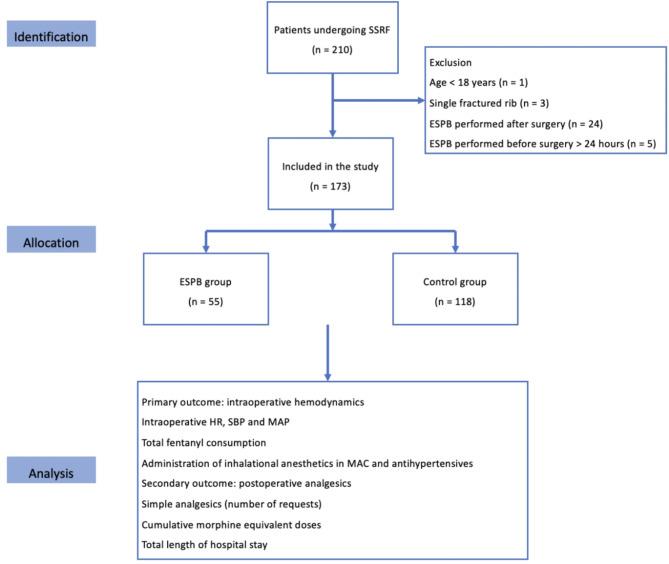
We retrospectively reviewed 173 patients who underwent surgical stabilization of rib fractures between May 2020 and December 2023. The patients were allocated into the ESPB group or the control group. Demographic data, intraoperative hemodynamic parameters, total intraoperative opioid consumption, the average minimum alveolar concentration (MAC) of inhalational anesthetics, postoperative simple analgesics and opioid consumption and the length of hospital stay were included in the analysis.
RESULTS
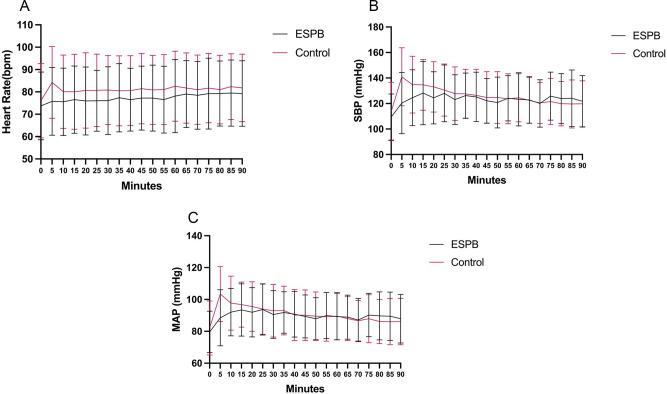
Compared with the control group, the ESPB group had a lower heart rate (HR) in the first 90 min after surgical incision and lower systolic blood pressure (SBP) and mean arterial pressure (MAP) at the beginning of surgery. Intraoperatively, a notable reduction in fentanyl consumption was observed in the ESPB group (p = 0.004), whereas no significant difference was observed in the average MAC of inhalational agents (p = 0.073). Postoperatively, the ESPB group required fewer doses of simple analgesics in the first 24 h (p < 0.001) and 48 h (p = 0.029). No statistically significant difference in the length of hospital stay (p = 0.608) was observed between the groups.
CONCLUSION
ESPB was shown to enhance intraoperative hemodynamic stability, reduce opioid consumption and decrease postoperative analgesic consumption in patients who underwent SSRF. These results suggest that ESPB may serve as a valuable component of multimodal analgesia protocols for SSRF. Larger prospective studies are warranted to confirm the results and evaluate long-term outcomes.
目的
评估竖脊肌平面阻滞(ESPB)对肋骨骨折手术固定(SSRF)患者术中血流动力学稳定性、阿片类药物和吸入性麻醉药需求以及术后镇痛效果的影响。
方法
我们回顾性分析了 2020 年 5 月至 2023 年 12 月期间接受肋骨骨折手术固定的 173 例患者。患者被分为 ESPB 组或对照组。分析了人口统计学数据、术中血流动力学参数、术中总阿片类药物用量、吸入性麻醉药的平均最低肺泡浓度(MAC)、术后单纯镇痛药和阿片类药物用量以及住院时间。
结果
与对照组相比,ESPB 组在手术切口后 90 分钟内的心率(HR)较低,手术开始时的收缩压(SBP)和平均动脉压(MAP)较低。术中,ESPB 组芬太尼用量明显减少(p=0.004),而吸入性麻醉药的平均 MAC 无显著差异(p=0.073)。术后 24 小时(p<0.001)和 48 小时(p=0.029)内,ESPB 组需要的单纯镇痛药剂量更少。两组患者的住院时间无统计学差异(p=0.608)。
结论
ESPB 可增强 SSRF 患者术中血流动力学稳定性,减少阿片类药物用量,降低术后镇痛药物用量。这些结果表明,ESPB 可能成为 SSRF 多模式镇痛方案的一个有价值的组成部分。需要更大的前瞻性研究来证实这些结果并评估长期结果。
 Zotero 插件