
光热增强芬顿反应联合谷胱甘肽抑制增强铁死亡用于肿瘤协同纳米催化治疗
Augment of Ferroptosis with Photothermal Enhanced Fenton Reaction and Glutathione Inhibition for Tumor Synergistic Nano-Catalytic Therapy.
机构信息
Department of Orthopaedic Surgery, Third Hospital of Hebei Medical University, Shijiazhuang, Hebei, People's Republic of China.
Orthopaedic Institution of Hebei Province, Shijiazhuang, Hebei, People's Republic of China.
出版信息
Int J Nanomedicine. 2024 Nov 16;19:11923-11940. doi: 10.2147/IJN.S480586. eCollection 2024.
INTRODUCTION
Ferroptosis-driven tumor ablation strategies based on nanotechnology could be achieved by elevating intracellular iron levels or inhibiting glutathione peroxidase 4 (GPX4) activity. However, the intracellular antioxidative defense mechanisms endow tumor cells with ferroptosis resistance capacity. The purpose of this study was to develop a synergistic therapeutic platform to enhance the efficacy of ferroptosis-based tumor therapy.
METHODS
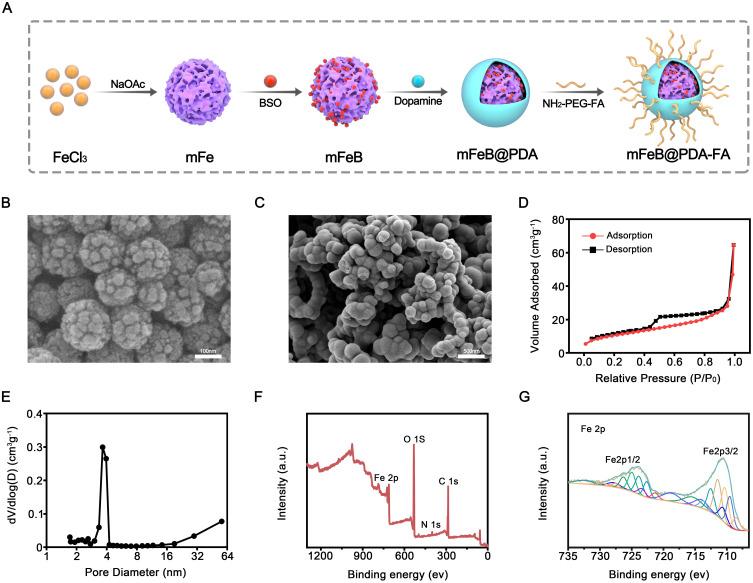
In this study, a multifunctional nano-catalytic therapeutic platform (mFeB@PDA-FA) based on chemodynamic therapy (CDT) and photothermal therapy (PTT) was developed to effectively trigger ferroptosis in tumor. In our work, iron-based mesoporous FeO nanoparticles (mFeO NPs) were employed for the encapsulation of L-buthionine sulfoximine (BSO), followed by the modification of folic acid-functionalized polydopamine (PDA) coating on the periphery. Then, the antitumor effect of mFeB@PDA-FA NPs was evaluated using Human OS cells (MNNG/HOS) and a subcutaneous xenograft model of osteosarcoma.
RESULTS
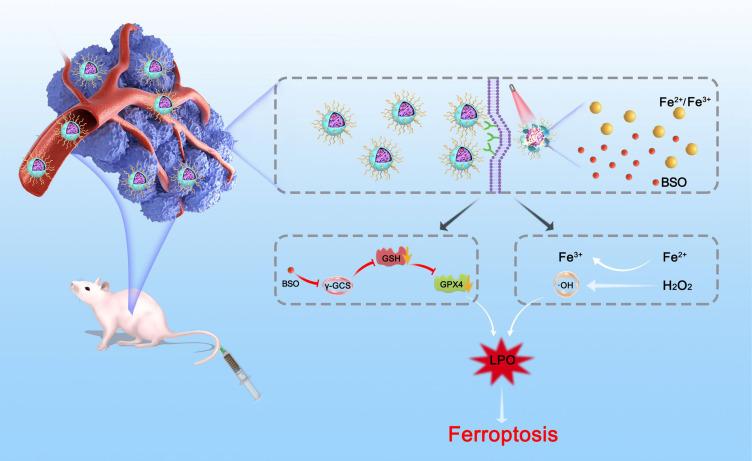
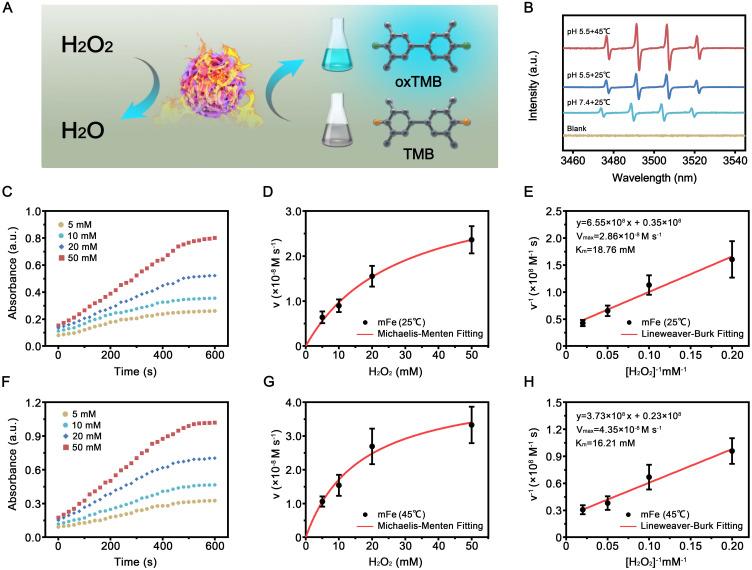
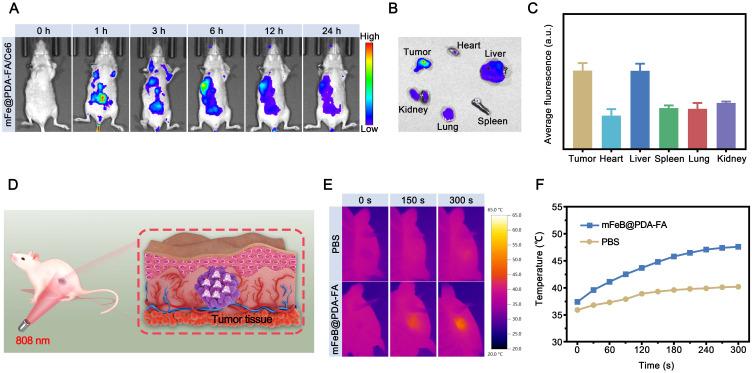
mFeO harboring multivalent elements (Fe) could catalyze hydrogen peroxide (HO) into highly cytotoxic ˙OH, while the tumor microenvironment (TME)-responsive released BSO molecules inhibit the biosynthesis of GSH, thus achieving the deactivation of GPX4 and the enhancement of ferroptosis. Moreover, thanks to the remarkable photothermal conversion performance of mFeO and PDA shell, PTT further synergistically enhanced the efficacy of CDT and facilitated ferroptosis. Both in vivo and in vitro experiments confirmed that this synergistic therapy could achieve excellent tumor inhibition effects.
CONCLUSION
The nanotherapeutic platform mFeB@PDA-FA could effectively disrupted the redox homeostasis in tumor cells for boosting ferroptosis through the combination of CDT, PTT and GSH elimination, which provided a new perspective for the treatment of ferroptosis sensitive tumors.
简介
基于纳米技术的铁死亡驱动的肿瘤消融策略可以通过提高细胞内铁水平或抑制谷胱甘肽过氧化物酶 4(GPX4)活性来实现。然而,细胞内抗氧化防御机制赋予肿瘤细胞铁死亡抗性能力。本研究旨在开发协同治疗平台以增强基于铁死亡的肿瘤治疗效果。
方法
在本研究中,开发了一种基于化学动力学治疗(CDT)和光热治疗(PTT)的多功能纳米催化治疗平台(mFeB@PDA-FA),以有效触发肿瘤中的铁死亡。在我们的工作中,使用基于铁的介孔 FeO 纳米颗粒(mFeO NPs)封装 L-丁硫氨酸亚砜(BSO),然后在其外围修饰叶酸功能化的聚多巴胺(PDA)涂层。然后,使用人骨肉瘤细胞(MNNG/HOS)和骨肉瘤皮下异种移植模型评估 mFeB@PDA-FA NPs 的抗肿瘤作用。
结果
mFeO 具有多价元素(Fe),可以催化过氧化氢(HO)生成高细胞毒性的·OH,而肿瘤微环境(TME)响应释放的 BSO 分子抑制 GSH 的生物合成,从而使 GPX4 失活并增强铁死亡。此外,由于 mFeO 和 PDA 壳的出色光热转换性能,PTT 进一步协同增强了 CDT 的效果并促进了铁死亡。体内和体外实验均证实,这种协同治疗可以实现优异的肿瘤抑制效果。
结论
纳米治疗平台 mFeB@PDA-FA 可以通过 CDT、PTT 和 GSH 消除的联合作用,有效破坏肿瘤细胞的氧化还原平衡,从而增强铁死亡,为治疗铁死亡敏感肿瘤提供了新的视角。




 Zotero 插件