
组织驻留巨噬细胞的发育编程。
Developmental programming of tissue-resident macrophages.
机构信息
Developmental Biology of the Immune System, Life and Medical Sciences (LIMES) Institute, University of Bonn, Bonn, Germany.
出版信息
Front Immunol. 2024 Nov 7;15:1475369. doi: 10.3389/fimmu.2024.1475369. eCollection 2024.
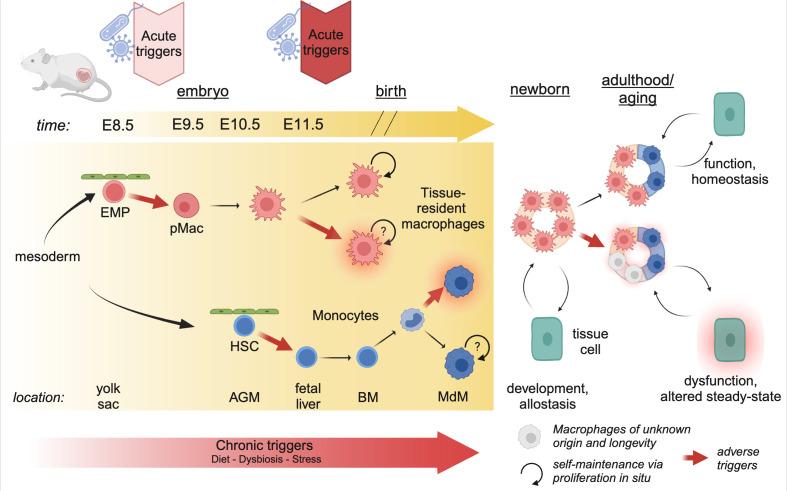
Macrophages are integral components of the innate immune system that colonize organs early in development and persist into adulthood through self-renewal. Their fate, whether they are replaced by monocytes or retain their embryonic origin, depends on tissue type and integrity. Macrophages are influenced by their environment, a phenomenon referred to as developmental programming. This influence extends beyond the local tissue microenvironment and includes soluble factors that can reach the macrophage niche. These factors include metabolites, antibodies, growth factors, and cytokines, which may originate from maternal diet, lifestyle, infections, or other developmental triggers and perturbations. These influences can alter macrophage transcriptional, epigenetic, and metabolic profiles, affecting cell-cell communication and tissue integrity. In addition to their crucial role in tissue immunity, macrophages play vital roles in tissue development and homeostasis. Consequently, developmental programming of these long-lived cells can modulate tissue physiology and pathology throughout life. In this review, we discuss the ontogeny of macrophages, the necessity of developmental programming by the niche for macrophage identity and function, and how developmental perturbations can affect the programming of macrophages and their subtissular niches, thereby influencing disease onset and progression in adulthood. Understanding these effects can inform targeted interventions or preventive strategies against diseases. Finally, understanding the consequences of developmental programming will shed light on how maternal health and disease may impact the well-being of future generations.
巨噬细胞是先天免疫系统的重要组成部分,它们在发育早期定植于器官,并通过自我更新在成年期持续存在。它们的命运,即它们是被单核细胞替代还是保留其胚胎起源,取决于组织类型和完整性。巨噬细胞受其环境的影响,这种现象被称为发育编程。这种影响不仅局限于局部组织微环境,还包括可以到达巨噬细胞龛位的可溶性因子。这些因子包括代谢物、抗体、生长因子和细胞因子,它们可能来自母体饮食、生活方式、感染或其他发育触发因素和干扰因素。这些影响可以改变巨噬细胞的转录、表观遗传和代谢特征,影响细胞间通讯和组织完整性。除了在组织免疫中发挥关键作用外,巨噬细胞在组织发育和稳态中也发挥着重要作用。因此,这些长寿细胞的发育编程可以调节整个生命周期的组织生理学和病理学。在这篇综述中,我们讨论了巨噬细胞的发生,龛位对巨噬细胞特性和功能的发育编程的必要性,以及发育干扰如何影响巨噬细胞及其亚细胞龛位的编程,从而影响成年期疾病的发生和进展。了解这些影响可以为针对疾病的靶向干预或预防策略提供信息。最后,了解发育编程的后果将揭示母体健康和疾病如何影响后代的健康。

 Zotero 插件