
超越先天性心脏缺陷的基因组研究:通过系统建模和表型分析。
Beyond genomic studies of congenital heart defects through systematic modelling and phenotyping.
机构信息
MRC National Mouse Genetics Network, Congenital Anomalies Cluster, Harwell, OX11 0RD, UK.
Biosciences Institute, Newcastle University, Centre for Life, Newcastle upon Tyne NE1 3BZ, UK.
出版信息
Dis Model Mech. 2024 Nov 1;17(11). doi: 10.1242/dmm.050913. Epub 2024 Nov 22.
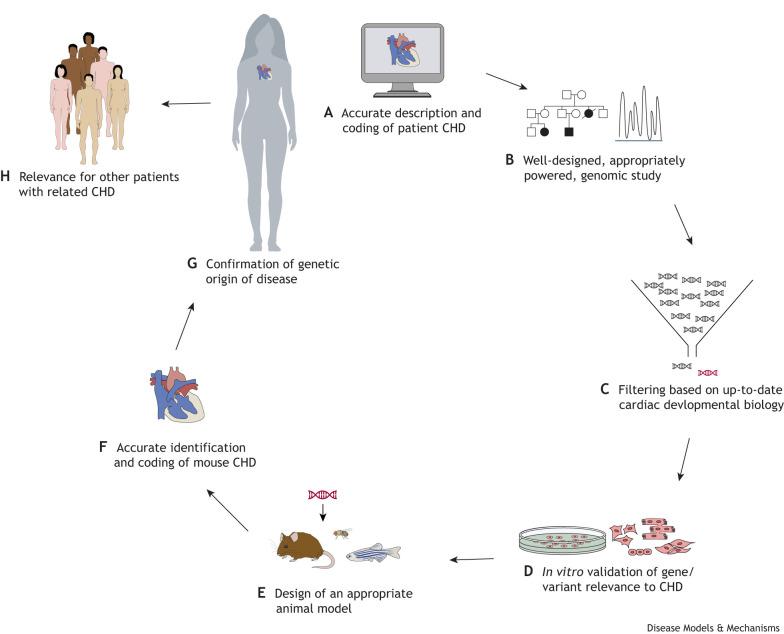
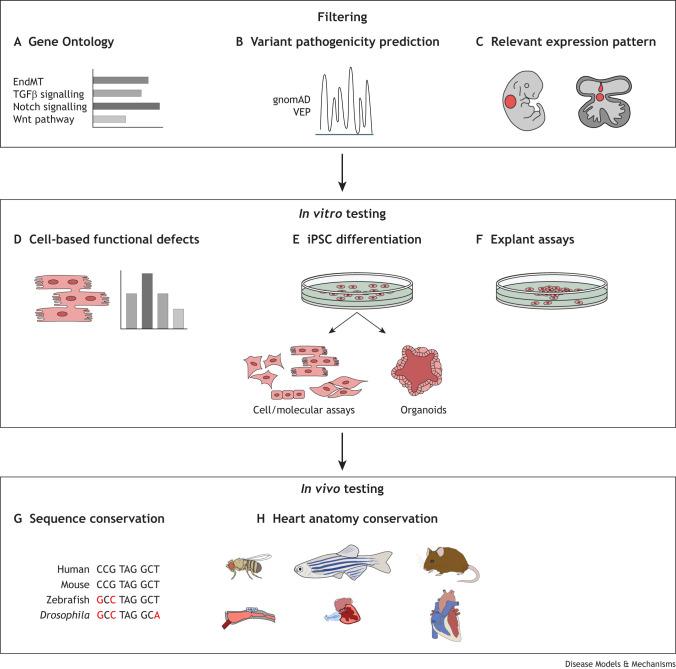
Congenital heart defects (CHDs), the most common congenital anomalies, are considered to have a significant genetic component. However, despite considerable efforts to identify pathogenic genes in patients with CHDs, few gene variants have been proven as causal. The complexity of the genetic architecture underlying human CHDs likely contributes to this poor genetic discovery rate. However, several other factors are likely to contribute. For example, the level of patient phenotyping required for clinical care may be insufficient for research studies focused on mechanistic discovery. Although several hundred mouse gene knockouts have been described with CHDs, these are generally not phenotyped and described in the same way as CHDs in patients, and thus are not readily comparable. Moreover, most patients with CHDs carry variants of uncertain significance of crucial cardiac genes, further complicating comparisons between humans and mouse mutants. In spite of major advances in cardiac developmental biology over the past 25 years, these advances have not been well communicated to geneticists and cardiologists. As a consequence, the latest data from developmental biology are not always used in the design and interpretation of studies aimed at discovering the genetic causes of CHDs. In this Special Article, while considering other in vitro and in vivo models, we create a coherent framework for accurately modelling and phenotyping human CHDs in mice, thereby enhancing the translation of genetic and genomic studies into the causes of CHDs in patients.
先天性心脏缺陷(CHD)是最常见的先天性畸形,被认为具有重要的遗传成分。然而,尽管人们为了在 CHD 患者中鉴定致病基因付出了巨大努力,但只有少数基因变异被证明是致病的。导致人类 CHD 的遗传结构复杂,这可能是遗传发现率低的原因之一。但还有其他一些因素可能也有影响。例如,临床护理所需的患者表型水平对于侧重于机制发现的研究可能不足。尽管已经描述了数百种具有 CHD 的小鼠基因敲除,但这些通常没有进行表型分析,也没有像患者中的 CHD 那样进行描述,因此不易进行比较。此外,大多数 CHD 患者携带关键心脏基因的意义不明的变异,这进一步增加了人与小鼠突变体之间的比较的复杂性。尽管在过去 25 年中心脏发育生物学取得了重大进展,但这些进展并没有很好地传达给遗传学家和心脏病学家。因此,发育生物学的最新数据并不总是用于设计和解释旨在发现 CHD 遗传原因的研究。在这篇专题文章中,我们在考虑其他体外和体内模型的同时,为在小鼠中准确模拟和表型分析人类 CHD 建立了一个连贯的框架,从而增强了将遗传和基因组研究转化为患者 CHD 病因的能力。

 Zotero 插件