
替沙格韦单抗-西加韦单抗用于 COVID-19 免疫功能低下 20 至 <40 千克儿童和青少年暴露前预防的免疫原性和安全性:一项前瞻性、开放标签、初步研究。
Immunogenicity and safety of tixagevimab-cilgavimab for COVID-19 pre-exposure prophylaxis in immunocompromised 20 to <40 kg children and adolescents: A pilot, prospective, open-labeled study.
机构信息
Division of Hematology and Oncology, Department of Pediatrics, Faculty of Medicine Siriraj Hospital, Mahidol University, Bangkok, Thailand.
Division of Infectious Diseases, Department of Pediatrics, Faculty of Medicine Siriraj Hospital, Mahidol University, Bangkok, Thailand.
出版信息
Hum Vaccin Immunother. 2024 Dec 31;20(1):2428011. doi: 10.1080/21645515.2024.2428011. Epub 2024 Nov 22.
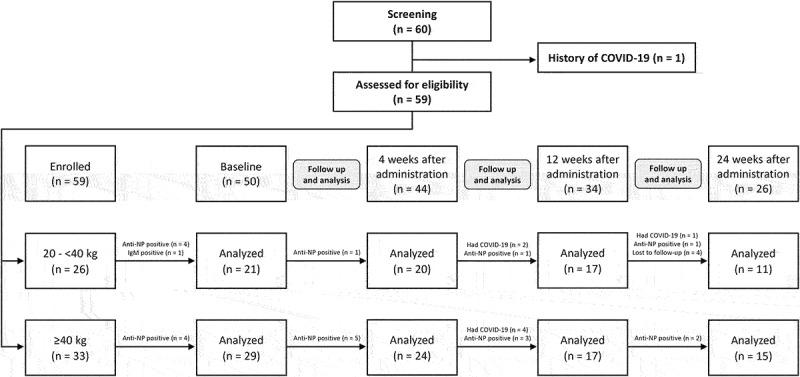
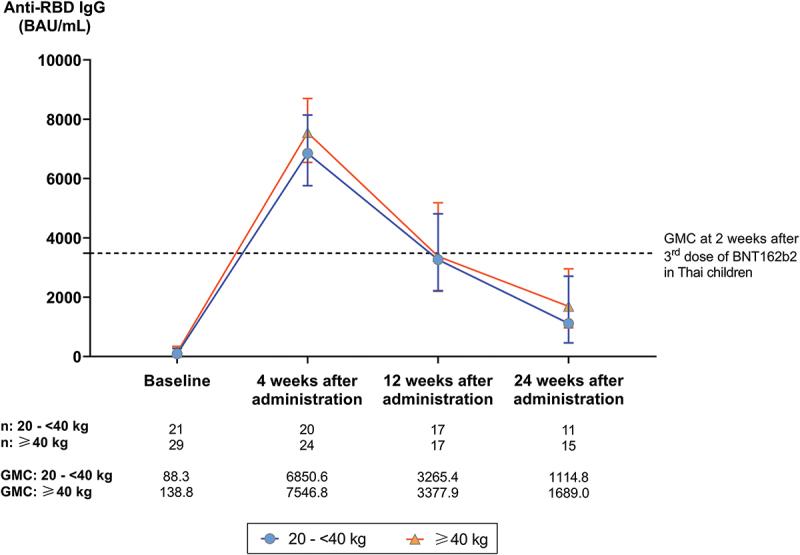
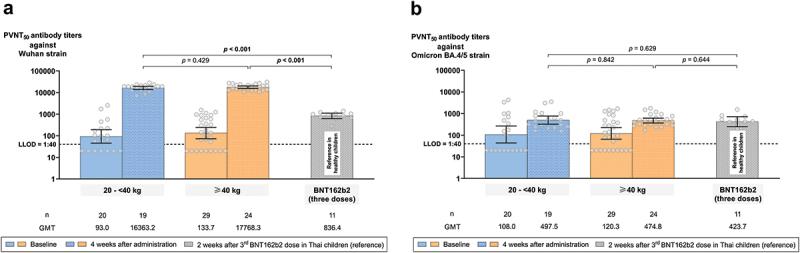
We evaluated the immunogenicity of 300 mg Tixagevimab-Cilgavimab in immunocompromised children and adolescents who weighed 20 to >40 kg. Six to 18-year-old participants were divided into two groups by body weight and received 300 mg (20 to <40 kg) and 600 mg (≥40 kg) Tixagevimab-Cilgavimab, respectively. Anti-SARS-CoV-2 receptor-binding domain IgG concentrations and pseudovirus neutralizing antibody (NAb) titers were measured at 4, 12, and 24 weeks after administration and compared with reference data from healthy Thai children at 2 weeks after three BNT162b2 vaccinations. Of 59 participants, 49.2% were female, with a median (IQR) age of 12 (9, 15) years; 16 (27.1%) had cancer. NAb titers (95% CI) for the ancestral Wuhan strain were comparatively high for both dosing regimens (16363.2 [13765.9, 19450.5] vs 17768.3 [15539.5, 20316.9] in 20 to <40 kg and ≥40 kg participants, respectively) and significantly higher than reference titers ( < 0.001 for both). NAb titers for Omicron BA.4/5 were on par with the reference for both dosing regimens. Adverse events were mild, well tolerated, and slightly more prevalent in ≥40 kg participants who received full-dose Tixagevimab-Cilgavimab. Minimal waning in anti-RBD IgG concentrations, comparable to the reference, was observed at 12 and 24 weeks after Tixagevimab-Cilgavimab administration for both regimens. We concluded that half-dose Tixagevimab-Cilgavimab in 20 to <40 kg participants generated equivalent antibodies to standard doses in ≥40 kg participants and significantly higher antibodies than three-dose BNT162b2 vaccination. Further study of monoclonal long-acting antibodies in larger cohorts and <6-year-old children are warranted.
我们评估了 300 毫克替沙格韦单抗-西加韦单抗在体重为 20 至>40 千克的免疫功能低下儿童和青少年中的免疫原性。6 至 18 岁的参与者按体重分为两组,分别接受 300 毫克(20 至<40 千克)和 600 毫克(≥40 千克)替沙格韦单抗-西加韦单抗。在给药后 4、12 和 24 周测量抗 SARS-CoV-2 受体结合域 IgG 浓度和假病毒中和抗体(NAb)滴度,并与健康泰国儿童在接受三剂 BNT162b2 疫苗后 2 周的参考数据进行比较。在 59 名参与者中,49.2%为女性,中位(IQR)年龄为 12(9,15)岁;16(27.1%)患有癌症。对于两种给药方案,针对原始武汉株的 NAb 滴度(95%CI)均较高(在 20 至<40 千克和≥40 千克参与者中分别为 16363.2[13765.9,19450.5]和 17768.3[15539.5,20316.9]),并且显著高于参考滴度(两者均<0.001)。对于两种给药方案,奥密克戎 BA.4/5 的 NAb 滴度与参考值相当。不良事件轻微,两种给药方案中均在接受全剂量替沙格韦单抗-西加韦单抗的≥40 千克参与者中更为常见。在替沙格韦单抗-西加韦单抗给药后 12 和 24 周,两种方案的抗-RBD IgG 浓度均有轻微下降,与参考值相当。我们得出结论,对于 20 至<40 千克的参与者,使用半剂量替沙格韦单抗-西加韦单抗可产生与≥40 千克参与者标准剂量相当的抗体,并且比三剂 BNT162b2 疫苗接种产生的抗体显著更高。在更大的队列和<6 岁的儿童中进一步研究单克隆长效抗体是必要的。

 Zotero 插件