
早期三阴性乳腺癌中肿瘤糖皮质激素受体的高表达与调节性T细胞浸润增加有关。
High tumor glucocorticoid receptor expression in early-stage, triple-negative breast cancer is associated with increased T-regulatory cell infiltration.
作者信息
Matossian Margarite D, Shiang Christine, Dolcen Deniz Nesli, Dreyer Marie, Hatogai Ken, Hall Katie, Saha Poornima, Biernacka Anna, Sweis Randy F, Karrison Theodore, Chen Nan, Nanda Rita, Conzen Suzanne D
机构信息
Section of Hematology and Oncology, Department of Medicine, The University of Chicago, Chicago, IL, 60637, USA.
Division of Hematology and Oncology, University of Texas Southwestern Medical Center, Dallas, TX, 75390, USA.
出版信息
Breast Cancer Res Treat. 2025 Feb;209(3):563-572. doi: 10.1007/s10549-024-07515-3. Epub 2024 Nov 23.
PURPOSE
In early-stage, triple-negative breast cancer (TNBC), immune cell infiltration contributes to cancer cell survival, tumor invasion, and metastasis. High TNBC glucocorticoid receptor (GR) expression in early-stage TNBC is associated with poor long-term outcomes; it is unknown if high GR expression is associated with an immunosuppressed tumor microenvironment. We hypothesized that high tumor GR expression would be associated with an immune-suppressed tumor microenvironment, which could thus account for the poor prognosis observed in GR-positive TNBC.
METHODS
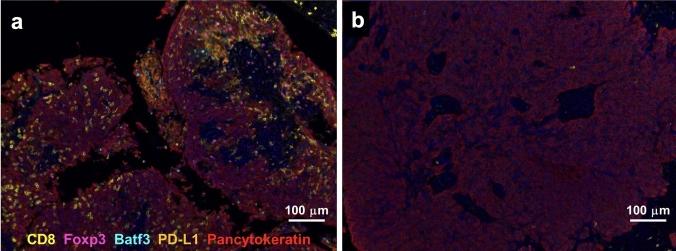
Formalin fixed-paraffin embedded tissue (n = 47) from patients diagnosed with early-stage TNBC from The University of Chicago (2002-2014) were evaluated for both tumor cell anti-GR immunohistochemistry and for infiltrating immune cells by immunofluorescence. Multiplexed antibodies were used to enumerate CD8+, FOXP3+, and BATF3+ immune cells infiltrating within pan-cytokeratin positive tumor cell regions of interest, and nonparametric tests compared absolute counts of each of these tumor-infiltrating immune cell types.
RESULTS
The average age of patients represented in this study was 52 years, and 63% self-identified as Black. There was no significant association between tumor GR expression and age, race, or clinical stage at diagnosis. Compared to GR-low tumors, high GR expression in early-stage, treatment-naïve TNBC was associated with relatively increased numbers of immunosuppressive FOXP3 + regulatory T cells (p = 0.046) and BATF3+immune cells (p = 0.021). While there was a positive correlation with high GR expression and CD8+ cell infiltration, it was not significant (p = 0.068). The ratio of CD8+/FOXP3+cells was also not significant (p = 0.24).
CONCLUSIONS
These data support the hypothesis that in early-stage TNBC, high GR expression is significantly associated with infiltration of immunosuppressive regulatory T cells, suggesting a tumor-intrinsic role in shaping the immunosuppressive immune cell milieu. Furthermore, suppression of GR activity may regulate the tumor immune microenvironment and improve long-term outcomes in GR-high TNBC.
目的
在早期三阴性乳腺癌(TNBC)中,免疫细胞浸润有助于癌细胞存活、肿瘤侵袭和转移。早期TNBC中高糖皮质激素受体(GR)表达与长期预后不良相关;尚不清楚高GR表达是否与免疫抑制的肿瘤微环境相关。我们假设肿瘤高GR表达与免疫抑制的肿瘤微环境相关,这可能解释了GR阳性TNBC中观察到的不良预后。
方法
对来自芝加哥大学(2002 - 2014年)诊断为早期TNBC患者的福尔马林固定石蜡包埋组织(n = 47)进行肿瘤细胞抗GR免疫组织化学和免疫荧光检测浸润免疫细胞。使用多重抗体对全细胞角蛋白阳性肿瘤细胞感兴趣区域内浸润的CD8 +、FOXP3 +和BATF3 +免疫细胞进行计数,非参数检验比较这些肿瘤浸润免疫细胞类型各自的绝对计数。
结果
本研究中患者的平均年龄为52岁,63%自认为是黑人。肿瘤GR表达与年龄、种族或诊断时的临床分期之间无显著关联。与GR低表达肿瘤相比,早期未经治疗的TNBC中高GR表达与免疫抑制性FOXP3 +调节性T细胞数量相对增加相关(p = 0.046),与BATF3 +免疫细胞数量相对增加相关(p = 0.021)。虽然高GR表达与CD8 +细胞浸润呈正相关,但不显著(p = 0.068)。CD8 + /FOXP3 +细胞的比例也不显著(p = 0.24)。
结论
这些数据支持以下假设,即在早期TNBC中,高GR表达与免疫抑制性调节性T细胞浸润显著相关,提示在塑造免疫抑制性免疫细胞环境中存在肿瘤内在作用。此外,抑制GR活性可能调节肿瘤免疫微环境并改善GR高表达TNBC的长期预后。



 Zotero 插件