
肿瘤微环境与癌症转移:分子机制及治疗意义
Tumor microenvironment and cancer metastasis: molecular mechanisms and therapeutic implications.
作者信息
Biray Avci Cigir, Goker Bagca Bakiye, Nikanfar Masoud, Takanlou Leila Sabour, Takanlou Maryam Sabour, Nourazarian Alireza
机构信息
Department of Medical Biology, Faculty of Medicine, Ege University, Izmir, Türkiye.
Department of Medical Biology, Faculty of Medicine, Adnan Menderes University, Aydin, Türkiye.
出版信息
Front Pharmacol. 2024 Nov 12;15:1442888. doi: 10.3389/fphar.2024.1442888. eCollection 2024.
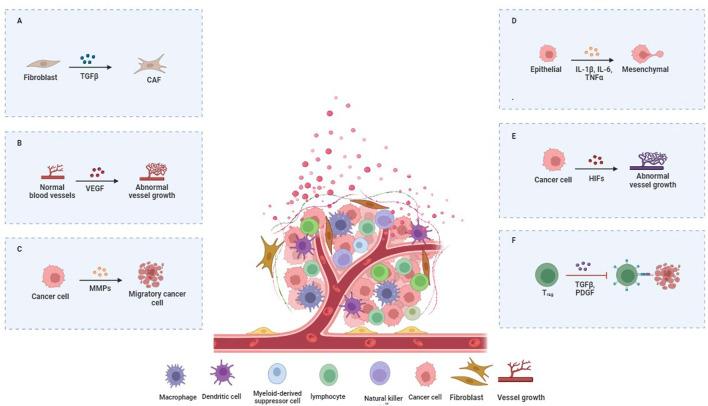
The tumor microenvironment (TME) plays a crucial role in cancer development and metastasis. This review summarizes the current research on how the TME promotes metastasis through molecular pathways, focusing on key components, such as cancer-associated fibroblasts, immune cells, endothelial cells, cytokines, and the extracellular matrix. Significant findings have highlighted that alterations in cellular communication within the TME enable tumor cells to evade immune surveillance, survive, and invade other tissues. This review highlights the roles of TGF-β and VEGF signaling in promoting angiogenesis and extracellular matrix remodeling, which facilitate metastasis. Additionally, we explored how metabolic reprogramming of tumor and stromal cells, influenced by nutrient availability in the TME, drives cancer progression. This study also evaluated the therapeutic strategies targeting these interactions to disrupt metastasis. By providing a multidisciplinary perspective, this study suggests that understanding the molecular basis of the TME can lead to more effective cancer therapies and identify potential avenues for future research. Future research on the TME should prioritize unraveling the molecular and cellular interactions within this complex environment, which could lead to novel therapeutic strategies and personalized cancer treatments. Moreover, advancements in technologies such as single-cell analysis, spatial transcriptomics, and epigenetic profiling offer promising avenues for identifying new therapeutic targets and improving the efficacy of immunotherapies, particularly in the context of metastasis.
肿瘤微环境(TME)在癌症发展和转移中起着关键作用。本综述总结了目前关于TME如何通过分子途径促进转移的研究,重点关注关键成分,如癌症相关成纤维细胞、免疫细胞、内皮细胞、细胞因子和细胞外基质。重要发现突出表明,TME内细胞通讯的改变使肿瘤细胞能够逃避免疫监视、存活并侵入其他组织。本综述强调了TGF-β和VEGF信号在促进血管生成和细胞外基质重塑中的作用,这有助于转移。此外,我们探讨了受TME中营养可用性影响的肿瘤和基质细胞的代谢重编程如何驱动癌症进展。本研究还评估了针对这些相互作用以破坏转移的治疗策略。通过提供多学科视角,本研究表明,了解TME的分子基础可带来更有效的癌症治疗方法,并确定未来研究的潜在途径。未来对TME的研究应优先阐明这个复杂环境中的分子和细胞相互作用,这可能会带来新的治疗策略和个性化癌症治疗方法。此外,单细胞分析、空间转录组学和表观遗传谱分析等技术的进步为识别新的治疗靶点和提高免疫治疗疗效提供了有希望的途径,特别是在转移的背景下。

 Zotero 插件