
阴谋叙事与疫苗犹豫:流行状况、影响及干预措施的范围综述。
Conspiracy narratives and vaccine hesitancy: a scoping review of prevalence, impact, and interventions.
机构信息
Institute for Planetary Health Behavior, Health Communication, University of Erfurt, Erfurt, Germany.
Health Communication Working Group, Implementation Research, Bernhard Nocht Institute for Tropical Medicine, Hamburg, Germany.
出版信息
BMC Public Health. 2024 Nov 29;24(1):3325. doi: 10.1186/s12889-024-20797-y.
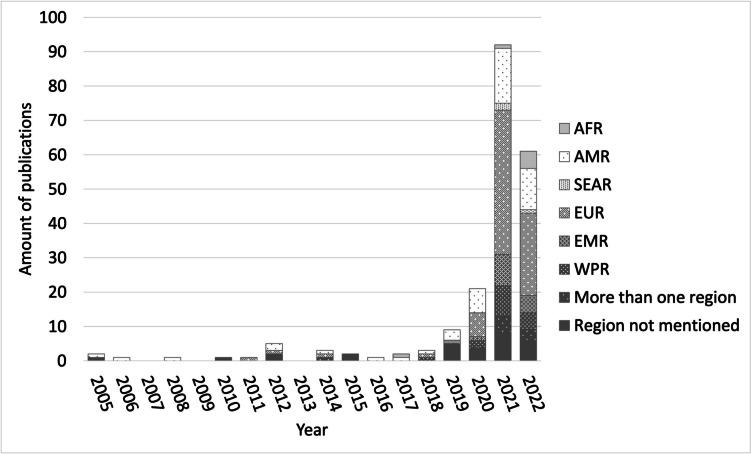
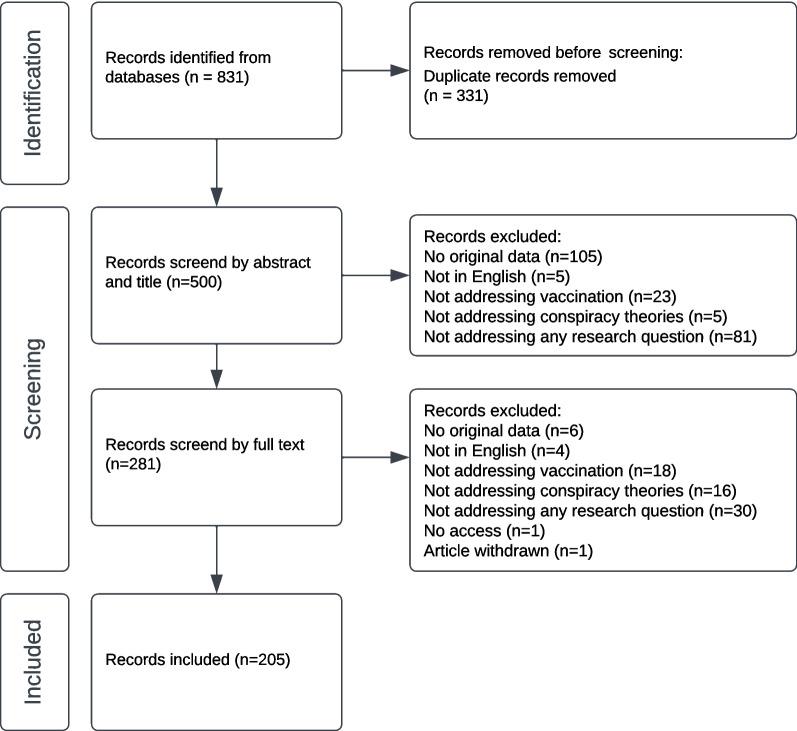
Believing conspiracy narratives is frequently assumed to be a major cause of vaccine hesitancy, i.e., the tendency to forgo vaccination despite its availability. In this scoping review, we synthesise and critically evaluate studies that assess i) the occurrence of vaccine-related conspiracy narratives on the internet, ii) the prevalence of belief in vaccine-related conspiracy narratives, iii) the relationship between belief in conspiracy narratives and vaccination intention or vaccination uptake, and iv) interventions that reduce the impact of conspiracy narratives on vaccination intention.In July 2022, we conducted a literature search using three databases: PubMed, PsychInfo, and Web of Science. Following the PRISMA approach, of the 500 initially identified articles, 205 were eligible and analysed.The majority of identified studies were conducted in Europe and North America, were published in 2021 and 2022, and investigated conspiracy narratives around the COVID-19 vaccination. The prevalence of belief in various vaccine-related conspiracy narratives varied greatly across studies, from 2 to 77%. We identified seven experimental studies investigating the effect of exposure to conspiracy narratives on vaccination intentions, of which six indicated a small negative effect. These findings are complemented by the evidence from over 100 correlative studies showing a significant negative relationship between conspiracy beliefs and vaccination intention or uptake. Additionally, the review identified interventions (e.g., social norm feedback, fact-checking labels, or prebunking) that decreased beliefs in vaccine-related conspiracy narratives and, in some cases, also increased vaccination intentions. Yet, these interventions had only small effects.In summary, the review revealed that vaccine-related conspiracy narratives have spread to varying degrees and can influence vaccination decisions. Causal relationships between conspiracy beliefs and vaccination intentions remain underexplored. Further, the review identified a need for more research on interventions that can reduce the impact of conspiracy narratives.
相信阴谋论通常被认为是疫苗犹豫的一个主要原因,即尽管疫苗可及,但仍不愿意接种。在这项范围综述中,我们综合并批判性地评估了研究,这些研究评估了:i)互联网上与疫苗相关的阴谋论叙述的发生情况,ii)对与疫苗相关的阴谋论叙述的信念的流行程度,iii)对阴谋论叙述的信念与接种意愿或接种率之间的关系,以及 iv)减少阴谋论对接种意愿影响的干预措施。2022 年 7 月,我们使用三个数据库(PubMed、PsychInfo 和 Web of Science)进行了文献检索。根据 PRISMA 方法,在最初确定的 500 篇文章中,有 205 篇符合条件并进行了分析。大多数确定的研究在欧洲和北美进行,发表于 2021 年和 2022 年,调查了围绕 COVID-19 疫苗接种的阴谋论。对各种与疫苗相关的阴谋论叙述的信念的流行程度在研究中差异很大,从 2%到 77%不等。我们确定了七项研究接种疫苗意向受暴露于阴谋论影响的实验研究,其中六项研究表明这种影响很小。这些发现得到了 100 多项相关性研究的证据的补充,这些研究表明阴谋信念与接种意愿或接种率之间存在显著的负相关关系。此外,该综述还确定了一些干预措施(例如,社会规范反馈、事实核查标签或预先劝阻)可以减少对与疫苗相关的阴谋论的信念,并且在某些情况下还可以提高接种意愿。然而,这些干预措施的效果很小。总之,该综述表明,与疫苗相关的阴谋论已经传播到不同程度,并可能影响疫苗接种决策。阴谋信念与接种意愿之间的因果关系仍未得到充分探索。此外,该综述还确定了需要进一步研究可以减少阴谋论影响的干预措施。
 Zotero 插件