
调查成年智力残疾患者中与疼痛相关的药物使用情况及其对多重用药的影响:一项系统综述。
Investigating pain-related medication use and contribution to polypharmacy in adults with intellectual disabilities: a systematic review.
作者信息
Pacitti Christine, Cairns Deborah, Ward Laura, Nicholl Barbara I
机构信息
School of Health & Wellbeing, University of Glasgow, Glasgow, G12 8TB, UK.
Scottish Learning Disabilities Observatory, School of Health & Wellbeing, University of Glasgow, Glasgow, G12 8TB, UK.
出版信息
BMC Med. 2024 Dec 2;22(1):565. doi: 10.1186/s12916-024-03770-9.
BACKGROUND
Adults with intellectual disability experience more pain than adults without and, despite a higher number of medications being prescribed, may be less likely to receive medication for pain. We conducted a systematic review of existing literature on medication for pain and painful conditions in adults with intellectual disability to explore if there is any association with polypharmacy, multimorbidity or demographic characteristics.
METHODS
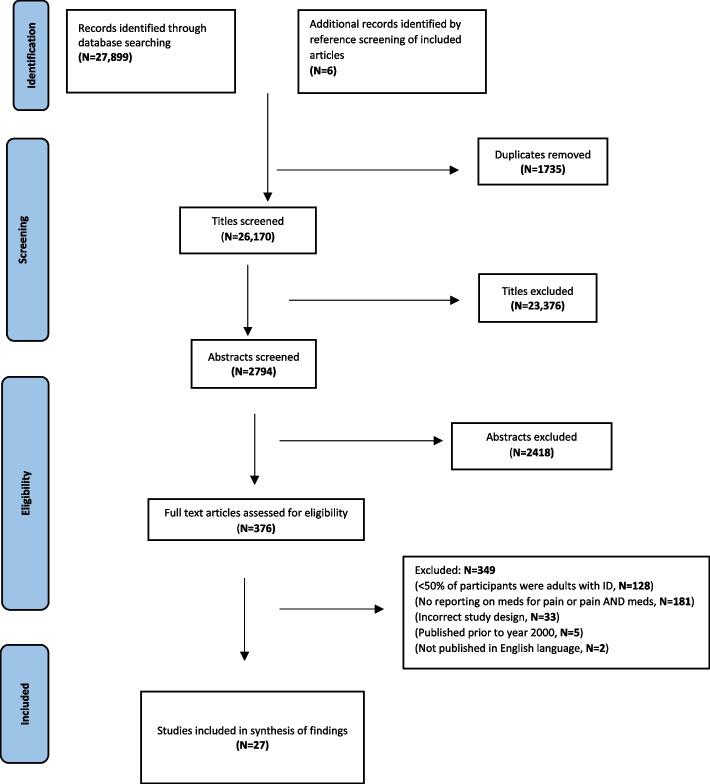
This systematic review followed PRISMA guidelines. Medline, Embase, PubMed, PsycINFO, Web of Science, CINAHL, Cochrane Library and Scopus were searched from January 2000 to 21st October 2024. We included original, peer-reviewed observational, qualitative or mixed-method studies published in English with data on medication for pain or painful conditions in adults with intellectual disability. Two independent reviewers performed study selection, data extraction, and quality assessment; disagreements were resolved by a third reviewer. Adapted Newcastle-Ottawa Scale or the Critical Appraisal Skills Programme for qualitative studies was used for quality assessment of included studies and findings were reported via narrative synthesis. PROSPERO registration: CRD42023415051.
RESULTS
Twenty-seven of 26,170 articles met the eligibility criteria. Adults with intellectual disability were more likely to have simple analgesic medication than non-steroidal anti-inflammatory drugs, opioids or adjuvant pain medications than the general population. Psychotropic medications were more commonly prescribed in adults with intellectual disability than medication for pain or painful conditions. Adults with intellectual disability and caregivers reported under-recognition and most likely under-treatment of pain.
CONCLUSIONS
Adults with intellectual disability may receive less pharmacological management of pain with analgesics and medication for painful conditions despite the high prevalence of polypharmacy, suggesting pain is under-treated. Better assessment and pharmacological treatment of pain and painful conditions is a key future research priority to address this health inequality and improve quality of life for this vulnerable group of people.
背景
与无智力残疾的成年人相比,有智力残疾的成年人经历的疼痛更多,尽管所开药物数量更多,但他们接受止痛药物治疗的可能性可能更低。我们对关于有智力残疾的成年人疼痛及疼痛性疾病用药的现有文献进行了系统综述,以探讨其与多重用药、多种疾病或人口统计学特征之间是否存在关联。
方法
本系统综述遵循PRISMA指南。检索了2000年1月至2024年10月21日期间的Medline、Embase、PubMed、PsycINFO、Web of Science、CINAHL、Cochrane图书馆和Scopus数据库。我们纳入了以英文发表的、经过同行评审的原创性观察性、定性或混合方法研究,这些研究包含有智力残疾的成年人疼痛及疼痛性疾病用药的数据。两名独立评审员进行研究筛选、数据提取和质量评估;分歧由第三名评审员解决。采用改编后的纽卡斯尔-渥太华量表或定性研究的批判性评估技能计划对纳入研究进行质量评估,并通过叙述性综合报告研究结果。PROSPERO注册号:CRD42023415051。
结果
26170篇文章中有27篇符合纳入标准。与普通人群相比,有智力残疾的成年人更有可能使用简单镇痛药,而非甾体抗炎药、阿片类药物或辅助性镇痛药的使用可能性较低。与用于疼痛或疼痛性疾病的药物相比,有智力残疾的成年人更常使用精神药物。有智力残疾的成年人及其照顾者报告称,疼痛未得到充分认识,很可能未得到充分治疗。
结论
尽管多重用药的发生率很高,但有智力残疾的成年人可能较少接受镇痛药和疼痛性疾病用药的药物治疗,这表明疼痛治疗不足。更好地评估和药物治疗疼痛及疼痛性疾病是未来研究解决这一健康不平等问题并改善这一弱势群体生活质量的关键优先事项。
 Zotero 插件