
舒噻美对中重度阻塞性睡眠呼吸暂停潜在生物标志物的影响。
The effect of sulthiame on potential biomarkers in moderate to severe obstructive sleep apnoea.
作者信息
Hoff Erik, Musovic Saliha, Komai Ali M, Zou Ding, Strassberger Christian, Stenlöf Kaj, Grote Ludger, Hedner Jan
机构信息
Centre for Sleep and Vigilance Disorders, Department of Internal Medicine and Clinical Nutrition, Institute of Medicine, Sahlgrenska Academy, University of Gothenburg, Gothenburg, Sweden.
Region Västra Götaland, Södra Älvsborgs Hospital, Department of Infectious Diseases, Borås, Sweden.
出版信息
ERJ Open Res. 2024 Dec 2;10(6). doi: 10.1183/23120541.00342-2024. eCollection 2024 Nov.
BACKGROUND
Obstructive sleep apnoea (OSA) is a common disease with breathing disturbances during sleep. Sulthiame (STM), a carbonic anhydrase (CA) inhibitor, was recently shown to reduce OSA in a significant proportion of patients. CA activity and hypoxia-inducible factor (HIF)-1α are two potential biomarkers reported in severe OSA and hypoxia. Both have been considered to play roles in the development of OSA comorbidities. This study investigated the effects of STM on these biomarkers in OSA.
METHODS
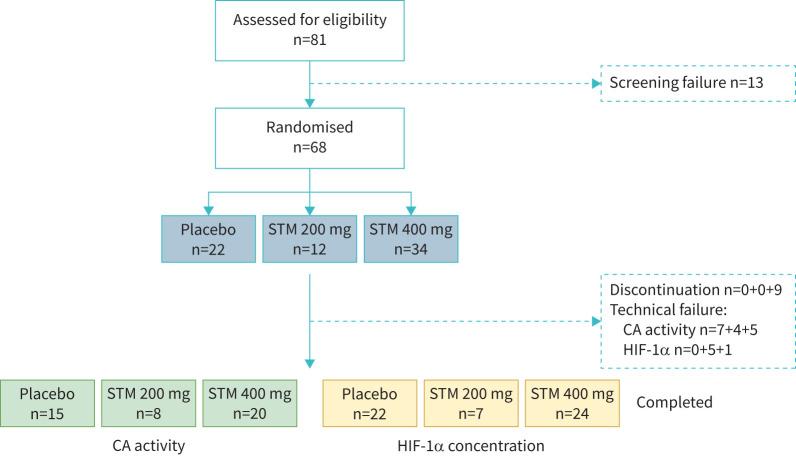
This was an exploratory analysis of a randomised, double-blind, placebo-controlled trial of STM in OSA. Patients with moderate to severe OSA, body mass index 20-35 kg·m, aged 18-75 years and not accepting positive airway pressure treatment were randomised to 4 weeks with placebo, STM 200 mg or STM 400 mg. CA activity (n=43) and HIF-1α concentration (n=53) were determined at baseline, after 4 weeks of treatment and 2 weeks after treatment completion.
RESULTS
In the 400 mg group, both CA activity and HIF-1α concentration were reduced (median difference -26% (95% CI -32- -12%) and -4% (95% CI -8- -2%); both p<0.05 placebo). The reductions were sustained 2 weeks after treatment completion. In the 200 mg group, both CA activity and HIF-1α were numerically reduced. The STM-induced reductions in CA activity and HIF-1α correlated significantly (r=0.443, p=0.023).
CONCLUSIONS
STM treatment in OSA induced a reduction of both CA activity and HIF-1α concentration. The effects remained 2 weeks after treatment completion, suggesting prolonged effects of STM in OSA.
背景
阻塞性睡眠呼吸暂停(OSA)是一种常见疾病,睡眠期间存在呼吸紊乱。舒噻美(STM)是一种碳酸酐酶(CA)抑制剂,最近研究表明其可使相当一部分患者的OSA症状减轻。CA活性和缺氧诱导因子(HIF)-1α是重度OSA和缺氧情况下报告的两种潜在生物标志物。二者均被认为在OSA合并症的发生发展中起作用。本研究调查了STM对OSA患者这些生物标志物的影响。
方法
这是一项对STM治疗OSA的随机、双盲、安慰剂对照试验的探索性分析。中度至重度OSA患者,体重指数20 - 35 kg·m²,年龄18 - 75岁且不接受气道正压治疗,被随机分为接受4周安慰剂、200 mg STM或400 mg STM治疗。在基线、治疗4周后以及治疗结束后2周测定CA活性(n = 43)和HIF-1α浓度(n = 53)。
结果
在400 mg组中,CA活性和HIF-1α浓度均降低(中位数差异分别为-26%(95%CI -32 - -12%)和-4%(95%CI -8 - -2%);与安慰剂相比,二者p均<0.05)。治疗结束后2周这些降低仍持续存在。在200 mg组中,CA活性和HIF-1α在数值上均有所降低。STM诱导的CA活性和HIF-1α降低显著相关(r = 0.443,p = 0.023)。
结论
OSA患者接受STM治疗可使CA活性和HIF-1α浓度均降低。治疗结束后2周这些影响仍然存在,提示STM对OSA有持久作用。



 Zotero 插件