
中国中老年人可改变的风险因素与认知功能之间的关联:纵向数据和生存数据的联合建模
Associations between modifiable risk factors and cognitive function in middle-aged and older Chinese adults: joint modelling of longitudinal and survival data.
作者信息
Ran Qin, Yang Fang, Su Qin, Li Peng, Hu Yaoyue
机构信息
School of Public Health, Chongqing Medical University, Chongqing, China.
Max Planck Institute for Demographic Research, Rostock, Germany.
出版信息
Front Public Health. 2024 Nov 18;12:1485556. doi: 10.3389/fpubh.2024.1485556. eCollection 2024.
BACKGROUND
Stronger associations between modifiable risk factors and cognitive function have been found in younger than older adults. This age pattern may be subject to mortality selection and non-ignorable missingness caused by dropouts due to death, but this remains unclear.
METHODS
Longitudinal data from 9,562 adults aged 50 and older from Waves 1-4 (2011-2018) of the China Health and Retirement Longitudinal Study were used. Cognitive function was assessed repeatedly using a battery of cognitive tests. Joint models of longitudinal and survival data were applied to examine the associations of modifiable risk factors with cognitive function and mortality.
RESULTS
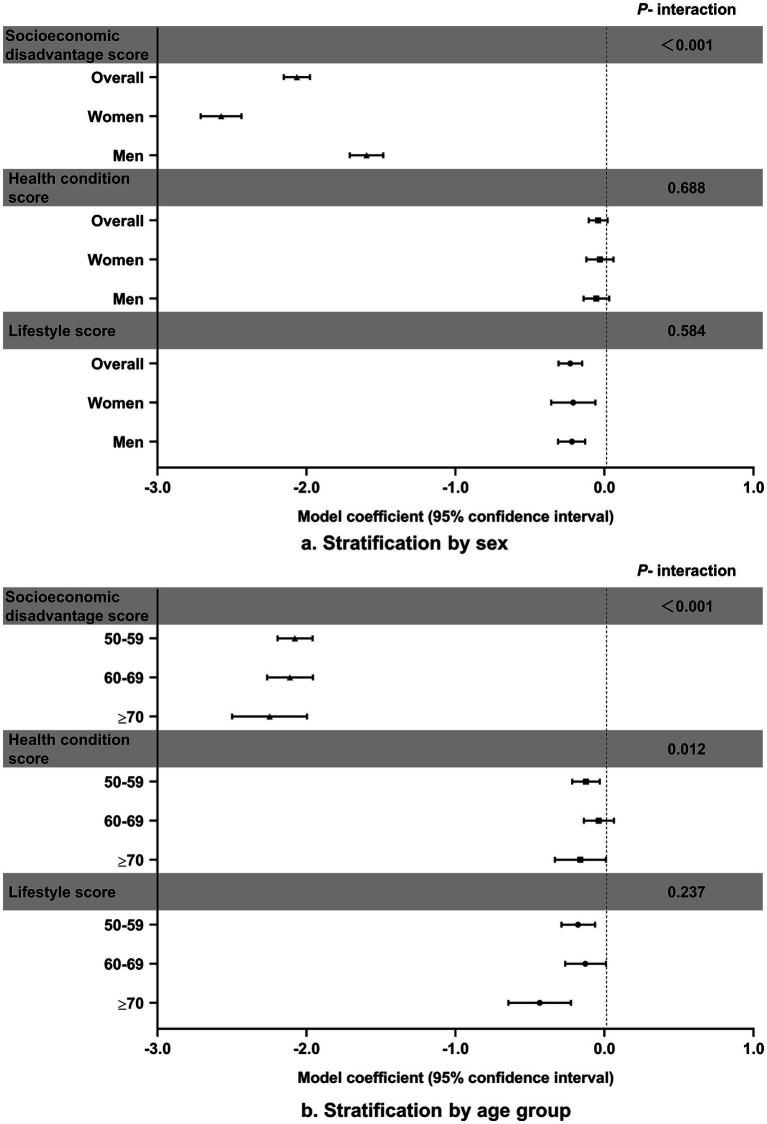
Worse cognitive function score was associated with being female (coefficient[] = -1.669, 95% confidence interval [CI]: -1.830, -1.511, < 0.001), low education ( = -2.672, 95%CI: -2.813, -2.530, < 0.001), rural residence ( = -1.204, 95%CI: -1.329, -1.074, < 0.001), stroke ( = -0.451, 95%CI: -0.857, -0.051, = 0.030), probable depression ( = -1.084, 95%CI: -1.226, -0.941, < 0.001), and current smoking ( = -0.284, 95%CI: -0.437, -0.133, < 0.001); whereas dyslipidaemia ( = 0.415, 95% CI: 0.207, 0.626, < 0.001), heart disease ( = 0.513, 95% CI: 0.328, 0.698, < 0.001), overweight ( = 0.365, 95% CI: 0.224, 0.506, < 0.001) and obesity ( = 0.264, 95% CI: 0.048, 0.473, = 0.014) were associated with better cognitive function. These associations changed less than 5% when the longitudinal and survival data were modelled separately. An increase in cognitive function over age was associated with reduced mortality risk (hazard ratio: 0.418, 95%CI: 0.333, 0.537, < 0.001). The association between socioeconomic disadvantage and cognitive function was more evident in women than in men, while the associations of socioeconomic disadvantage and lifestyle with cognitive function increased with age.
CONCLUSION
Mortality selection and non-ignorable missingness caused by dropouts due to death played a minor role in the associations between modifiable risk factors and cognitive function in middle-aged and older Chinese adults.
背景
在年轻人中,可改变的风险因素与认知功能之间的关联比老年人更强。这种年龄模式可能受到死亡率选择以及因死亡导致的失访所引起的不可忽视的缺失值影响,但情况仍不明确。
方法
使用了来自中国健康与养老追踪调查第1 - 4轮(2011 - 2018年)的9562名50岁及以上成年人的纵向数据。通过一系列认知测试反复评估认知功能。应用纵向和生存数据的联合模型来检验可改变风险因素与认知功能及死亡率之间的关联。
结果
较差的认知功能得分与女性(系数[] = -1.669,95%置信区间[CI]:-1.830,-1.511,<0.001)、低教育水平( = -2.672,95%CI:-2.813,-2.530,<0.001)、农村居住( = -1.204,95%CI:-1.329,-1.074,<0.001)、中风( = -0.451,95%CI:-0.857,-0.051, = 0.030)、可能的抑郁症( = -1.084,95%CI:-1.226,-0.941,<0.001)以及当前吸烟( = -0.284,95%CI:-0.437,-0.133,<0.001)相关;而血脂异常( = 0.415,95%CI:0.207,0.626,<0.001)、心脏病( = 0.513,95%CI:0.328,0.698,<0.001)、超重( = 0.365,95%CI:0.224,0.506,<0.001)和肥胖( = 0.264,95%CI:0.048,0.473, = 0.014)与较好的认知功能相关。当分别对纵向和生存数据进行建模时,这些关联的变化小于5%。认知功能随年龄增长与死亡风险降低相关(风险比:0.418,95%CI:0.333,0.537,<0.001)。社会经济劣势与认知功能之间的关联在女性中比男性更明显,而社会经济劣势和生活方式与认知功能的关联随年龄增长而增加。
结论
在中年及老年中国成年人中,因死亡导致的失访所引起的死亡率选择和不可忽视的缺失值在可改变风险因素与认知功能之间的关联中作用较小。
 Zotero 插件