
探索树叶提取物对小鼠体内疟原虫的抗疟潜力。
Exploring the Antimalarial Potential of Leaf Extract Against in Mice.
作者信息
Ounjaijean Sakaewan, Somsak Voravuth
机构信息
Research Institute for Health Sciences, Chiang Mai University, Chiang Mai 50200, Thailand.
School of Allied Health Sciences, Walailak University, Nakhon Si Thammarat 80160, Thailand.
出版信息
J Trop Med. 2024 Nov 23;2024:3471083. doi: 10.1155/jotm/3471083. eCollection 2024.
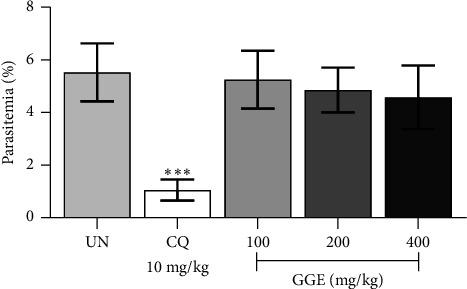
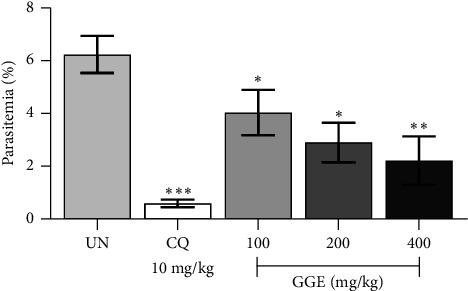
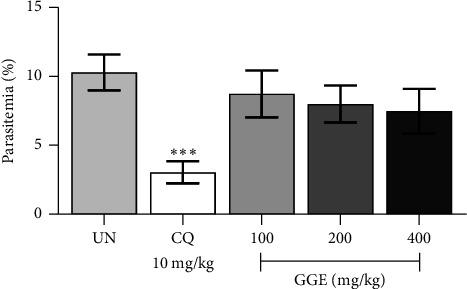
Malaria remains a critical global health issue, particularly in tropical and subtropical regions. The disease, caused by parasites, is transmitted by mosquitoes and can lead to severe complications and death if untreated. The emergence of drug-resistant strains highlights the urgent need for new antimalarial agents. , a plant native to Southeast Asia, has shown promise due to its rich bioactive compounds. This study aims to evaluate the suppressive, curative, and prophylactic antimalarial potential of leaf extract (GGE) against in mice. GGE was prepared using a combination of hot water extraction and microwave-assisted heating. Acute toxicity tests revealed no significant adverse effects at a dose of 3000 mg/kg. The doses of 100, 200, and 400 mg/kg were selected based on preliminary toxicity assessments to systematically investigate the dose-dependent antimalarial efficacy of the extract. Suppressive tests showed that GGE at doses of 100, 200, and 400 mg/kg significantly reduced parasitemia levels, with the highest dose achieving a 63.97% inhibition. In these tests, GGE also increased the mean survival time (MST) of treated mice compared to untreated controls. However, GGE did not exhibit significant curative effects, as parasitemia levels in the treated groups were similar to the untreated control group. Prophylactic tests indicated that GGE pretreatment did not significantly reduce parasitemia levels or improve MST compared to controls, unlike chloroquine (CQ), which demonstrated potent prophylactic efficacy with a significant increase in MST. These findings suggest that while GGE has notable suppressive antimalarial activity, it does not exhibit strong curative or prophylactic effects at the tested doses. This study contributes to the understanding of plant-based antimalarial agents and underscores the importance of continued exploration of natural products for malaria treatment.
疟疾仍然是一个严重的全球健康问题,尤其是在热带和亚热带地区。这种由寄生虫引起的疾病通过蚊子传播,如果不治疗,可能会导致严重的并发症甚至死亡。耐药菌株的出现凸显了对新型抗疟药物的迫切需求。[植物名称]是一种原产于东南亚的植物,由于其富含生物活性化合物而显示出应用前景。本研究旨在评估[植物名称]叶提取物(GGE)对小鼠体内[疟原虫名称]的抑制、治疗和预防疟疾的潜力。GGE采用热水提取和微波辅助加热相结合的方法制备。急性毒性试验表明,在剂量为3000 mg/kg时没有显著的不良反应。根据初步毒性评估选择了100、200和400 mg/kg的剂量,以系统地研究提取物的剂量依赖性抗疟效果。抑制试验表明,100、200和400 mg/kg剂量的GGE显著降低了疟原虫血症水平,最高剂量达到了63.97%的抑制率。在这些试验中,与未治疗的对照组相比,GGE还延长了治疗小鼠的平均存活时间(MST)。然而,GGE没有表现出显著的治疗效果,因为治疗组的疟原虫血症水平与未治疗的对照组相似。预防试验表明,与对照组相比,GGE预处理并没有显著降低疟原虫血症水平或改善MST,这与氯喹(CQ)不同,氯喹显示出强大的预防效果,MST显著增加。这些发现表明,虽然GGE具有显著的抑制疟疾活性,但在测试剂量下它没有表现出强大的治疗或预防效果。本研究有助于对植物源抗疟药物的理解,并强调了继续探索天然产物用于疟疾治疗的重要性。


 Zotero 插件