
美国成年人家庭收入与贫困率之比与严重头痛/偏头痛之间的关联:来自1999 - 2004年美国国家健康与营养检查调查(NHANES)的数据。
Association between family income to poverty ratio and severe headache/migraine in the American adults: data from NHANES 1999-2004.
作者信息
Sun Lingling, Zhao Rongjian, You Xuemei, Meng Junpeng, Meng Lin, Di Haili
机构信息
Department of Neurology, Northwest University First Hospital, Xi'an, China.
出版信息
Front Neurol. 2024 Nov 18;15:1427277. doi: 10.3389/fneur.2024.1427277. eCollection 2024.
BACKGROUND
The relationship between family income to poverty ratio (PIR) and severe headache/migraine remains unclear.
METHODS
Data for this cross-sectional study were obtained from NHANES 1999-2004. PIR was the exposure variable, and severe headache/migraine was the dependent variable. We performed univariate analyses of severe headache/migraine, PIR, and other covariates. The association between PIR and severe headache/migraine was tested using multiple regression models. Furthermore, interaction tests and stratified analyses assessed the relationship between PIR and severe headache/migraine across subgroups.
RESULTS
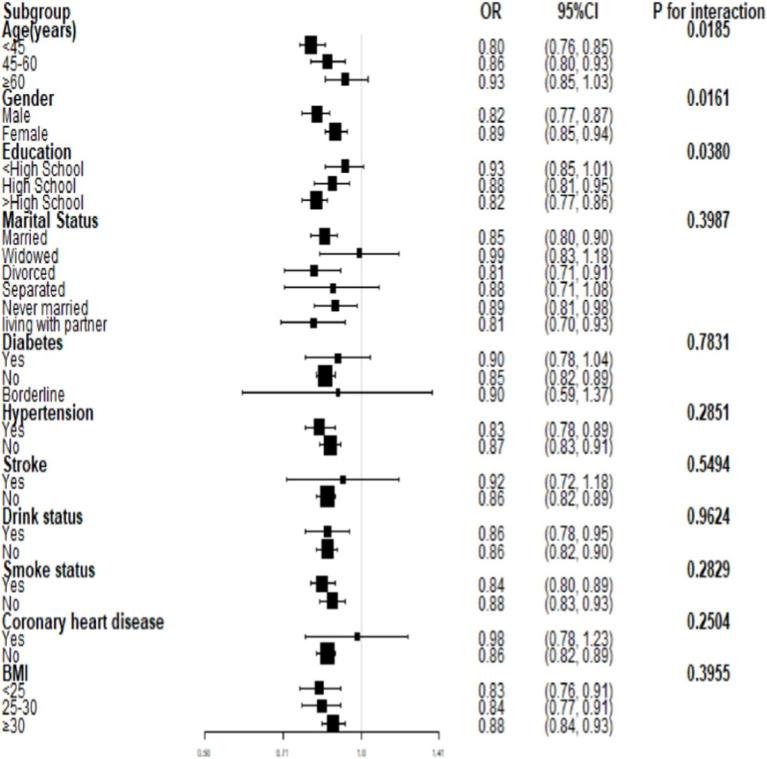
There were a total of 8,800 participants: 4,833 (54.92%) males and 3,967 (45.08%) females, 1,714 (19.48%) with severe headache/migraine and 7,086 (80.52%) without severe headache/migraine. After adjustment for all variables, PIR negatively correlated with severe headache/migraine OR = 0.86 95% CI (0.83, 0.90) < 0.0001. The variable PIR was categorized as the low-income (PIR < 1), the middle-income (PIR1-4), and the high-income (PIR > 4). Notably, there was a significant difference in trend for the high-income group (PIR > 4) compared to the control low-income group (PIR < 1) (all for interaction<0.05). Dose-response correlations were also analyzed using smoothed curve fitting, revealing a negative correlation between PIR and severe headache/migraine ( < 0.0001). Subgroup analysis results indicated that the negative association between PIR and severe headache/migraine was more pronounced in the following populations: males (OR = 0.84 95% CI (0.79, 0.90), <60 years old [Age < 45 group OR = 0.81 95% CI (0.76, 0.85)], Age 45-60 group OR = 0.86 95% CI (0.79, 0.93), and those with education levels ≥high school [High School OR = 0.87 95% CI (0.81, 0.95), >High School OR = 0.82 95% CI (0.78, 0.87)].
CONCLUSION
There is a negative correlation between PIR and the incidence of severe headaches/ migraine in Americans aged 20 years or older. This study has implications for the comprehensive management of patients with severe headache/migraine.
背景
家庭收入与贫困率(PIR)和严重头痛/偏头痛之间的关系尚不清楚。
方法
本横断面研究的数据来自1999 - 2004年的美国国家健康与营养检查调查(NHANES)。PIR为暴露变量,严重头痛/偏头痛为因变量。我们对严重头痛/偏头痛、PIR和其他协变量进行了单变量分析。使用多元回归模型检验PIR与严重头痛/偏头痛之间的关联。此外,交互作用检验和分层分析评估了各亚组中PIR与严重头痛/偏头痛之间的关系。
结果
共有8800名参与者:男性4833名(54.92%),女性3967名(45.08%);1714名(19.48%)有严重头痛/偏头痛,7086名(80.52%)无严重头痛/偏头痛。在对所有变量进行调整后,PIR与严重头痛/偏头痛呈负相关,OR = 0.86,95%可信区间(0.83,0.90),P < 0.0001。PIR变量分为低收入组(PIR < 1)、中等收入组(PIR 1 - 4)和高收入组(PIR > 4)。值得注意的是,与对照低收入组(PIR < 1)相比,高收入组(PIR > 4)在趋势上存在显著差异(所有交互作用P < 0.05)。还使用平滑曲线拟合分析了剂量反应相关性,结果显示PIR与严重头痛/偏头痛之间呈负相关(P < 0.0001)。亚组分析结果表明,PIR与严重头痛/偏头痛之间的负相关在以下人群中更为明显:男性(OR = 0.84,95%可信区间(0.79,0.90))、年龄<60岁[年龄<45岁组OR = 0.81,95%可信区间(0.76,0.85)]、年龄45 - 60岁组OR = 0.86,95%可信区间(0.79,0.93)以及教育水平≥高中的人群[高中组OR = 0.87,95%可信区间(0.81,0.95),>高中组OR = 0.82,95%可信区间(0.78,0.87)]。
结论
在美国20岁及以上人群中,PIR与严重头痛/偏头痛的发病率呈负相关。本研究对严重头痛/偏头痛患者的综合管理具有启示意义。


 Zotero 插件