
细胞唾液酸聚糖对于严重急性呼吸综合征冠状病毒2(SARS-CoV-2)在肺细胞系中的内体和细胞表面进入具有不同需求。
Cellular sialoglycans are differentially required for endosomal and cell-surface entry of SARS-CoV-2 in lung cell lines.
作者信息
Siwak Kimberley C, LeBlanc Emmanuelle V, Scott Heidi M, Kim Youjin, Pellizzari-Delano Isabella, Ball Alice M, Temperton Nigel J, Capicciotti Chantelle J, Colpitts Che C
机构信息
Department of Biomedical and Molecular Sciences, Queen's University, Kingston, Canada.
Viral Pseudotype Unit, Medway School of Pharmacy, University of Kent and Greenwich at Medway, Chatham, United Kingdom.
出版信息
PLoS Pathog. 2024 Dec 3;20(12):e1012365. doi: 10.1371/journal.ppat.1012365. eCollection 2024 Dec.
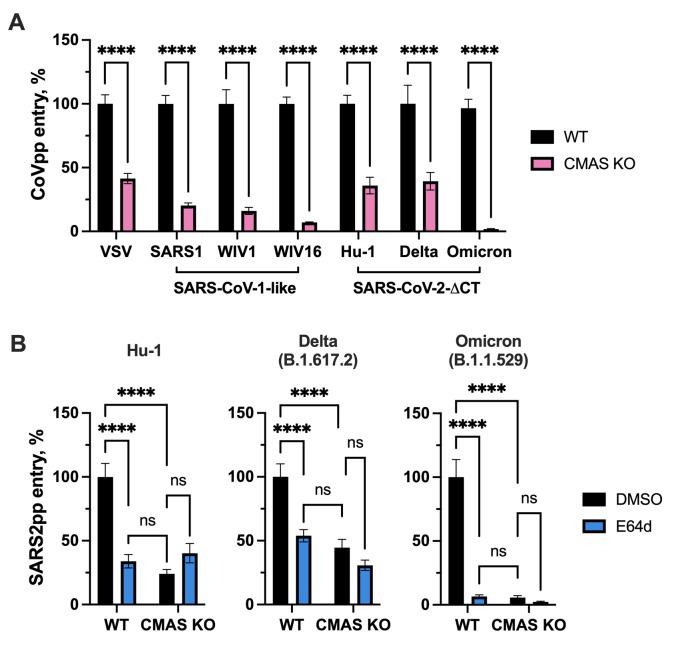
Cell entry of severe acute respiratory coronavirus-2 (SARS-CoV-2) and other CoVs can occur via two distinct routes. Following receptor binding by the spike glycoprotein, membrane fusion can be triggered by spike cleavage either at the cell surface in a transmembrane serine protease 2 (TMPRSS2)-dependent manner or within endosomes in a cathepsin-dependent manner. Cellular sialoglycans have been proposed to aid in CoV attachment and entry, although their functional contributions to each entry pathway are unknown. In this study, we used genetic and enzymatic approaches to deplete sialic acid from cell surfaces and compared the requirement for sialoglycans during endosomal and cell-surface CoV entry using lentiviral particles pseudotyped with the spike proteins of different sarbecoviruses. We show that entry of SARS-CoV-1, WIV1-CoV and WIV16-CoV, like the SARS-CoV-2 omicron variant, depends on endosomal cathepsins and requires cellular sialoglycans for entry. Ancestral SARS-CoV-2 and the delta variant can use either pathway for entry, but only require sialic acid for endosomal entry in cells lacking TMPRSS2. Binding of SARS-CoV-2 spike protein to cells did not require sialic acid, nor was sialic acid required for SARS-CoV-2 entry in TMRPSS2-expressing cells. These findings suggest that cellular sialoglycans are not strictly required for SARS-CoV-2 attachment, receptor binding or fusion, but rather promote endocytic entry of SARS-CoV-2 and related sarbecoviruses. In contrast, the requirement for sialic acid during entry of MERS-CoV pseudoparticles and authentic HCoV-OC43 was not affected by TMPRSS2 expression, consistent with a described role for sialic acid in merbecovirus and embecovirus cell attachment. Overall, these findings clarify the role of sialoglycans in SARS-CoV-2 entry and suggest that cellular sialoglycans mediate endosomal, but not cell-surface, SARS-CoV-2 entry.
严重急性呼吸综合征冠状病毒2(SARS-CoV-2)及其他冠状病毒进入细胞可通过两种不同途径。在刺突糖蛋白与受体结合后,刺突蛋白的切割可触发膜融合,其方式要么是在细胞表面以跨膜丝氨酸蛋白酶2(TMPRSS2)依赖的方式进行,要么是在内体中以组织蛋白酶依赖的方式进行。细胞唾液酸聚糖已被认为有助于冠状病毒的附着和进入,尽管它们对每种进入途径的功能贡献尚不清楚。在本研究中,我们使用基因和酶学方法从细胞表面去除唾液酸,并使用不同沙贝病毒刺突蛋白假型化的慢病毒颗粒,比较了内体和细胞表面冠状病毒进入过程中对唾液酸聚糖的需求。我们发现,与SARS-CoV-2奥密克戎变异株一样,SARS-CoV-1、WIV1-CoV和WIV16-CoV的进入依赖内体组织蛋白酶,且进入需要细胞唾液酸聚糖。原始SARS-CoV-2和德尔塔变异株可以使用任何一种途径进入细胞,但仅在缺乏TMPRSS2的细胞中内体进入时需要唾液酸。SARS-CoV-2刺突蛋白与细胞的结合不需要唾液酸,在表达TMRPSS2的细胞中SARS-CoV-2进入也不需要唾液酸。这些发现表明,细胞唾液酸聚糖对于SARS-CoV-2的附着、受体结合或融合并非严格必需,而是促进SARS-CoV-2及相关沙贝病毒的内吞进入。相比之下,MERS-CoV假病毒颗粒和真性人冠状病毒OC43进入过程中对唾液酸的需求不受TMPRSS2表达的影响,这与唾液酸在沙贝病毒和恩贝病毒细胞附着中所描述的作用一致。总体而言,这些发现阐明了唾液酸聚糖在SARS-CoV-2进入中的作用,并表明细胞唾液酸聚糖介导SARS-CoV-2的内体进入,但不介导细胞表面进入。




 Zotero 插件