
磷酸化介导的构象变化调节人类SLFN11。
Phosphorylation-mediated conformational change regulates human SLFN11.
作者信息
Kugler Michael, Metzner Felix J, Witte Gregor, Hopfner Karl-Peter, Lammens Katja
机构信息
Gene Center and Department of Biochemistry, Ludwig-Maximilians-Universität München, Feodor-Lynen Straße 25, 81377, Munich, Germany.
出版信息
Nat Commun. 2024 Dec 3;15(1):10500. doi: 10.1038/s41467-024-54833-7.
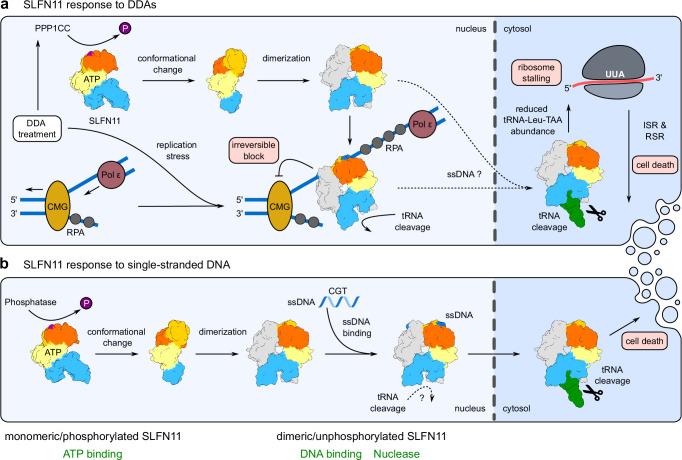
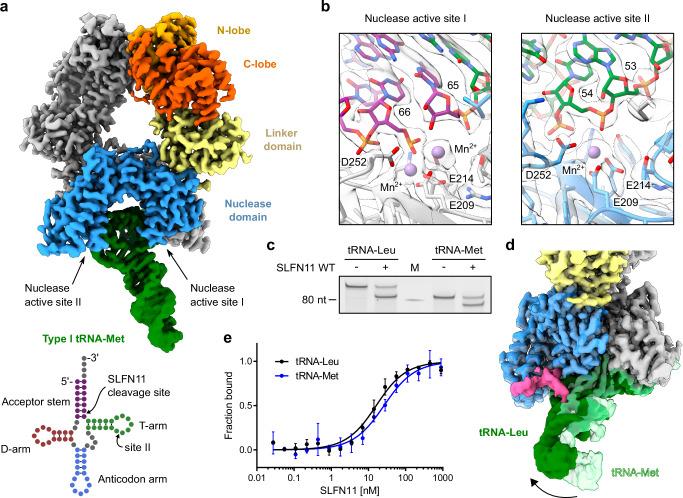
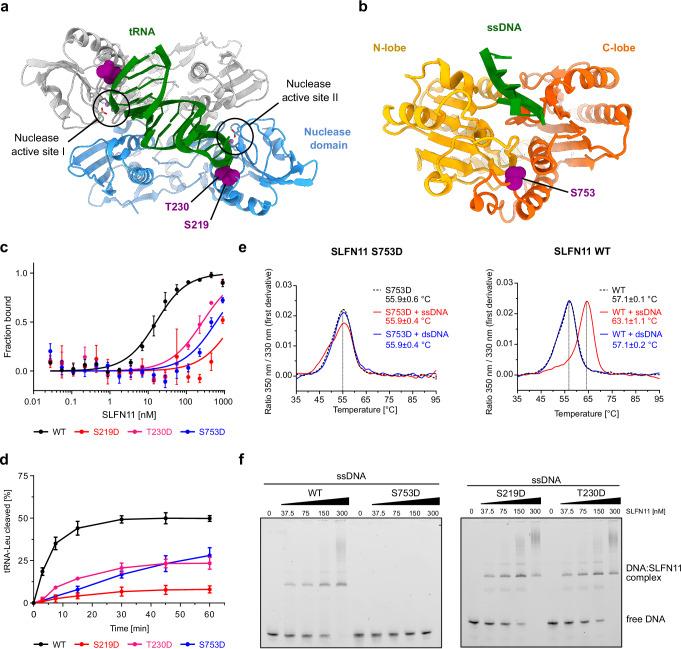
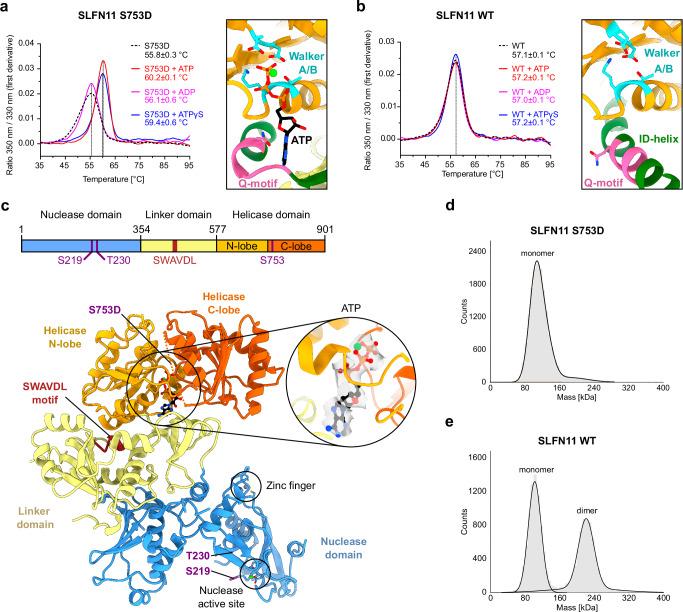
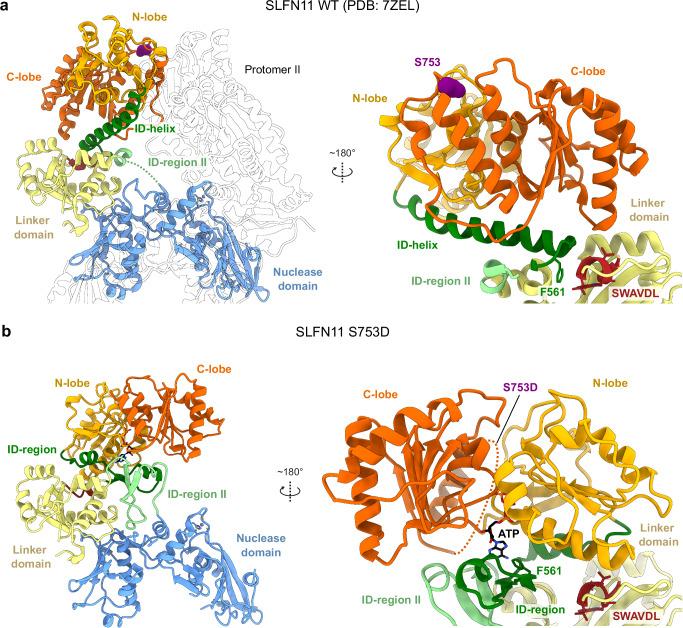
Human Schlafen 11 (SLFN11) is sensitizing cells to DNA damaging agents by irreversibly blocking stalled replication forks, making it a potential predictive biomarker in chemotherapy. Furthermore, SLFN11 acts as a pattern recognition receptor for single-stranded DNA (ssDNA) and functions as an antiviral restriction factor, targeting translation in a codon-usage-dependent manner through its endoribonuclease activity. However, the regulation of the various SLFN11 functions and enzymatic activities remains enigmatic. Here, we present cryo-electron microscopy (cryo-EM) structures of SLFN11 bound to tRNA-Leu and tRNA-Met that give insights into tRNA binding and cleavage, as well as its regulation by phosphorylation at S219 and T230. SLFN11 phosphomimetic mutant S753D adopts a monomeric conformation, shows ATP binding, but loses its ability to bind ssDNA and shows reduced ribonuclease activity. Thus, the phosphorylation site S753 serves as a conformational switch, regulating SLFN11 dimerization, as well as ATP and ssDNA binding, while S219 and T230 regulate tRNA recognition and nuclease activity.
人类 Schlafen 11(SLFN11)通过不可逆地阻断停滞的复制叉使细胞对 DNA 损伤剂敏感,这使其成为化疗中一种潜在的预测生物标志物。此外,SLFN11 作为单链 DNA(ssDNA)的模式识别受体,并作为一种抗病毒限制因子,通过其核糖核酸内切酶活性以密码子使用依赖的方式靶向翻译。然而,SLFN11 各种功能和酶活性的调控仍然未知。在这里,我们展示了与 tRNA-Leu 和 tRNA-Met 结合的 SLFN11 的冷冻电子显微镜(cryo-EM)结构,这些结构揭示了 tRNA 结合和切割以及其在 S219 和 T230 处磷酸化的调控情况。SLFN11 磷酸模拟突变体 S753D 采用单体构象,显示出 ATP 结合,但失去了结合 ssDNA 的能力并表现出降低的核糖核酸酶活性。因此,磷酸化位点 S753 作为一种构象开关,调节 SLFN11 的二聚化以及 ATP 和 ssDNA 结合,而 S219 和 T230 调节 tRNA 识别和核酸酶活性。

 Zotero 插件