
揭示赖氨酸特异性去甲基化酶1(LSD1)在肿瘤免疫中的双重作用:固有免疫和适应性免疫途径
Unlocking the dual role of LSD1 in tumor immunity: innate and adaptive pathways.
作者信息
Zhang Yu, Guo Ningjie, Zhu Haoyi, Liu Mengyang, Hao Jiahui, Wang Shoukai, Guo Ting, Mamun Maa, Pang Jingru, Liu Qi, Zheng Yichao, Liu Hongmin, Si Pilei, Zhao Lijuan
机构信息
State Key Laboratory of Esophageal Cancer Prevention & Treatment; Key Laboratory of Advanced Drug Preparation Technologies, Ministry of Education of China; Key Laboratory of Henan Province for Drug Quality and Evaluation, Henan Province; School of Pharmaceutical Sciences; Academy of Medical Sciences; Tianjian Laboratory of Advanced Biomedical Sciences; Zhengzhou University, Zhengzhou, Henan 450001, China.
XNA platform, School of Pharmaceutical Sciences, Zhengzhou University, Zhengzhou, Henan 450001, China.
出版信息
Theranostics. 2024 Oct 21;14(18):7054-7071. doi: 10.7150/thno.102037. eCollection 2024.
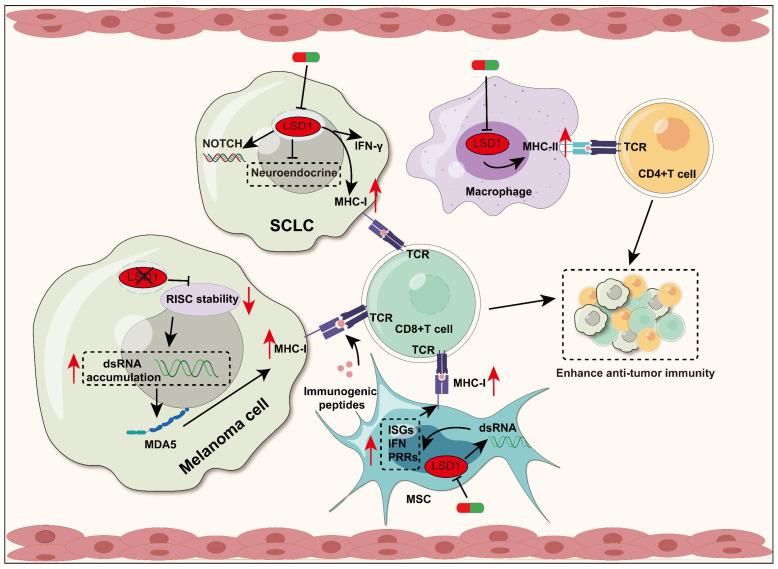
The roles of innate and adaptive immunity are crucial in both the development of cancer and its response to treatment. Numerous studies have demonstrated that histone lysine-specific demethylase 1 (LSD1) is overexpressed in various cancers. Elevated levels of LSD1 intricately modulate immune checkpoints, the function of immune cells, and the expression of immunomodulators, impacting both innate and adaptive immunity. Moreover, compelling evidence suggests that inhibiting LSD1 enhances tumor immunity, suppresses tumor growth, and improves the effectiveness of immunotherapy. However, a comprehensive classification of LSD1's role in both innate and adaptive immunity is lacking. In this review, we outline the role of LSD1 in tumor immunity in terms of both innate and adaptive immunity, summarizing the mechanisms associated with LSD1-mediated tumor immunity and its potential regulatory capacity in tumor immune escape. Finally, we summarize the research status of LSD1 inhibitors in tumor immunotherapy, which be valuable for promoting the development of effective LSD1-targeted agents used as combination immunotherapy drugs.
固有免疫和适应性免疫在癌症的发展及其对治疗的反应中都起着至关重要的作用。大量研究表明,组蛋白赖氨酸特异性去甲基化酶1(LSD1)在多种癌症中均有过表达。LSD1水平的升高会复杂地调节免疫检查点、免疫细胞的功能以及免疫调节剂的表达,从而影响固有免疫和适应性免疫。此外,有力证据表明,抑制LSD1可增强肿瘤免疫、抑制肿瘤生长并提高免疫治疗的效果。然而,目前缺乏对LSD1在固有免疫和适应性免疫中作用的全面分类。在这篇综述中,我们从固有免疫和适应性免疫两个方面概述了LSD1在肿瘤免疫中的作用,总结了与LSD1介导的肿瘤免疫相关的机制及其在肿瘤免疫逃逸中的潜在调节能力。最后,我们总结了LSD1抑制剂在肿瘤免疫治疗中的研究现状,这对于推动开发用作联合免疫治疗药物的有效LSD1靶向药物具有重要价值。



 Zotero 插件