
一种针对成纤维细胞活化蛋白的疫苗通过防止肌成纤维细胞的积累改善小鼠心脏纤维化。
A Vaccine Against Fibroblast Activation Protein Improves Murine Cardiac Fibrosis by Preventing the Accumulation of Myofibroblasts.
作者信息
Yoshida Shota, Hayashi Hiroki, Kawahara Takuro, Katsuki Shunsuke, Kimura Mitsukuni, Hino Rissei, Sun Jiao, Nakamaru Ryo, Tenma Akiko, Toyoura Masayoshi, Baba Satoshi, Shimamura Munehisa, Katsuya Tomohiro, Morishita Ryuichi, Rakugi Hiromi, Matoba Tetsuya, Nakagami Hironori
机构信息
Department of Geriatric and General Medicine (S.Y., S.B., H.R.), Osaka University Graduate School of Medicine, Japan.
Department of Health Development and Medicine (S.Y., H.H., J.S., S.B., H.N.), Osaka University Graduate School of Medicine, Japan.
出版信息
Circ Res. 2025 Jan 3;136(1):26-40. doi: 10.1161/CIRCRESAHA.124.325017. Epub 2024 Dec 4.
BACKGROUND
Myofibroblasts are primary cells involved in chronic response-induced cardiac fibrosis. Fibroblast activation protein (FAP) is a relatively specific marker of activated myofibroblasts and a potential target molecule. This study aimed to clarify whether a vaccine targeting FAP could eliminate myofibroblasts in chronic cardiac stress model mice and reduce cardiac fibrosis.
METHODS
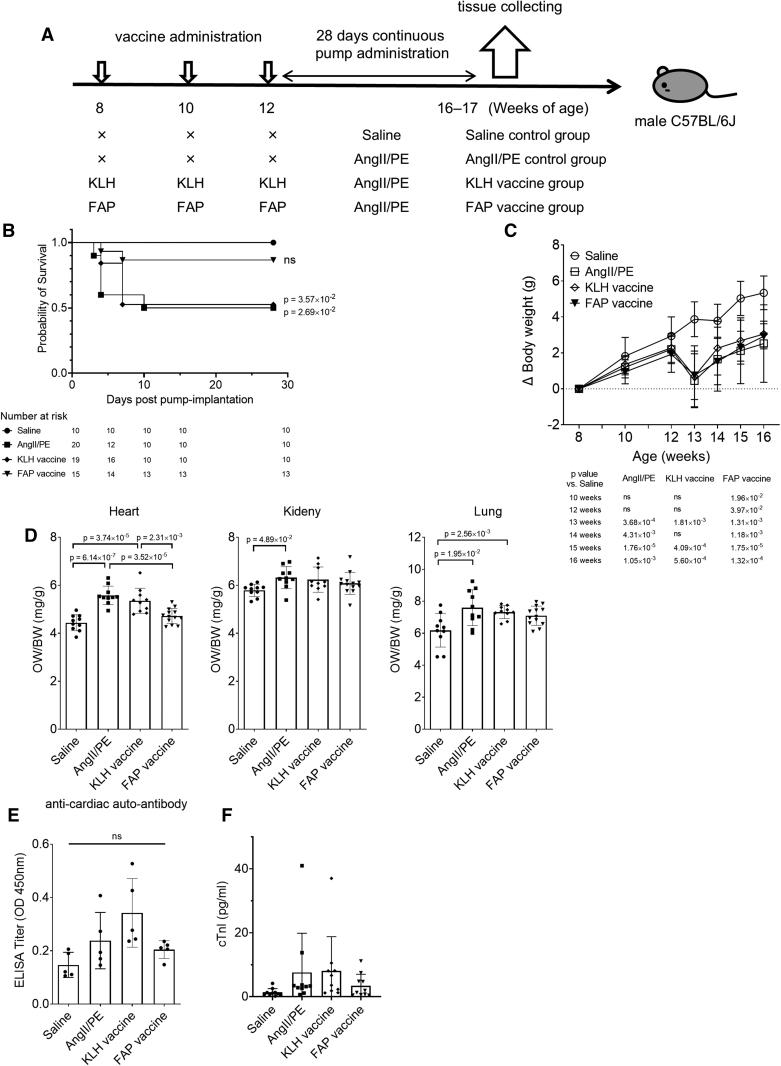
We coadministered a FAP peptide vaccine with a cytosine-phosphate-guanine (CpG) K3 oligonucleotide adjuvant to male C57/BL6J mice and confirmed an elevation in the anti-FAP antibody titer. After continuous angiotensin II and phenylephrine administration for 28 days, we evaluated the degree of cardiac fibrosis and the number of myofibroblasts in cardiac tissues.
RESULTS
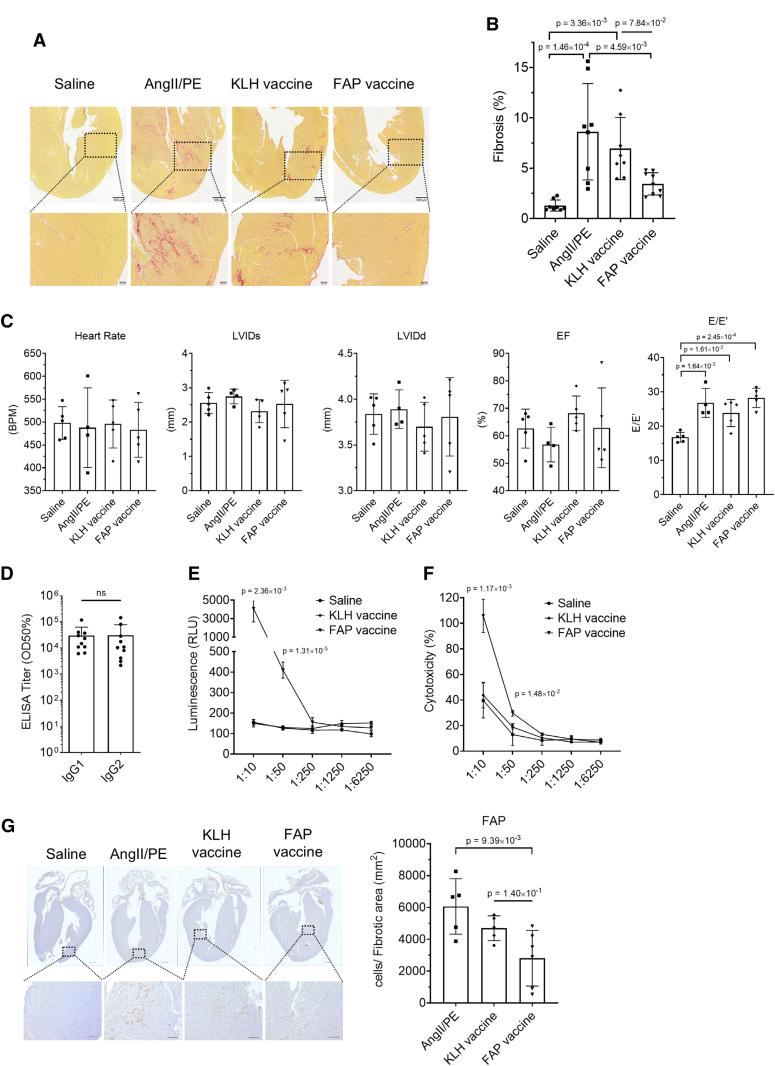
We found that cardiac fibrosis was significantly decreased in the FAP-vaccinated mice compared with the angiotensin II and phenylephrine control mice (3.45±1.11% versus 8.62±4.79%; =4.59×10) and that the accumulation of FAP-positive cells was also significantly decreased, as indicated by FAP immunohistochemical staining (4077±1746 versus 7327±1741 cells/mm; FAP vaccine versus angiotensin II and phenylephrine control; =6.67×10). No systemic or organ-specific inflammation due to antibody-dependent cell cytotoxicity induced by the FAP vaccine was observed. Although the transient activation of myofibroblasts has an important role in maintaining the structural robustness in the process of tissue repair, the FAP vaccine showed no adverse effects in myocardial infarction and skin injury models.
CONCLUSIONS
Our study demonstrates the FAP vaccine can be a therapeutic tool for cardiac fibrosis.
背景
肌成纤维细胞是参与慢性反应诱导的心脏纤维化的主要细胞。成纤维细胞活化蛋白(FAP)是活化肌成纤维细胞相对特异的标志物及潜在的靶分子。本研究旨在阐明靶向FAP的疫苗能否消除慢性心脏应激模型小鼠中的肌成纤维细胞并减轻心脏纤维化。
方法
我们将FAP肽疫苗与胞嘧啶-磷酸-鸟嘌呤(CpG)K3寡核苷酸佐剂共同给予雄性C57/BL6J小鼠,并证实抗FAP抗体滴度升高。在连续给予血管紧张素II和去氧肾上腺素28天后,我们评估了心脏组织中的心脏纤维化程度及肌成纤维细胞数量。
结果
我们发现,与血管紧张素II和去氧肾上腺素对照小鼠相比,接种FAP疫苗的小鼠心脏纤维化显著减轻(3.45±1.11%对8.62±4.79%;=4.59×10),且FAP免疫组化染色显示FAP阳性细胞的积聚也显著减少(4077±1746对7327±1741个细胞/mm;FAP疫苗对血管紧张素II和去氧肾上腺素对照;=6.67×10)。未观察到因FAP疫苗诱导的抗体依赖性细胞毒性导致的全身或器官特异性炎症。尽管肌成纤维细胞的短暂活化在组织修复过程中维持结构稳定性方面具有重要作用,但FAP疫苗在心肌梗死和皮肤损伤模型中未显示出不良反应。
结论
我们的研究表明FAP疫苗可成为治疗心脏纤维化的一种工具。




 Zotero 插件