
探索连接童年不良经历与心理风险因素的桥梁节点在男男性行为者自杀意念中的作用。
Exploring the role of bridging nodes linking adverse childhood experiences and psychological risk factors in suicidal ideation among MSM.
作者信息
Xu Huifang, Xu Lulu, Wang Zuxin, Xu Chen, Hu Fan, Cai Yong, Wang Ying
机构信息
School of Public Health, Shanghai Jiao Tong University School of Medicine, 227 South Chongqing Road, Shanghai, 200025, China.
Public Health Research Center, Tongren Hospital, Shanghai Jiao Tong University School of Medicine, 1111 Xianxia Road, Shanghai, 200335, China.
出版信息
Sci Rep. 2024 Dec 5;14(1):30395. doi: 10.1038/s41598-024-81811-2.
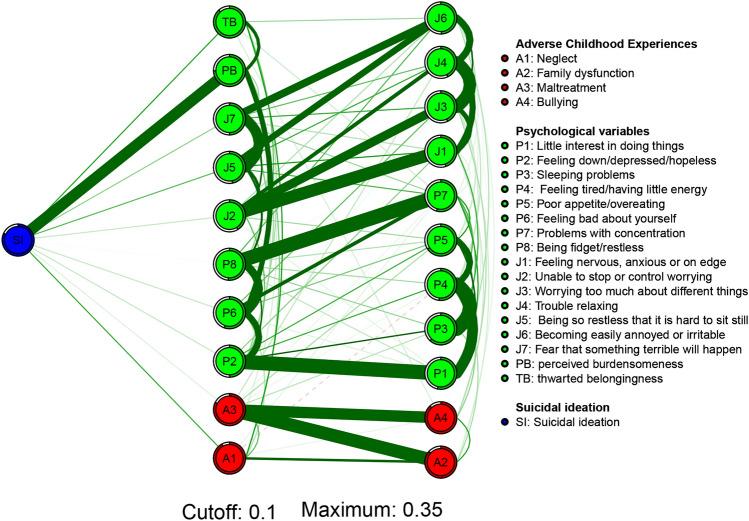
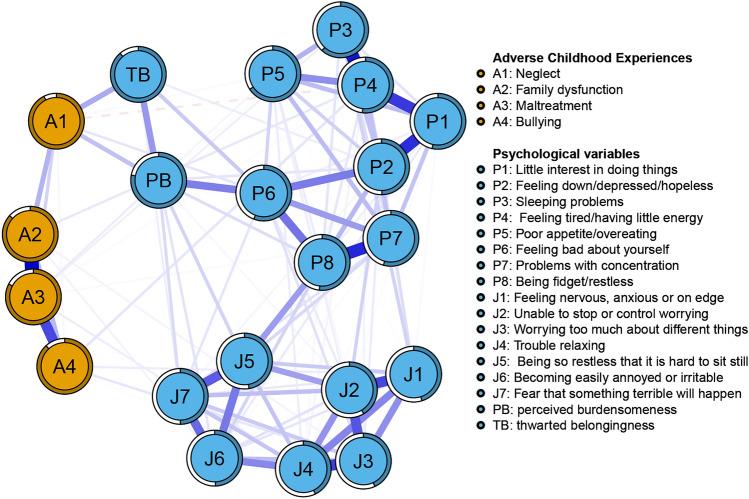
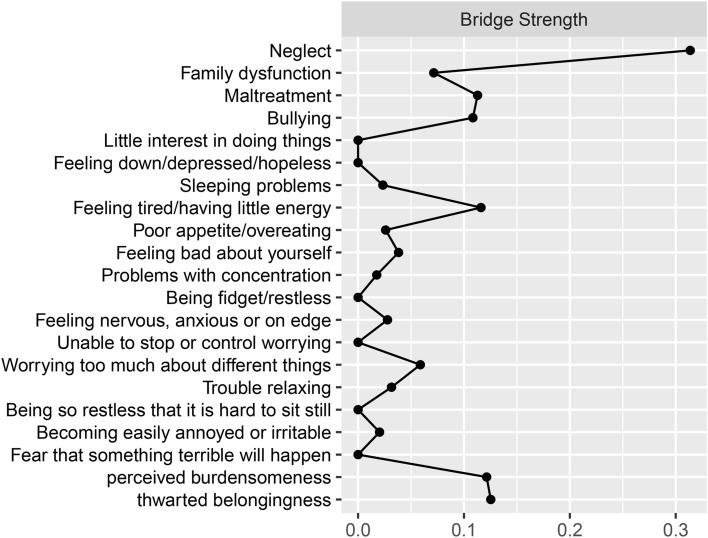
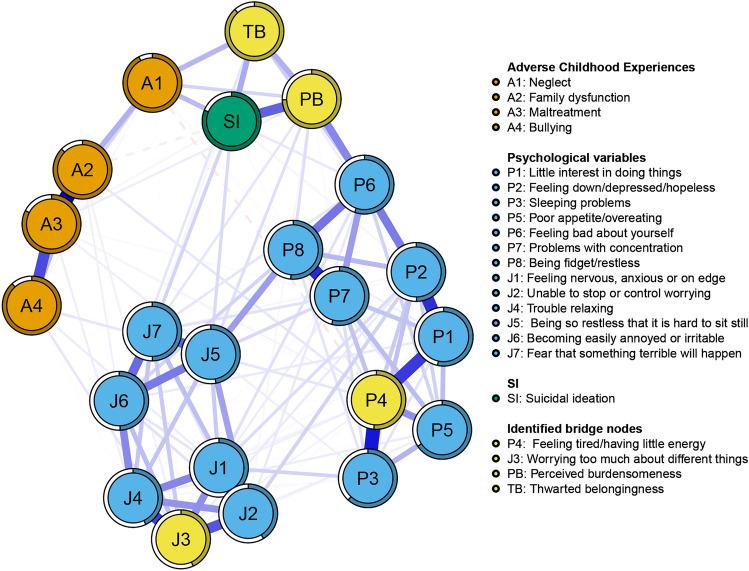
This study investigates the interplay between distal adverse childhood experiences (ACEs) and proximal psychological risk factors in predicting suicidal ideation among men who have sex with men (MSM) using network analysis. A total of 1138 MSM completed self-reported questionnaires on demographics, ACEs, depression, anxiety, interpersonal needs, and suicidal ideation. We employed Gaussian graphical models to perform a network analysis that mapped the relationships between ACEs and proximal psychological variables and identified bridge nodes. Additionally, suicidal ideation was incorporated to reevaluate the network and explore the association between the identified bridge nodes and suicidal ideation. The results show that approximately 88.3% of participants reported experiencing ACEs, with an average occurrence of 3.4 types of ACEs. Suicidal ideation was reported by 31.3% of participants. Key bridging nodes in the psychosocial network included perceived burdensomeness, thwarted belongingness, feeling tired/having little energy, and excessive worrying. Perceived burdensomeness exhibited the strongest correlation with suicidal ideation, followed by thwarted belongingness. Moreover, neglect is strongly associated with suicidal ideation. Our findings suggest that ACEs are associated with suicidal ideation and may be linked to specific proximal psychological factors that correlate with and potentially exacerbate suicidal ideation. These findings provide support to the Interpersonal Theory of Suicide, which suggests that perceived burdensomeness and thwarted belongingness are vital psychological factors in the onset of suicidal ideation. Addressing and intervening in these bridging nodes could help reduce the influence of ACEs on suicide ideation within the MSM community.
本研究运用网络分析方法,调查了童年期不良经历(ACEs)远端因素与近端心理风险因素之间的相互作用,以预测男男性行为者(MSM)的自杀意念。共有1138名男男性行为者完成了关于人口统计学、童年期不良经历、抑郁、焦虑、人际需求和自杀意念的自我报告问卷。我们采用高斯图形模型进行网络分析,绘制童年期不良经历与近端心理变量之间的关系,并确定桥梁节点。此外,纳入自杀意念以重新评估网络,并探索已确定的桥梁节点与自杀意念之间的关联。结果显示,约88.3%的参与者报告有童年期不良经历,平均发生3.4种童年期不良经历类型。31.3%的参与者报告有自杀意念。心理社会网络中的关键桥梁节点包括感知到的负担感、归属感受挫、感到疲倦/精力不足和过度担忧。感知到的负担感与自杀意念的相关性最强,其次是归属感受挫。此外,忽视与自杀意念密切相关。我们的研究结果表明,童年期不良经历与自杀意念相关,可能与特定的近端心理因素有关,这些因素与自杀意念相关并可能加剧自杀意念。这些发现为自杀人际理论提供了支持,该理论认为感知到的负担感和归属感受挫是自杀意念产生的重要心理因素。解决和干预这些桥梁节点有助于减少童年期不良经历对男男性行为者群体自杀意念的影响。
 Zotero 插件