
严重急性呼吸综合征冠状病毒2(SARS-CoV-2)刺突受体结合域(RBD)与人类血管紧张素转换酶2(hACE2)的界面亚区域通过它们在结合和解离动力学中所起的不同作用影响分子间亲和力。
Interfacial subregions of SARS-CoV-2 spike RBD to hACE2 affect intermolecular affinity by their distinct roles played in association and dissociation kinetics.
作者信息
Tang Xiangwu, Chen Jingxian, Zhang Lu, Liu Tao, Ding Min, Zheng Yun-Wen, Zhang Yinghui
机构信息
Guangdong Provincial Key Laboratory of Large Animal Models for Biomedicine, School of Pharmacy and Food Engineering, Wuyi University, Jiangmen, 529020, Guangdong, China.
Beijing Institute of Microbiology and Epidemiology, Beijing, 100071, China.
出版信息
Commun Biol. 2024 Dec 5;7(1):1621. doi: 10.1038/s42003-024-07081-w.
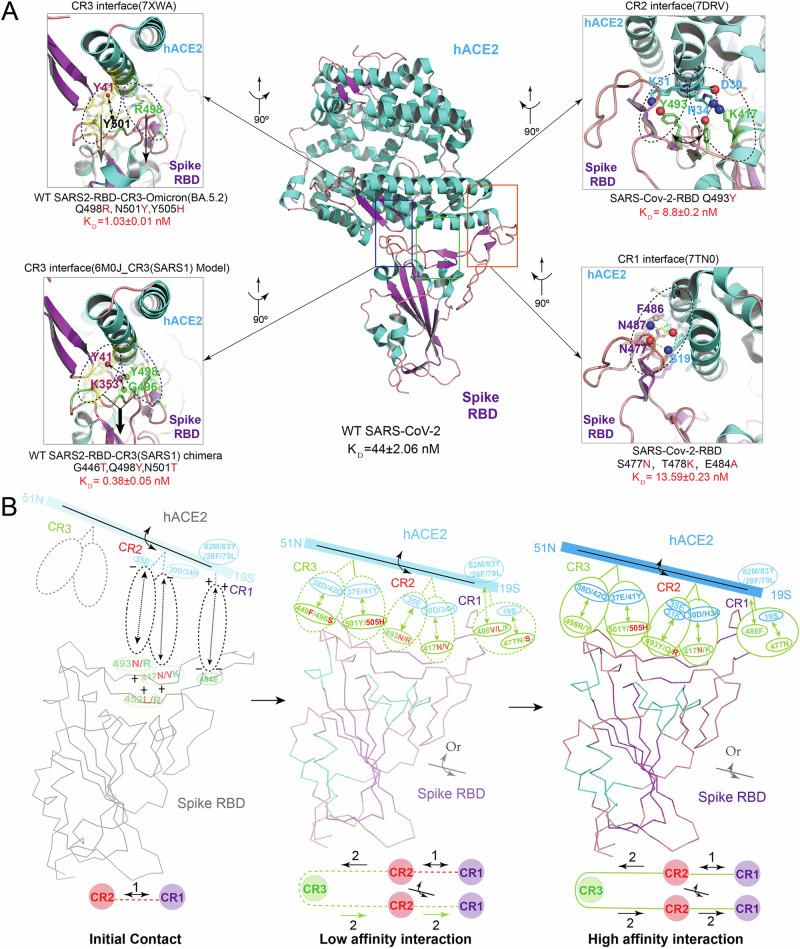
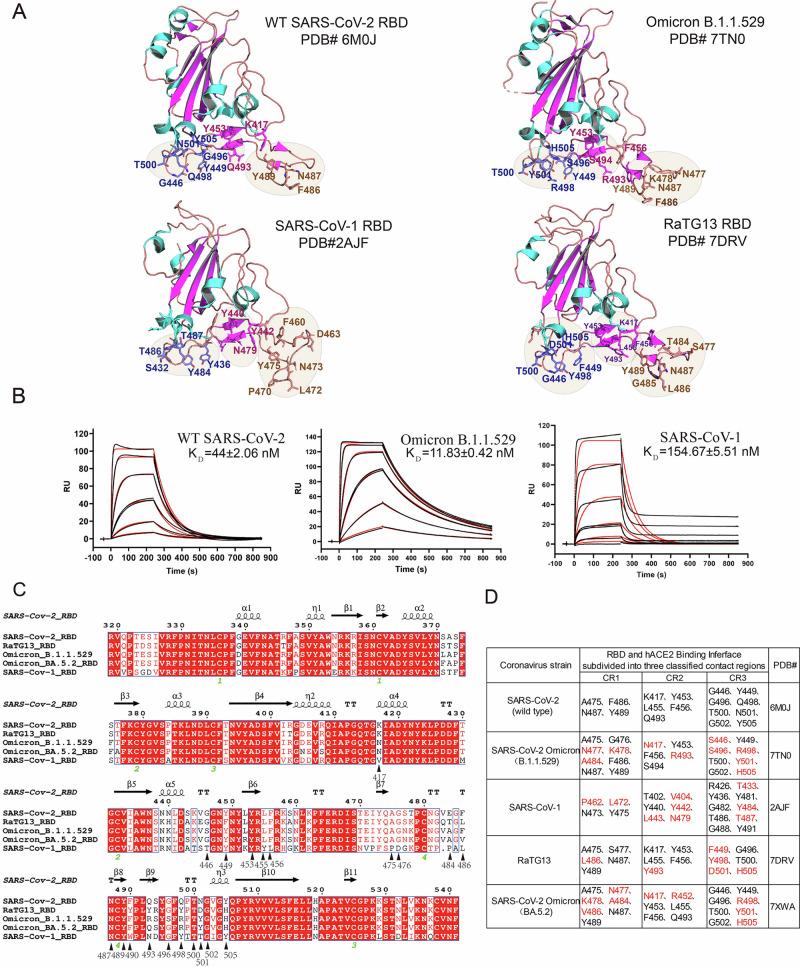
SARS-CoV-2's rapid global transmission depends on spike RBD's strong affinity to hACE2. In the context of binding hot spots well defined, the work investigated how interfacial subregions of SARS-CoV-2 spike RBD to hACE2 affect intermolecular affinity and their potential distinct roles involved in association and dissociation kinetics due to their local structural characteristics. Three spatially consecutive subregions of SARS-CoV-2 RBD were structurally partitioned across RBD's receptor binding motif (RBM). Their impacts on binding affinity and kinetics were differentiated through a comprehensive SPR measurement of hACE2 binding by chimeric swap mutants of respective subdomains from SARS-CoV-2 VOCs & phylogenetically close sarbecoviruses, and further compared with those of included single mutations across RBM and around the RBD core. The data supports that the intermediate interfacial subregion of RBD involving key residue at 417 is the rate-limiting effector of association kinetics and the subregion encompassing residues at 501/498/449 is the key binding energy contributor dictating dissociation kinetics, both of which relate to SARS-CoV-2's adaptive mutational evolution and host tropism closely. The kinetic data and structural analysis of local mutations' impact on spike RBD's binding and thermal stability provide a new perspective in evaluating SARS-CoV-2 evolution and other sarbecoviruses' evolvable binding to hACE2. The inherent binding mode offers direct clues of valid epitope in designing new antibodies that the coronavirus can't elude.
严重急性呼吸综合征冠状病毒2(SARS-CoV-2)在全球的快速传播取决于刺突蛋白受体结合域(spike RBD)与人类血管紧张素转换酶2(hACE2)的强亲和力。在明确了结合热点的背景下,这项研究调查了SARS-CoV-2刺突RBD与hACE2的界面亚区域如何因其局部结构特征影响分子间亲和力以及它们在结合和解离动力学中可能发挥的不同作用。SARS-CoV-2 RBD的三个在空间上连续的亚区域在其受体结合基序(RBM)上进行了结构划分。通过对来自SARS-CoV-2变异株(VOCs)和系统发育关系密切的沙贝病毒的各个亚结构域的嵌合交换突变体与hACE2结合进行全面的表面等离子体共振(SPR)测量,区分了它们对结合亲和力和动力学的影响,并进一步与RBM及RBD核心周围的单个突变进行了比较。数据支持,RBD的中间界面亚区域涉及417位关键残基,是结合动力学的限速效应器,而包含501/498/449位残基的亚区域是决定解离动力学的关键结合能贡献者,这两者都与SARS-CoV-2的适应性突变进化和宿主嗜性密切相关。局部突变对刺突RBD结合和热稳定性影响的动力学数据和结构分析为评估SARS-CoV-2进化以及其他沙贝病毒与hACE2的可进化结合提供了新的视角。其固有的结合模式为设计冠状病毒无法逃避的新型抗体提供了有效表位的直接线索。


 Zotero 插件