
复发/难治性慢性淋巴细胞白血病:异基因造血干细胞移植、嵌合抗原受体T细胞疗法及T细胞衔接器的作用
Relapsed/refractory CLL: the role of allo-SCT, CAR-T, and T-cell engagers.
作者信息
Kater Arnon P, Siddiqi Tanya
机构信息
Department of Hematology, Cancer Center Amsterdam, Amsterdam University Medical Centers, University of Amsterdam, Amsterdam, The Netherlands.
Department of Hematology/Hematopoietic Cell Transplantation, City of Hope Orange County, Irvine, CA.
出版信息
Hematology Am Soc Hematol Educ Program. 2024 Dec 6;2024(1):474-481. doi: 10.1182/hematology.2024000570.
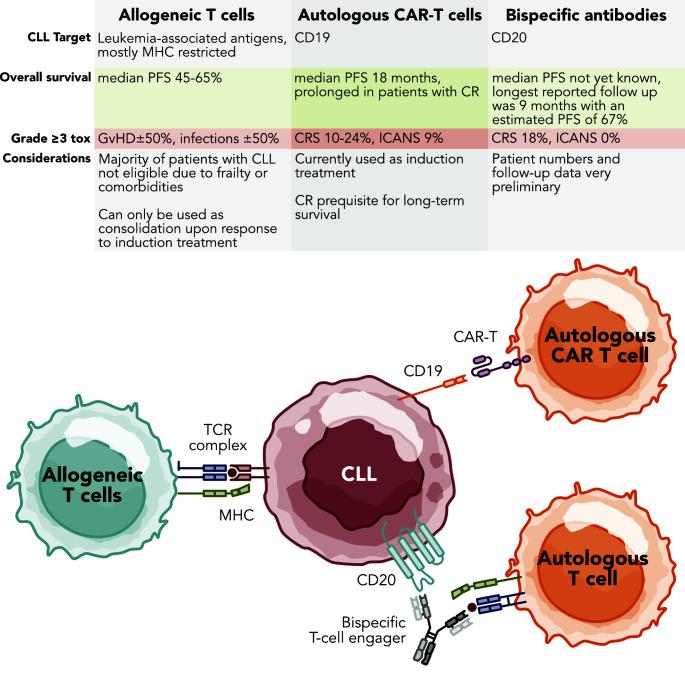
Chronic lymphocytic leukemia (CLL) patients who are refractory to both Bruton's tyrosine kinase and B-cell/CLL lymphoma 2 (BCL2) inhibitors face a significant treatment challenge, with limited and short-lasting disease control options. This underscores the urgent need for novel therapeutic strategies. Immunotherapy has emerged as a promising approach to address this unmet need, offering the potential for durable remissions and improved patient outcomes. Historically, allogeneic stem cell transplantation has been used for high-risk CLL patients, demonstrating promising survival rates. However, its applicability is limited by high treatment-related mortality and chronic graft-versus-host disease, especially in older and frail patients. Chimeric antigen receptor (CAR) T-cell therapy is gaining attention for its potential in relapsed/refractory CLL. Early clinical trials have shown that CAR T cells can induce durable remissions, with encouraging overall response rates in heavily pretreated patients. Additionally, bispecific antibodies are being explored as immunotherapeutic strategies, showing promising preclinical and early clinical results in targeting CLL cells effectively. One of the major challenges in CLL treatment with T-cell-based therapies is the acquired T-cell dysfunction observed in patients. To overcome these limitations, strategies such as combining targeted agents with cellular immunotherapies, modifying CAR designs, and incorporating immunomodulatory compounds into the manufacturing process are being investigated. These innovative approaches aim to enhance T-cell engagement and improve outcomes for CLL patients, offering hope for more effective and sustainable treatments in the future.
对布鲁顿酪氨酸激酶和B细胞淋巴瘤/白血病-2(BCL2)抑制剂均耐药的慢性淋巴细胞白血病(CLL)患者面临着重大的治疗挑战,疾病控制选择有限且持续时间短。这凸显了对新型治疗策略的迫切需求。免疫疗法已成为满足这一未满足需求的一种有前景的方法,具有实现持久缓解和改善患者预后的潜力。从历史上看,异基因干细胞移植已用于高危CLL患者,生存率显示出良好前景。然而,其适用性受到高治疗相关死亡率和慢性移植物抗宿主病的限制,尤其是在老年和体弱患者中。嵌合抗原受体(CAR)T细胞疗法因其在复发/难治性CLL中的潜力而受到关注。早期临床试验表明,CAR T细胞可诱导持久缓解,在经过大量预处理的患者中总体缓解率令人鼓舞。此外,双特异性抗体正作为免疫治疗策略进行探索,在有效靶向CLL细胞方面显示出有前景的临床前和早期临床结果。基于T细胞的疗法治疗CLL的主要挑战之一是在患者中观察到的获得性T细胞功能障碍。为克服这些限制,正在研究将靶向药物与细胞免疫疗法相结合、修改CAR设计以及在制造过程中加入免疫调节化合物等策略。这些创新方法旨在增强T细胞的参与度并改善CLL患者的预后,为未来更有效和可持续的治疗带来希望。
 Zotero 插件