
色氨酸-574-亮氨酸以及新发现的脯氨酸-197-组氨酸/亮氨酸突变导致了李氏禾对五氟磺草胺的抗性。
Trp-574-Leu and the novel Pro-197-His/Leu mutations contribute to penoxsulam resistance in (L.) P. Beauv.
作者信息
Sun Penglei, Niu Liangliang, He Pengfei, Yu Haiyan, Chen Jingchao, Cui Hailan, Li Xiangju
机构信息
Institute of Plant Protection, Chinese Academy of Agricultural Sciences, Beijing, China.
出版信息
Front Plant Sci. 2024 Nov 25;15:1488976. doi: 10.3389/fpls.2024.1488976. eCollection 2024.
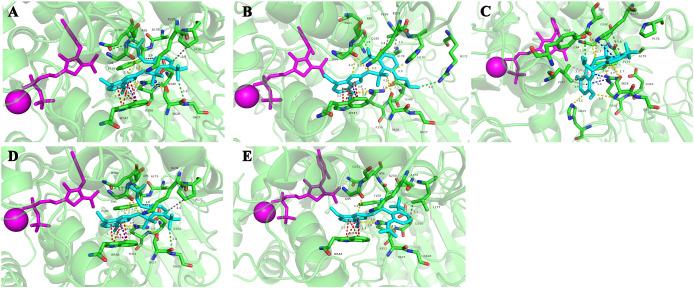
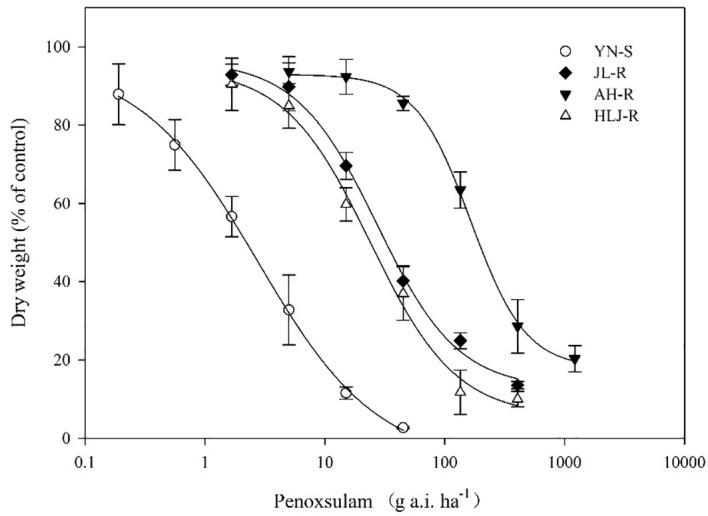
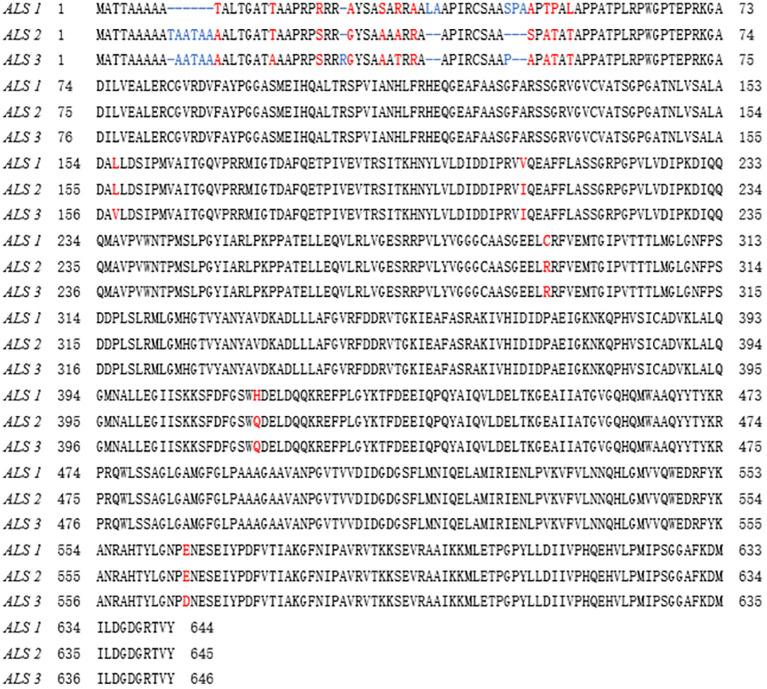
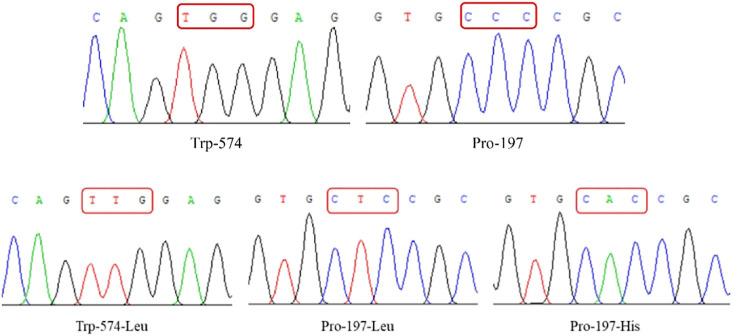
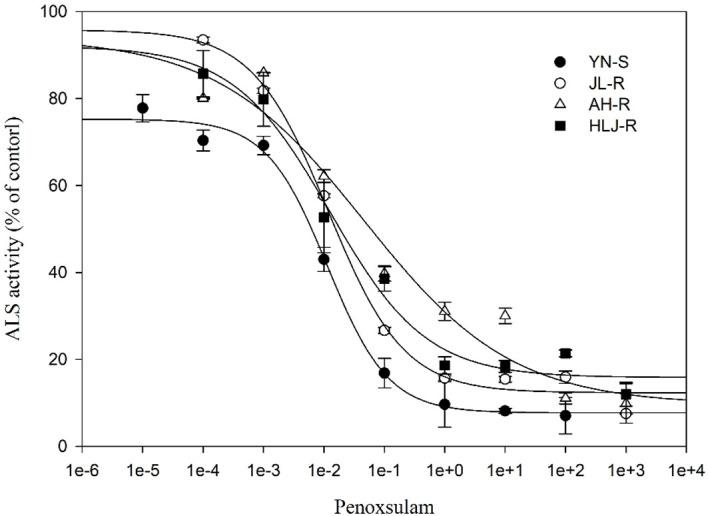
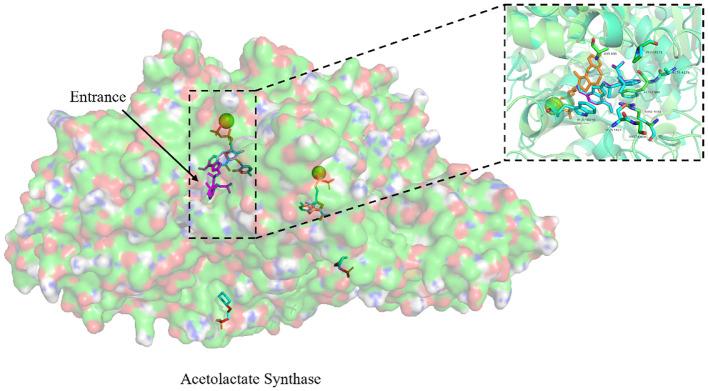
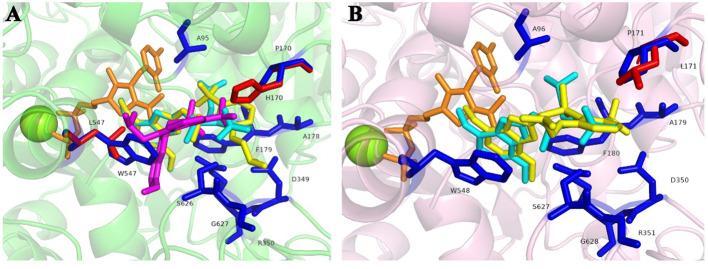
Recently, due to the widespread use of the acetolactate synthase (ALS)-inhibiting herbicide penoxsulam in paddy fields in China, (L.) P. Beauv. has become a problematic grass weed that is frequently not controlled, posing a threat to weed management and rice yield. There are many reports on target-site mutations of ALS inhibiting herbicides; however, the detailed penoxsulam resistance mechanism in remains to be determined. Greenhouse and laboratory studies were conducted to characterize target-site resistance mechanisms in JL-R, AH-R, and HLJ-R suspected resistant populations of survived the field-recommended dose of penoxsulam. The whole-plant dose-response testing of to penoxsulam confirmed the evolution of moderate-level resistance in two populations, JL-R (9.88-fold) and HLJ-R (8.66-fold), and a high-level resistance in AH-R (59.71-fold) population. gene sequencing identified specific mutations in resistant populations, including Pro-197-His in for JL-R, Trp-574-Leu in for AH-R, and Pro-197-Leu in for HLJ-R. ALS activity assays demonstrated a significantly higher activity in AH-R compared to the susceptible population (YN-S). Molecular docking studies revealed that Trp-574-Leu mutation primarily reduced the enzyme's ability to bind to the triazole-pyrimidine ring of penoxsulam due to decreased π-π stacking interactions, while Pro-197-His/Leu mutations impaired binding to the benzene ring by altering hydrogen bonds and hydrophobic interactions. Additionally, the Pro-197-His/Leu amino acid residue changes resulted in alterations in the shape of the active channel, impeding the efficient entry of penoxsulam into the binding site in the ALS protein. The three mutant ALS proteins expressed via the Bac-to-Bac baculovirus system exhibited notably lower activity inhibition rates than the non-mutant ALS proteins to penoxsulam, indicating all three ALS mutations reduce sensitivity to penoxsulam. This study elucidated the distinct impacts of the Pro-197-His/Leu and Trp-574-Leu mutations in to penoxsulam resistance. Notably, the Trp-574-Leu mutation conferred stronger resistance to penoxsulam compared to the Pro-197-His/Leu mutations in . The Pro-197-His/Leu mutations were first detected in conferring penoxsulam resistance. These findings provide deeper insights into the molecular mechanisms underlying target-site resistance to penoxsulam in
近年来,由于乙酰乳酸合成酶(ALS)抑制型除草剂五氟磺草胺在中国稻田的广泛使用,稗草已成为一种难以防除的恶性杂草,对杂草治理和水稻产量构成威胁。关于ALS抑制型除草剂的靶标位点突变已有很多报道;然而,稗草对五氟磺草胺的详细抗性机制仍有待确定。开展了温室和实验室研究,以表征疑似抗性种群JL-R、AH-R和HLJ-R中对五氟磺草胺的靶标位点抗性机制,这些种群能在田间推荐剂量的五氟磺草胺下存活。稗草对五氟磺草胺的整株剂量反应测试证实,两个种群JL-R(9.88倍)和HLJ-R(8.66倍)产生了中等水平抗性,AH-R种群(59.71倍)产生了高水平抗性。基因测序确定了抗性种群中的特异性突变,包括JL-R种群稗草中第197位脯氨酸突变为组氨酸,AH-R种群稗草中第574位色氨酸突变为亮氨酸,HLJ-R种群稗草中第197位脯氨酸突变为亮氨酸。ALS活性测定表明,与敏感种群(YN-S)相比,AH-R种群的活性显著更高。分子对接研究表明,第574位色氨酸突变为亮氨酸主要是由于π-π堆积相互作用减少,降低了该酶与五氟磺草胺三唑嘧啶环的结合能力,而第197位脯氨酸突变为组氨酸/亮氨酸则通过改变氢键和疏水相互作用,损害了与苯环的结合。此外,第197位脯氨酸突变为组氨酸/亮氨酸导致活性通道形状改变,阻碍五氟磺草胺有效进入ALS蛋白的结合位点。通过杆状病毒表达系统表达的三种突变型ALS蛋白对五氟磺草胺的活性抑制率明显低于非突变型ALS蛋白,表明这三种ALS突变均降低了对五氟磺草胺的敏感性。本研究阐明了稗草中第197位脯氨酸突变为组氨酸/亮氨酸和第574位色氨酸突变为亮氨酸对五氟磺草胺抗性的不同影响。值得注意的是,与稗草中第197位脯氨酸突变为组氨酸/亮氨酸相比,第574位色氨酸突变为亮氨酸赋予了对五氟磺草胺更强的抗性。首次在稗草中检测到第197位脯氨酸突变为组氨酸/亮氨酸赋予了对五氟磺草胺的抗性。这些发现为稗草对五氟磺草胺靶标位点抗性的分子机制提供了更深入了解。


 Zotero 插件