
1990 - 2019年中国归因于高体重指数的2型糖尿病、中风和高血压性心脏病的疾病负担趋势
Trends in disease burden of type 2 diabetes, stroke, and hypertensive heart disease attributable to high BMI in China: 1990-2019.
作者信息
Wang Yunchao, Jiang Junlin, Zhu Zhongxin
机构信息
Department of General Medicine, The First People's Hospital of Xiaoshan District, Xiaoshan Affiliated Hospital of Wenzhou Medical University, Hangzhou, Zhejiang, China.
Clinical Research Center, The First People's Hospital of Xiaoshan District, Xiaoshan Affiliated Hospital of Wenzhou Medical University, Hangzhou, Zhejiang, China.
出版信息
Open Med (Wars). 2024 Nov 29;19(1):20241087. doi: 10.1515/med-2024-1087. eCollection 2024.
BACKGROUND
High body mass index (BMI) is a significant risk factor for non-communicable diseases; however, its impact on disease burden in China remains understudied. This study aimed to analyze trends in the burden of type 2 diabetes mellitus (T2DM), stroke, and hypertensive heart disease (HHD) attributable to high BMI in China from 1990 to 2019.
METHODS
We utilized data from the Global Burden of Disease 2019 study, quantifying disease burden through years lived with disability (YLDs), years of life lost (YLLs), and disability-adjusted life years (DALYs). Joinpoint regression analysis was employed to determine temporal trends.
RESULTS
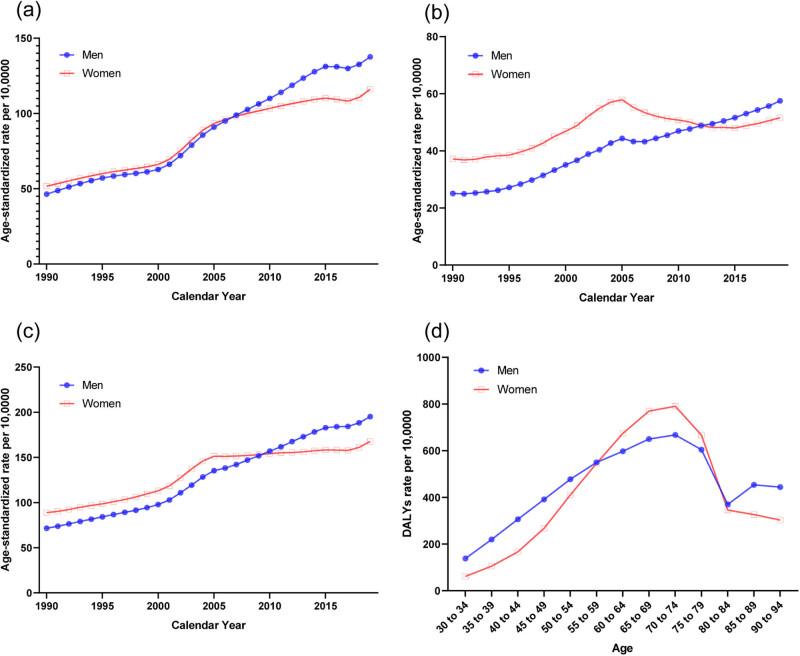
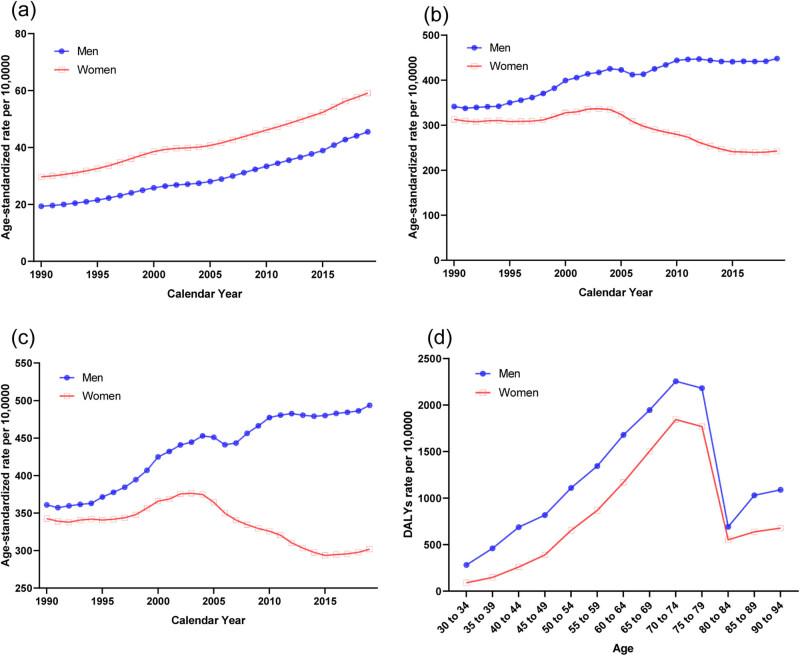
The study revealed distinct gender-specific temporal trends. Men exhibited a consistent increase in disease burden across all three conditions. Women showed more nuanced patterns: a gradual rise in T2DM burden, an inverted U-shaped trend for stroke, and a U-shaped trend for HHD in terms of age-standardized DALYs. Age-specific analysis demonstrated that the burden of T2DM and stroke peaked in the 70-74-year age group, whereas HHD-related DALYs continued to increase with advancing age.
CONCLUSIONS
Our findings underscore the need for tailored obesity prevention and management strategies in Chinese healthcare settings, emphasizing early screening and intervention for high BMI, particularly in middle-aged and older adults.
背景
高体重指数(BMI)是非传染性疾病的重要风险因素;然而,其对中国疾病负担的影响仍未得到充分研究。本研究旨在分析1990年至2019年中国高BMI所致2型糖尿病(T2DM)、中风和高血压性心脏病(HHD)的疾病负担趋势。
方法
我们利用了《2019年全球疾病负担》研究的数据,通过伤残调整生命年(YLDs)、寿命损失年数(YLLs)和伤残调整生命年(DALYs)来量化疾病负担。采用Joinpoint回归分析来确定时间趋势。
结果
该研究揭示了明显的性别特异性时间趋势。在所有三种疾病中,男性的疾病负担持续增加。女性则呈现出更为细微的模式:T2DM负担逐渐上升,中风呈倒U形趋势,HHD的年龄标准化DALYs呈U形趋势。按年龄分层分析表明,T2DM和中风的负担在70-74岁年龄组达到峰值,而与HHD相关的DALYs随着年龄的增长持续增加。
结论
我们的研究结果强调在中国医疗环境中需要制定针对性的肥胖预防和管理策略,强调对高BMI进行早期筛查和干预,特别是在中老年人群中。

 Zotero 插件