
辅助生殖中的早产:妊娠期高血压疾病的中介作用
Preterm birth in assisted reproduction: the mediating role of hypertensive disorders in pregnancy.
作者信息
Petersen Sindre Hoff, Åsvold Bjørn Olav, Lawlor Deborah A, Pinborg Anja, Spangmose Anne Lærke, Romundstad Liv Bente, Bergh Christina, Wennerholm Ulla-Britt, Gissler Mika, Tiitinen Aila, Elhakeem Ahmed, Opdahl Signe
机构信息
Department of Public Health and Nursing, Faculty of Medicine and Health Sciences, Norwegian University of Science and Technology, Trondheim, Norway.
HUNT Center for Molecular and Clinical Epidemiology, Department of Public Health and Nursing, Faculty of Medicine and Health Sciences, Norwegian University of Science and Technology, Trondheim, Norway.
出版信息
Hum Reprod. 2025 Jan 1;40(1):167-177. doi: 10.1093/humrep/deae261.
STUDY QUESTION
To what extent can hypertensive disorders in pregnancy (HDP) explain the higher risk of preterm birth following frozen embryo transfer (frozen-ET) and fresh embryo transfer (fresh-ET) in ART compared with naturally conceived pregnancies?
SUMMARY ANSWER
HDP did not contribute to the higher risk of preterm birth in pregnancies after fresh-ET but mediated 20.7% of the association between frozen-ET and preterm birth.
WHAT IS KNOWN ALREADY
Risk of preterm birth is higher after ART compared to natural conception. However, there is also a higher risk of HDP in pregnancies after ART compared to natural conception, in particular after frozen-ET. HDP increases the risk of both spontaneous and medically indicated preterm birth. It is not known to what extent the higher risk of preterm birth in ART-conceived pregnancies is mediated through HDP.
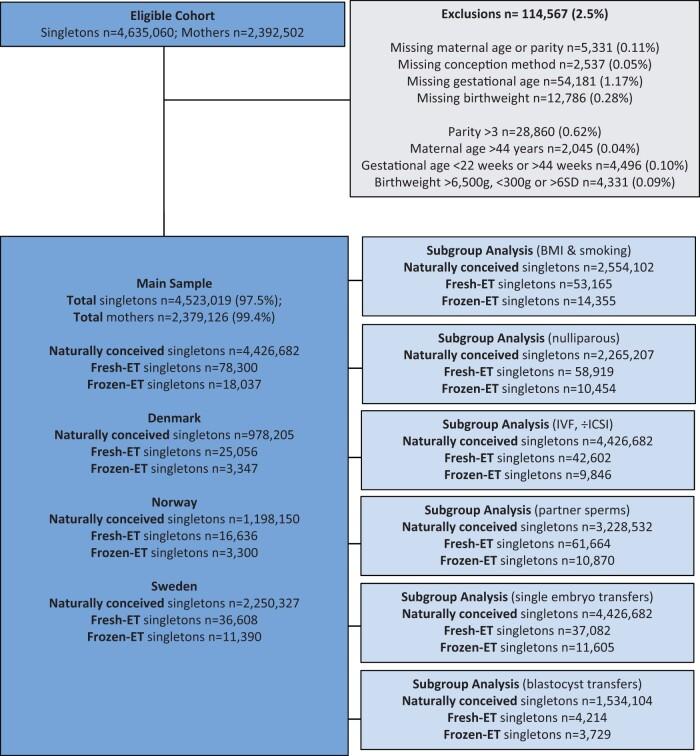
STUDY DESIGN, SIZE, DURATION: This registry-based cohort study included singleton pregnancies from the Committee of Nordic ART and Safety (CoNARTaS) cohort from Denmark (1994-2014), Norway (1988-2015), and Sweden (1988-2015). The analysis included 78 300 singletons born after fresh-ET, 18 037 after frozen-ET, and 4 426 682 after natural conception. The exposure was ART conception with either frozen-ET or fresh-ET versus natural conception. The main mediator of interest was any of the following HDP: gestational hypertension, preeclampsia, eclampsia, or chronic hypertension with superimposed preeclampsia. The main outcome was any preterm birth, defined as delivery <37 weeks of gestation. Secondary outcomes were spontaneous and medically indicated preterm birth, and different severities of preterm birth based on the gestational age threshold.
PARTICIPANTS/MATERIALS, SETTING, METHODS: We linked data from the national Medical Birth Registries, ART registries/databases, and the National Patient Registries in each country using the unique national identity number of the mother. Criteria for inclusion were singleton pregnancies with birth order 1-4 in women aged ≥20 years at delivery. We used logistic regression to estimate odds ratios (ORs) with 95% CIs of preterm birth and decomposed the total effect into direct and mediated (indirect) effects to estimate the proportion mediated by HDP. Main models included adjustment for the year of delivery, maternal age, parity, and country.
MAIN RESULTS AND THE ROLE OF CHANCE
Pregnancies following frozen-ET had a higher risk of any preterm birth compared to natural conception (occurrence 6.6% vs 5.0%, total effect OR 1.29, 95% CI 1.21-1.37) and 20.7% of the association was mediated by HDP (mediated effect OR 1.05, 95% CI 1.04-1.05). The mediation occurred primarily in medically indicated preterm births. Pregnancies following fresh-ET also had a higher risk of any preterm birth compared to naturally conceived pregnancies (occurrence 8.1% vs 5.0%, total effect OR 1.49, 95% CI: 1.45-1.53), but none of this could be mediated by HDP (mediated effect OR 1.00, 95%CI 1.00-1.00, proportion mediated 0.5%). Sensitivity analyses with extra confounder adjustment for body mass index and smoking, and restriction to primiparous women, were consistent with our main findings. Furthermore, the results were not driven by differences in ART procedures (intracytoplasmic sperm injection, culture duration, or the number of embryos transferred).
LIMITATIONS, REASONS FOR CAUTION: Although we could adjust for some important confounders, we cannot exclude residual confounding, particularly from factors associated with infertility.
WIDER IMPLICATIONS OF THE FINDINGS
This population-based mediation analysis suggests that some of the higher risk of preterm birth after ART treatment may be explained by the higher risk of HDP after frozen-ET. If causality is established, investigations into preventive strategies such as prophylactic aspirin in pregnancies after frozen-ET may be warranted.
STUDY FUNDING/COMPETING INTEREST(S): Funding was provided by NordForsk (project number: 71450), the Nordic Federation of Obstetrics and Gynaecology (project numbers NF13041, NF15058, NF16026, and NF17043), the Norwegian University of Science and Technology (project number 81850092), an ESHRE Grant for research in reproductive medicine (grant number 2022-2), and the Research Council of Norway's Centres of Excellence funding scheme (project number 262700). D.A.L.'s and A.E.'s contribution to this work was supported by the European Research Council under the European Union's Horizon 2020 research and innovation program (grant agreements No 101021566) and the UK Medical Research Council (MC_UU_00032/05). D.A.L. has received support from Roche Diagnostics and Medtronic Ltd for research unrelated to that presented here. Pinborg declares grants from Gedeon Richter, Ferring, Cryos, and Merck, consulting fees from IBSA, Ferring, Gedeon Richter, Cryos, and Merck, payments from Gedeon Richter, Ferring, Merck, and Organon,travel support from Gedeon Richter. All other authors declare no conflicts of interest related to this work.
TRIAL REGISTRATION NUMBER
ISRCTN 35879.
研究问题
与自然受孕相比,辅助生殖技术(ART)中,冻融胚胎移植(frozen-ET)和新鲜胚胎移植(fresh-ET)后早产风险增加的情况,在多大程度上可由妊娠期高血压疾病(HDP)来解释?
总结答案
HDP并非导致新鲜胚胎移植后早产风险增加的原因,但介导了冻融胚胎移植与早产之间20.7%的关联。
已知信息
与自然受孕相比,ART后早产风险更高。然而,与自然受孕相比,ART后妊娠发生HDP的风险也更高,尤其是冻融胚胎移植后。HDP会增加自然早产和医源性早产的风险。目前尚不清楚ART受孕妊娠中较高的早产风险在多大程度上是由HDP介导的。
研究设计、规模、持续时间:这项基于登记处的队列研究纳入了来自丹麦(1994 - 2014年)、挪威(1988 - 2015年)和瑞典(1988 - 2015年)的北欧ART与安全委员会(CoNARTaS)队列中的单胎妊娠。分析包括新鲜胚胎移植后出生的78300名单胎、冻融胚胎移植后出生的18037名单胎以及自然受孕后出生的4426682名单胎。暴露因素为冻融胚胎移植或新鲜胚胎移植的ART受孕与自然受孕。主要关注的中介因素为以下任何一种HDP:妊娠期高血压、子痫前期、子痫或慢性高血压并发子痫前期。主要结局为任何早产,定义为妊娠<37周分娩。次要结局为自然早产和医源性早产,以及基于孕周阈值的不同严重程度的早产。
参与者/材料、环境、方法:我们使用母亲的唯一国家身份号码,将每个国家的国家医疗出生登记处、ART登记处/数据库和国家患者登记处的数据进行了关联。纳入标准为分娩时年龄≥20岁、出生顺序为1 - 4的单胎妊娠妇女。我们使用逻辑回归来估计早产的比值比(OR)及其95%置信区间(CI),并将总效应分解为直接效应和中介(间接)效应,以估计由HDP介导的比例。主要模型包括对分娩年份、产妇年龄、产次和国家进行调整。
主要结果及偶然性的作用
与自然受孕相比,冻融胚胎移植后的妊娠发生任何早产的风险更高(发生率6.6%对5.0%,总效应OR 1.29,95%CI 1.21 - 1.37),且20.7%的关联由HDP介导(中介效应OR 1.05,95%CI 1.04 - 1.05)。这种中介作用主要发生在医源性早产中。与自然受孕的妊娠相比,新鲜胚胎移植后的妊娠发生任何早产的风险也更高(发生率8.1%对5.0%,总效应OR 1.49,95%CI:1.45 - 1.53),但这一关联均不能由HDP介导(中介效应OR 1.00,95%CI 1.00 - 1.00,介导比例0.5%)。对体重指数和吸烟进行额外混杂因素调整以及限制为初产妇的敏感性分析与我们的主要发现一致。此外,结果并非由ART程序(卵胞浆内单精子注射、培养时间或移植胚胎数量)的差异所驱动。
局限性、谨慎原因:尽管我们可以对一些重要的混杂因素进行调整,但我们不能排除残余混杂,特别是来自与不孕相关因素的混杂。
研究结果的更广泛影响
这项基于人群的中介分析表明,ART治疗后较高的早产风险部分可能由冻融胚胎移植后较高的HDP风险所解释。如果确定了因果关系,可能有必要对冻融胚胎移植后妊娠的预防性策略(如预防性使用阿司匹林)进行研究。
研究资金/利益冲突:资金由NordForsk(项目编号:71450)、北欧妇产科学会(项目编号NF13041、NF15058、NF16026和NF17043)、挪威科技大学(项目编号81850092)、欧洲人类生殖与胚胎学会生殖医学研究基金(资助编号2022 - 2)以及挪威研究理事会卓越中心资助计划(项目编号262700)提供。D.A.L.和A.E.对本工作的贡献得到了欧盟“地平线2020”研究与创新计划下欧洲研究理事会(资助协议编号101021566)和英国医学研究理事会(MC_UU_00032/05)的支持。D.A.L.曾接受罗氏诊断公司和美敦力有限公司与本文无关研究的支持。Pinborg声明接受了吉德昂·里奇特公司、辉凌公司、Cryos公司和默克公司的资助,从IBSA公司、辉凌公司、吉德昂·里奇特公司、Cryos公司和默克公司收取咨询费,从吉德昂·里奇特公司、辉凌公司、默克公司和欧加农公司获得报酬,以及获得吉德昂·里奇特公司的差旅支持。所有其他作者声明与本工作无利益冲突。
试验注册号
ISRCTN 35879
 Zotero 插件