
使用聚(乙交酯-共-三亚甲基碳酸酯)-聚(对苯二甲酸丁二醇酯)多嵌段共聚物进行弹性支架的熔体电写
Melt Electrowriting of Elastic Scaffolds Using PEOT-PBT Multi-block Copolymer.
作者信息
Amirsadeghi Armin, Gudeti Pavan Kumar Reddy, Tock Sietse, Koch Marcus, Parisi Daniele, Kamperman Marleen, Włodarczyk-Biegun Małgorzata Katarzyna
机构信息
Polymer Science, Zernike Institute for Advanced Materials, University of Groningen, Nijenborgh 3, Groningen, 9747 AG, The Netherlands.
Biotechnology Centre, The Silesian University of Technology, B. Krzywoustego 8, Gliwice, 44-100, Poland.
出版信息
Adv Healthc Mater. 2025 Jan;14(3):e2402914. doi: 10.1002/adhm.202402914. Epub 2024 Dec 10.
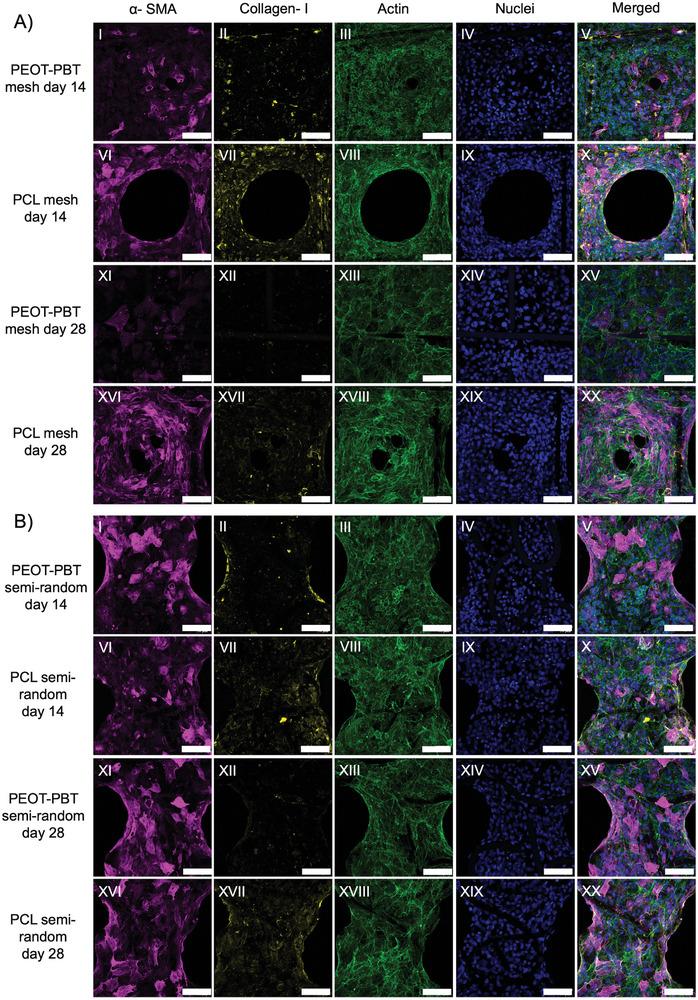
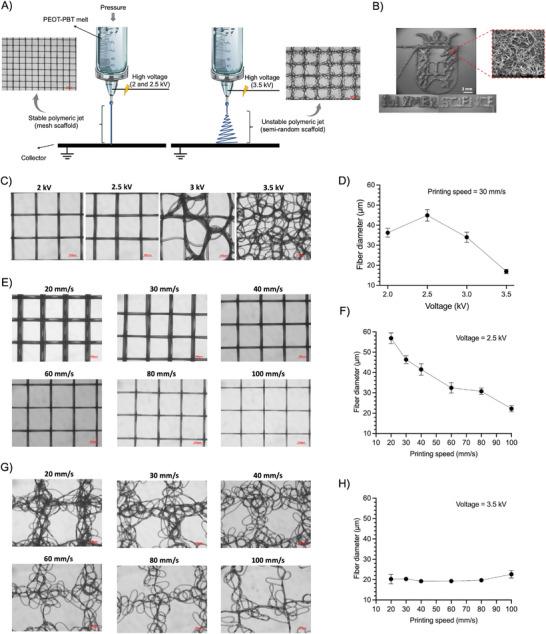
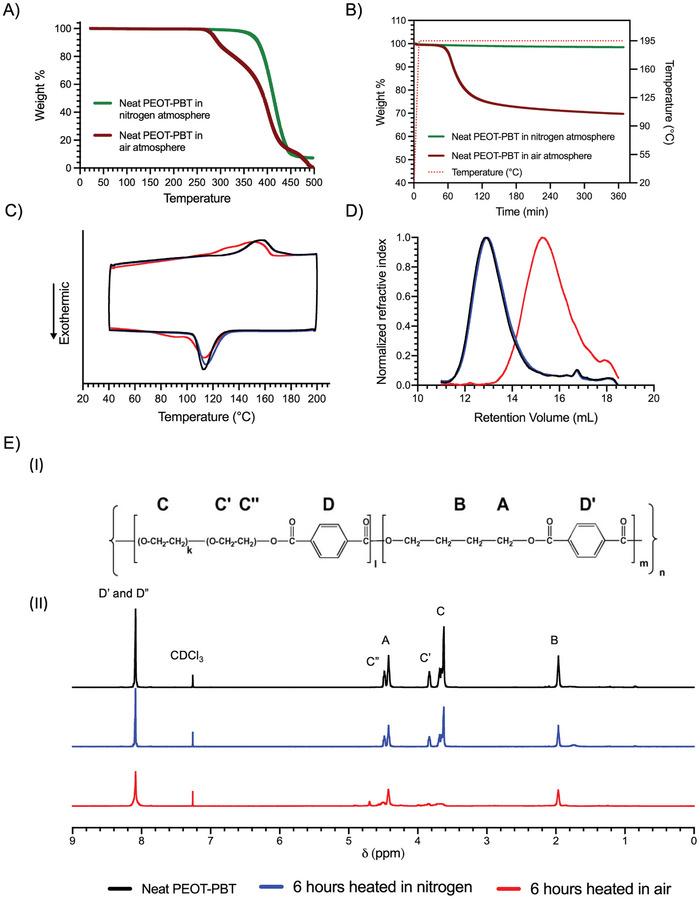
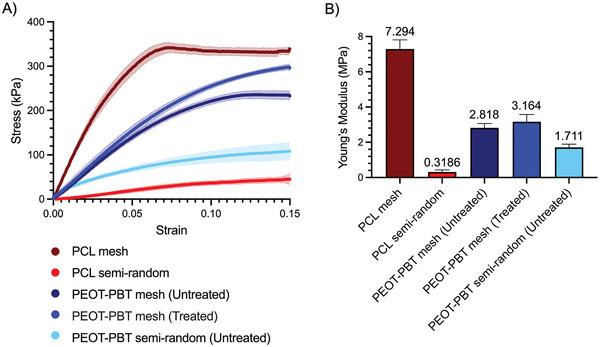
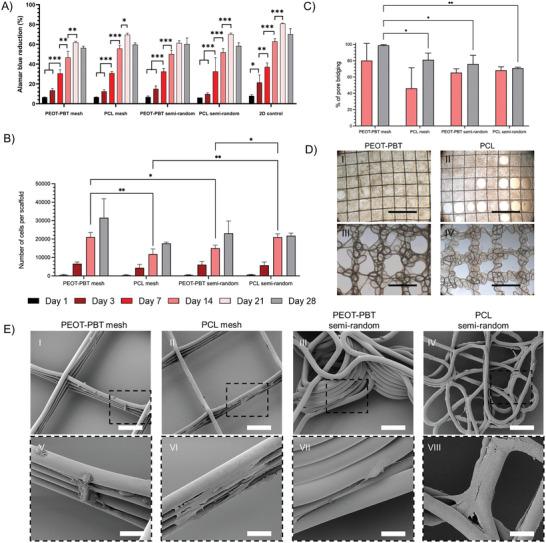
Melt electrowriting (MEW) is a powerful additive manufacturing technique to produce tissue engineering scaffolds. Despite its strength, it is limited by a small number of processable polymers. Therefore, to broaden the library of materials for MEW, we investigated the printability of poly(ethylene oxide terephthalate)-poly(butylene terephthalate) (PEOT-PBT), a thermoplastic elastomer. The effect of different printing parameters and material thermal degradation are studied. It is observed that the material is stable for >60 min at a printing temperature of 195 °C in a nitrogen environment. Next, two types of designs are printed and characterized: mesh-like and semi-random scaffolds. For both types of designs, PEOT-PBT scaffolds reveal a higher yield strain, and lower Young's modulus as compared to control polycaprolactone scaffolds. Biological studies performed using mouse embryonic fibroblasts (NIH-3T3) show good cell viability and metabolic activity on all print scaffolds. SEM imaging reveals actively migrating cells on PEOT-PBT mesh scaffolds after 24 h of culture and 98.87% of pore bridging by cells after 28 days of culture. Immunofluorescence staining shows decreased expression of alpha-smooth muscle actin from day 14 to day 28 in PEOT-PBT mesh scaffolds. Overall, it is shown that melt electrowritten PEOT-PBT scaffolds have great potential for soft tissue regeneration.
熔体静电纺丝书写(MEW)是一种用于生产组织工程支架的强大增材制造技术。尽管它有优势,但受限于可加工聚合物的种类较少。因此,为了拓宽MEW的材料库,我们研究了热塑性弹性体聚(对苯二甲酸乙二酯)-聚(对苯二甲酸丁二酯)(PEOT-PBT)的可打印性。研究了不同打印参数和材料热降解的影响。观察到在氮气环境中,该材料在195℃的打印温度下60多分钟内保持稳定。接下来,打印并表征了两种类型的设计:网状和半随机支架。与对照聚己内酯支架相比,两种类型的设计中,PEOT-PBT支架均显示出更高的屈服应变和更低的杨氏模量。使用小鼠胚胎成纤维细胞(NIH-3T3)进行的生物学研究表明,所有打印支架上的细胞活力和代谢活性良好。扫描电子显微镜成像显示,培养24小时后,PEOT-PBT网状支架上有细胞活跃迁移,培养28天后,98.87%的孔隙被细胞桥接。免疫荧光染色显示,在PEOT-PBT网状支架中,从第14天到第28天,α-平滑肌肌动蛋白的表达降低。总体而言,结果表明熔体静电纺丝书写的PEOT-PBT支架在软组织再生方面具有巨大潜力。



 Zotero 插件