
抗体介导的免疫突触结构与动力学中未被充分认识的层面。
Underappreciated layers of antibody-mediated immune synapse architecture and dynamics.
作者信息
Goldberg Benjamin S, Ackerman Margaret E
机构信息
Thayer School of Engineering, Dartmouth College, Hanover, New Hampshire, USA.
Geisel School of Medicine, Dartmouth College, Hanover, New Hampshire, USA.
出版信息
mBio. 2025 Jan 8;16(1):e0190024. doi: 10.1128/mbio.01900-24. Epub 2024 Dec 11.
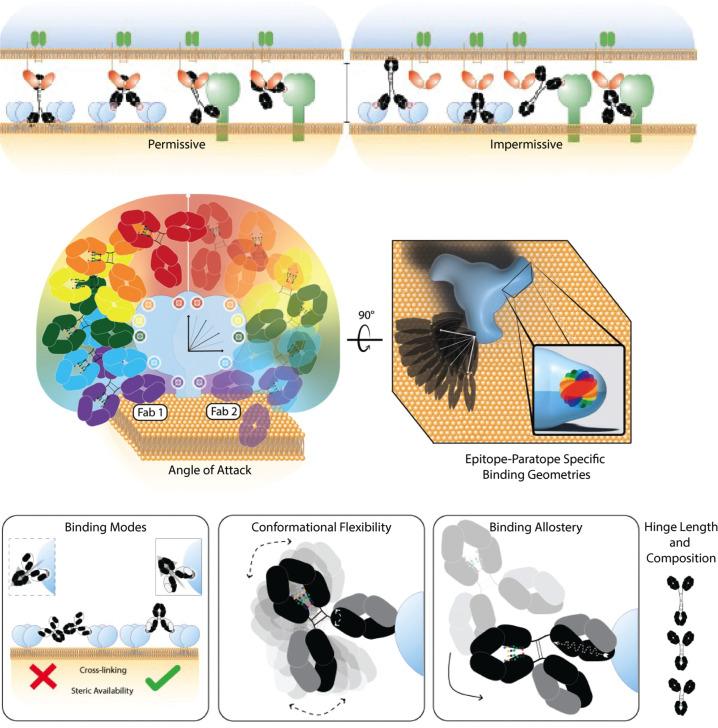
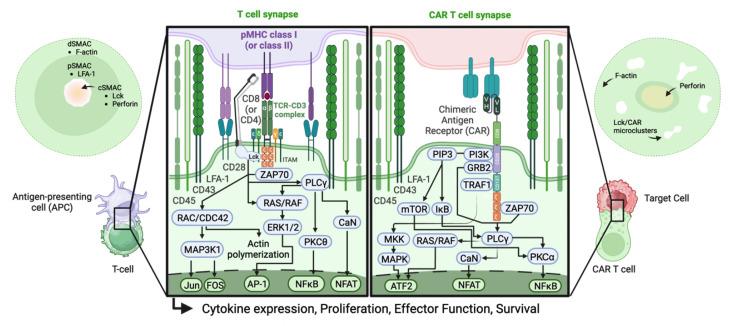
The biologic activities of antibody drugs are dictated by structure-function relationships-emerging from the kind, composition, and degree of interactions with a target antigen and with soluble and cellular antibody receptors of the innate immune system. These activities are canonically understood to be both modular: antigen recognition is driven by the heterodimeric antigen-binding fragment, and innate immune recruitment by the homodimeric constant/crystallizable fragment. The model that treats these domains with a high degree of independence has served the field well but is not without limitations. Here, we consider how new insights, particularly from structural studies, complicate the model of neat biophysical separation between these domains and shape our understanding of antibody effector functions. The emerging model endeavors to explain the phenotypic impact of both antibody intrinsic characteristics and extrinsic features-fitting them within a spatiotemporal paradigm that better accounts for observed antibody activities. In this review, we will use insights from recent models of classical complement complexes and T cell immune synapse formation to explore how structural differences in antibody-mediated immune synapses may relate to their functional diversity.
抗体药物的生物学活性由结构-功能关系决定,这些关系源于与靶抗原以及与先天免疫系统的可溶性和细胞性抗体受体相互作用的种类、组成和程度。通常认为这些活性具有模块化特征:抗原识别由异二聚体抗原结合片段驱动,而先天免疫募集则由同二聚体恒定/可结晶片段驱动。高度独立地处理这些结构域的模型在该领域发挥了很好的作用,但并非没有局限性。在此,我们探讨新的见解,特别是来自结构研究的见解,如何使这些结构域之间纯粹的生物物理分离模型变得复杂,并塑造我们对抗体效应功能的理解。新出现的模型试图解释抗体内在特征和外在特征的表型影响——将它们纳入一个能更好解释观察到的抗体活性的时空范式中。在本综述中,我们将利用经典补体复合物和T细胞免疫突触形成的最新模型中的见解,来探讨抗体介导的免疫突触中的结构差异可能如何与其功能多样性相关。


 Zotero 插件