
由最后一个共同祖先的蛋白质结构域解析的氨基酸纳入遗传密码的顺序。
Order of amino acid recruitment into the genetic code resolved by last universal common ancestor's protein domains.
作者信息
Wehbi Sawsan, Wheeler Andrew, Morel Benoit, Manepalli Nandini, Minh Bui Quang, Lauretta Dante S, Masel Joanna
机构信息
Genetics Graduate Interdisciplinary Program, University of Arizona, Tucson, AZ 85721.
Computational Molecular Evolution Group, Heidelberg Institute for Theoretical Studies, Heidelberg, Germany.
出版信息
Proc Natl Acad Sci U S A. 2024 Dec 24;121(52):e2410311121. doi: 10.1073/pnas.2410311121. Epub 2024 Dec 12.
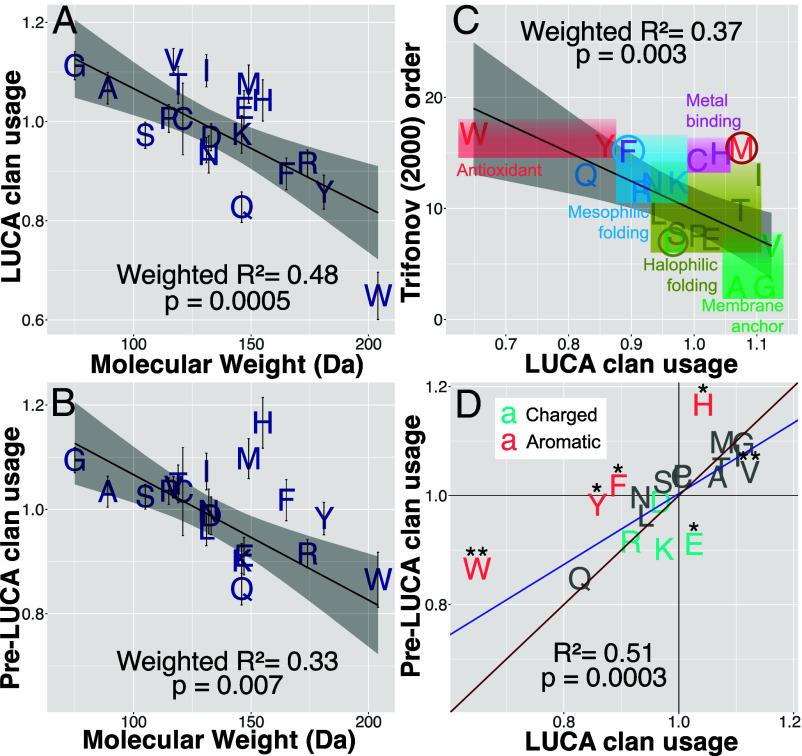
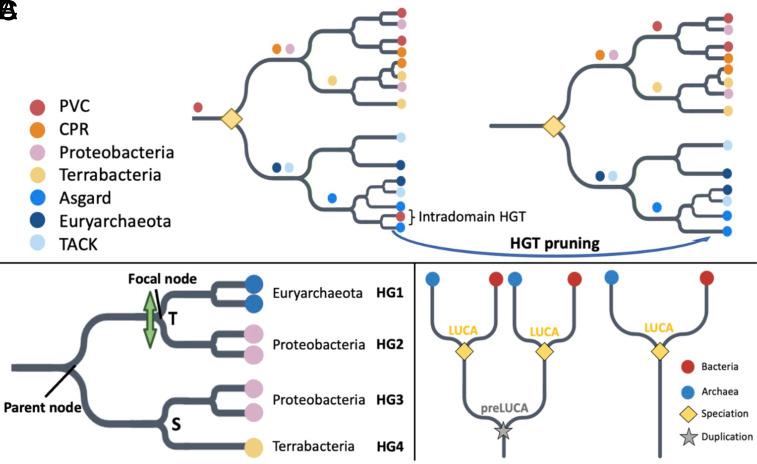
The current "consensus" order in which amino acids were added to the genetic code is based on potentially biased criteria, such as the absence of sulfur-containing amino acids from the Urey-Miller experiment which lacked sulfur. More broadly, abiotic abundance might not reflect biotic abundance in the organisms in which the genetic code evolved. Here, we instead identify which protein domains date to the last universal common ancestor (LUCA) and then infer the order of recruitment from deviations of their ancestrally reconstructed amino acid frequencies from the still-ancient post-LUCA controls. We find that smaller amino acids were added to the code earlier, with no additional predictive power in the previous consensus order. Metal-binding (cysteine and histidine) and sulfur-containing (cysteine and methionine) amino acids were added to the genetic code much earlier than previously thought. Methionine and histidine were added to the code earlier than expected from their molecular weights and glutamine later. Early methionine availability is compatible with inferred early use of S-adenosylmethionine and early histidine with its purine-like structure and the demand for metal binding. Even more ancient protein sequences-those that had already diversified into multiple distinct copies prior to LUCA-have significantly higher frequencies of aromatic amino acids (tryptophan, tyrosine, phenylalanine, and histidine) and lower frequencies of valine and glutamic acid than single-copy LUCA sequences. If at least some of these sequences predate the current code, then their distinct enrichment patterns provide hints about earlier, alternative genetic codes.
目前关于氨基酸添加到遗传密码中的“共识”顺序是基于可能有偏差的标准,比如在缺乏硫的尤里-米勒实验中不含含硫氨基酸。更广泛地说,非生物丰度可能无法反映遗传密码进化过程中生物体内的生物丰度。在这里,我们转而确定哪些蛋白质结构域可追溯到最后一个普遍共同祖先(LUCA),然后根据它们祖先重建的氨基酸频率与仍然古老的LUCA后控制组的偏差来推断招募顺序。我们发现较小的氨基酸更早被添加到密码中,而之前的共识顺序没有额外的预测能力。金属结合(半胱氨酸和组氨酸)和含硫(半胱氨酸和甲硫氨酸)氨基酸被添加到遗传密码中的时间比之前认为的要早得多。甲硫氨酸和组氨酸被添加到密码中的时间比根据它们的分子量预期的要早,而谷氨酰胺则较晚。早期甲硫氨酸的可用性与推断的早期对S-腺苷甲硫氨酸的使用以及早期组氨酸与其嘌呤样结构和金属结合需求相符合。甚至更古老的蛋白质序列——那些在LUCA之前就已经多样化为多个不同拷贝的序列——与单拷贝LUCA序列相比,芳香族氨基酸(色氨酸、酪氨酸、苯丙氨酸和组氨酸)的频率显著更高,缬氨酸和谷氨酸的频率更低。如果这些序列中至少有一些早于当前的密码,那么它们独特的富集模式为更早的、替代的遗传密码提供了线索。

 Zotero 插件