
含小胶质细胞的脑类器官的生成、研究及未来应用。
Generation, interrogation, and future applications of microglia-containing brain organoids.
作者信息
Di Stefano Julia, Di Marco Federica, Cicalini Ilaria, FitzGerald Una, Pieragostino Damiana, Verhoye Marleen, Ponsaerts Peter, Van Breedam Elise
机构信息
Laboratory of Experimental Hematology, Vaccine and Infectious Disease Institute (Vaxinfectio), University of Antwerp, Wilrijk, Belgium.
Bio-Imaging Lab, University of Antwerp, Wilrijk, Belgium.
出版信息
Neural Regen Res. 2025 Dec 1;20(12):3448-3460. doi: 10.4103/NRR.NRR-D-24-00921. Epub 2024 Dec 7.
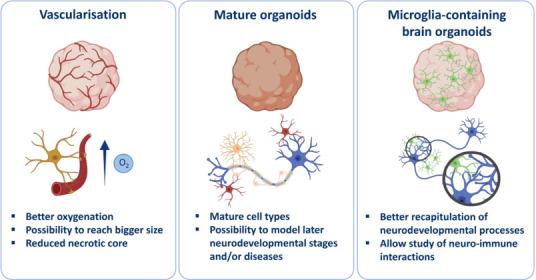
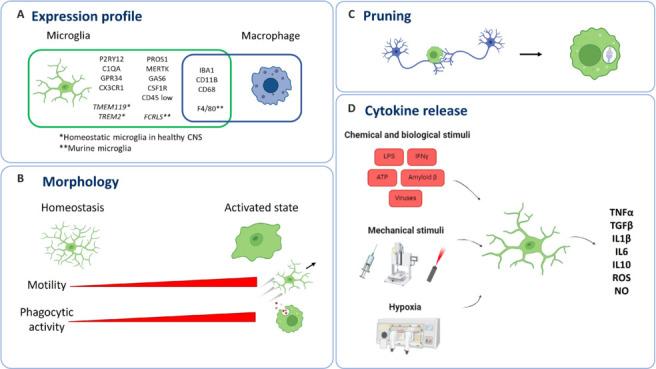
Brain organoids encompass a large collection of in vitro stem cell-derived 3D culture systems that aim to recapitulate multiple aspects of in vivo brain development and function. First, this review provides a brief introduction to the current state-of-the-art for neuro-ectoderm brain organoid development, emphasizing their biggest advantages in comparison with classical two-dimensional cell cultures and animal models. However, despite their usefulness for developmental studies, a major limitation for most brain organoid models is the absence of contributing cell types from endodermal and mesodermal origin. As such, current research is highly investing towards the incorporation of a functional vasculature and the microglial immune component. In this review, we will specifically focus on the development of immune-competent brain organoids. By summarizing the different approaches applied to incorporate microglia, it is highlighted that immune-competent brain organoids are not only important for studying neuronal network formation, but also offer a clear future as a new tool to study inflammatory responses in vitro in 3D in a brain-like environment. Therefore, our main focus here is to provide a comprehensive overview of assays to measure microglial phenotype and function within brain organoids, with an outlook on how these findings could better understand neuronal network development or restoration, as well as the influence of physical stress on microglia-containing brain organoids. Finally, we would like to stress that even though the development of immune-competent brain organoids has largely evolved over the past decade, their full potential as a pre-clinical tool to study novel therapeutic approaches to halt or reduce inflammation-mediated neurodegeneration still needs to be explored and validated.
脑类器官包含大量体外干细胞衍生的三维培养系统,旨在重现体内脑发育和功能的多个方面。首先,本综述简要介绍了神经外胚层脑类器官发育的当前技术水平,强调了它们与经典二维细胞培养和动物模型相比的最大优势。然而,尽管它们对发育研究有用,但大多数脑类器官模型的一个主要限制是缺乏内胚层和中胚层来源的贡献细胞类型。因此,当前的研究大量投入到功能性脉管系统和小胶质细胞免疫成分的整合中。在本综述中,我们将特别关注具有免疫活性的脑类器官的发育。通过总结用于整合小胶质细胞的不同方法,强调了具有免疫活性的脑类器官不仅对研究神经元网络形成很重要,而且作为一种在类似脑的三维环境中体外研究炎症反应的新工具,有着光明的前景。因此,我们这里的主要重点是全面概述用于测量脑类器官内小胶质细胞表型和功能的检测方法,并展望这些发现如何能更好地理解神经元网络发育或修复,以及物理应激对含小胶质细胞的脑类器官的影响。最后,我们想强调的是,尽管在过去十年中具有免疫活性的脑类器官的发展有了很大进展,但它们作为一种临床前工具来研究阻止或减少炎症介导的神经退行性变的新治疗方法的全部潜力仍有待探索和验证。



 Zotero 插件