
幼虫暴露于微塑料和杀虫剂后,疟疾媒介冈比亚按蚊的杀虫剂耐受性
Insecticide tolerance of the malaria vector Anopheles gambiae following larval exposure to microplastics and insecticide.
作者信息
Shilla Dativa J, Matiya Deokary Joseph, Nyamandito Nyanda Laini, Tambwe Mgeni Mohamed, Quilliam Richard S
机构信息
Dar es Salaam University College of Education, University of Dar es Salaam, Dar es Salaam, Tanzania.
Dar es Salaam Institute of Technology, Dar es Salaam, Tanzania.
出版信息
PLoS One. 2024 Dec 12;19(12):e0315042. doi: 10.1371/journal.pone.0315042. eCollection 2024.
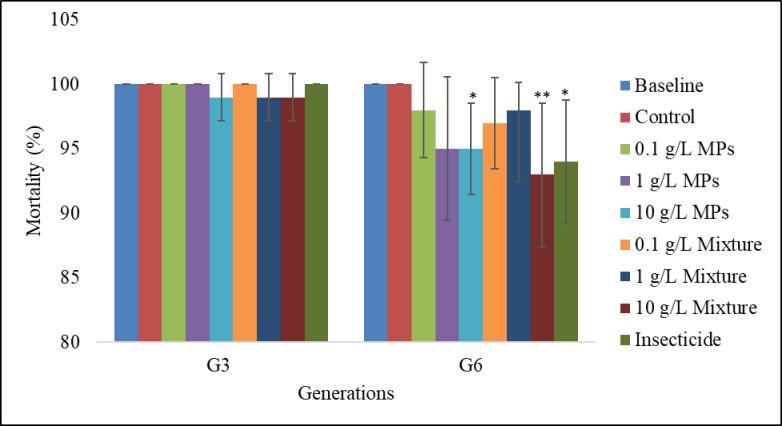
Microplastic (MP) pollution poses a global threat to urban and rural environments and can have negative effects on a range of organisms. Mosquito larvae often breed in water contaminated with MPs, and given their important role as disease vectors, understanding the effects of larval exposure to MPs is critical for understanding the potential impact on their life history traits and subsequent methods for their control. Here, we have exposed first instar larvae of Anopheles gambiae s.s. to environmentally realistic concentrations of PET microplastics (1.0-7.5 μm) and a sub-lethal dose of insecticide mixed with microplastics, and quantified survival, development, and susceptibility of larvae over six generations. Adult mosquitoes from larvae exposed to these treatments were subsequently tested for insecticide resistance. Exposure to MPs decreased larval survival rates compared to the control; however, over six generations of exposure, survival rates significantly increased. Similarly, there was a higher survival rate of those larvae exposed to MPs mixed with insecticide compared to those exposed to just the insecticide, and survival increased further over the six generations. For the adult mosquito susceptibility tests, knockdown times (KDTs) indicated some level of insecticide tolerance when larvae had been previously exposed to MPs and insecticides. This is the first study demonstrating the selection of insecticide tolerance in adult mosquitoes after consecutive generations of larval exposures to varying concentrations of MPs. Therefore, field-scale studies are now urgently required to quantify whether larval insecticides are less effective at controlling mosquitoes in breeding sites commonly polluted with MPs.
微塑料(MP)污染对城乡环境构成全球威胁,并可能对一系列生物产生负面影响。蚊子幼虫经常在受微塑料污染的水中繁殖,鉴于它们作为疾病传播媒介的重要作用,了解幼虫接触微塑料的影响对于理解其对生活史特征的潜在影响以及后续的控制方法至关重要。在这里,我们将冈比亚按蚊的一龄幼虫暴露于环境现实浓度的聚对苯二甲酸乙二酯微塑料(1.0 - 7.5微米)以及与微塑料混合的亚致死剂量杀虫剂中,并对六代幼虫的存活率、发育情况和易感性进行了量化。随后对来自这些处理组的幼虫羽化出的成年蚊子进行了抗药性测试。与对照组相比,接触微塑料降低了幼虫的存活率;然而,经过六代接触后,存活率显著提高。同样,与仅接触杀虫剂的幼虫相比,接触与杀虫剂混合的微塑料的幼虫存活率更高,并且在六代中存活率进一步提高。对于成年蚊子的易感性测试,击倒时间(KDTs)表明,当幼虫先前接触过微塑料和杀虫剂时,存在一定程度的杀虫剂耐受性。这是第一项证明在幼虫连续几代暴露于不同浓度的微塑料后,成年蚊子中出现杀虫剂耐受性选择的研究。因此,现在迫切需要进行实地规模的研究,以量化在通常受微塑料污染的繁殖地,幼虫杀虫剂在控制蚊子方面是否效果较差。

 Zotero 插件