
一名年轻患者角膜溃疡后形成瘢痕,急需及时恢复视力,采用光化学角膜切削术(PTK)+地形图引导的准分子激光原位角膜磨镶术(PRK)进行治疗。
Corneal scar after ulcer in a young patient demanding visual restoration in a timely fashion treated with PTK + topo-guided PRK.
作者信息
Santhiago Marcony R, Morgado Claudia R, Koo Ellen, Iyer Geetha, Srinivasan Bhaskar, Berrospi Ruben, Ghanem Ramon
机构信息
Rio de Janeiro, Brazil.
出版信息
J Cataract Refract Surg. 2024 Dec 1;50(12):1293. doi: 10.1097/j.jcrs.0000000000001570.
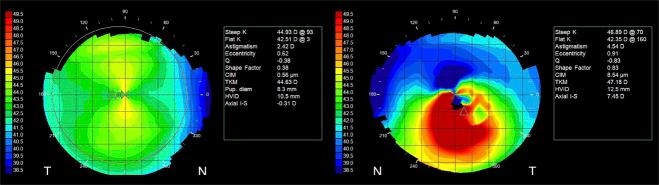
A 23-year-old woman was referred for low visual acuity in the left eye after a corneal ulcer associated with contact lens use 2 years previously. The patient had a history of contact lens use, reported use of antibiotic eye drops with improvement of infection, and subsequent scarring. There were no comorbidities. The manifest refraction was -3.25 -2.25 × 180 (20/20) in the right eye and was -2.00 esf -2.00 × 165 (20/80) in the left eye. The patient demands a solution in a reasonable time because of the need for functional vision and possible restoration of her binocular functions. The slitlamp examination revealed a corneal scar partially affecting the visual axis (Figure 1JOURNAL/jcrs/04.03/02158034-202412000-00016/figure1/v/2024-12-12T192825Z/r/image-tiff). Corneal topography revealed an irregular pattern and spectral-domain optical coherence tomography (OCT) examinations revealed scarring in the anterior stroma (Figures 2 and 3JOURNAL/jcrs/04.03/02158034-202412000-00016/figure2/v/2024-12-12T192825Z/r/image-tiffJOURNAL/jcrs/04.03/02158034-202412000-00016/figure3/v/2024-12-12T192825Z/r/image-tiff). Given the patient's refraction, corneal scar, and visual demands, would you perform photorefractive keratectomy (PRK) treatment to correct ametropia and partially remove the anterior stroma? Would you perform excimer laser treatment for therapeutic purposes guided by topography? Would you opt for a 2-stage treatment, regularizing the cornea with neutral phototherapeutic keratectomy (PTK) or PRK treatment guided by topography and then correcting the ametropia? Considering the OTC maps, would you perform a femtosecond laser-assisted anterior lamellar keratoplasty (FALK), deep anterior lamellar keratoplasty (DALK), or even penetrating keratoplasty? Would you consider any other surgical step to prevent delayed cornea healing-persistent epithelial defect?
一名23岁女性因两年前使用隐形眼镜后出现角膜溃疡,导致左眼视力低下前来就诊。该患者有隐形眼镜使用史,曾使用抗生素眼药水,感染有所改善,但随后出现了瘢痕。无合并症。右眼明显验光结果为-3.25 -2.25×180(20/20),左眼为-2.00 esf -2.00×165(20/80)。由于需要功能性视力并可能恢复双眼功能,患者要求在合理时间内得到解决方案。裂隙灯检查发现角膜瘢痕部分影响视轴(图1JOURNAL/jcrs/04.03/02158034-202412000-00016/figure1/v/2024-12-12T192825Z/r/image-tiff)。角膜地形图显示不规则图案,光谱域光学相干断层扫描(OCT)检查显示前基质有瘢痕形成(图2和图3JOURNAL/jcrs/04.03/02158034-202412000-00016/figure2/v/2024-12-12T192825Z/r/image-tiffJOURNAL/jcrs/04.03/02158034-202412000-00016/figure3/v/2024-12-12T192825Z/r/image-tiff)。鉴于患者的验光结果、角膜瘢痕和视觉需求,你会进行准分子激光原位角膜磨镶术(PRK)治疗以矫正屈光不正并部分去除前基质吗?你会进行以地形图为导向的准分子激光治疗以达到治疗目的吗?你会选择两阶段治疗,先用中性光治疗性角膜切削术(PTK)或地形图引导的PRK治疗使角膜规则化,然后矫正屈光不正吗?考虑到OTC地图,你会进行飞秒激光辅助前板层角膜移植术(FALK)、深板层角膜移植术(DALK),甚至穿透性角膜移植术吗?你会考虑采取其他手术步骤来预防角膜愈合延迟——持续性上皮缺损吗?


 Zotero 插件